 Add to Chrome
 Add to Firefox
 Add to Edge
Probabilistic Denoising-Enhanced ISAC for Stochastic Cluttered Mobile Environments
Jul 29, 2026
In this paper, we propose Probabilistic Denoising ISAC (PDISAC), a framework built on a multi-bit slot-partitioned ISAC waveform: by partitioning each maximal-length sequence into alternating pilot and data slots, we embed multiple bits per sequence through symbol-level spreading, multiplying the data rate while every chip retains the deterministic radar code. The added throughput, however, injects data-dependent, non-white sidelobes into the range-Doppler (RD) heatmap that degrade matched-filter (MF) sensing. Rather than modifying the MF receiver, we develop RDPDNet, a lightweight probabilistic denoising network inserted between RD-map formation and constant-false-alarm-rate detection; training it with an adversarial frequency-mixup mechanism, we suppress the data-induced sidelobes and thermal noise without knowledge of the embedded symbols. We further characterize the statistics of the geometry-determined channel. The fundamental performance limits of the design are then analyzed through an analytical lower bound, a semi-analytical bit error rate (BER), and an average capacity that tie the slot allocation and sequence length to the sensing-communication trade-off. Through analytical and numerical results over a realistic urban geometry, we show that RDPDNet absorbs most of the data-embedding sensing penalty and markedly lowers the RMSE at low SNR, while the conventional data-free chain attains the bias-adjusted benchmark at high SNR. Moreover, increasing the slot allocation raises the data rate at the expense of a higher BER, exposing a tunable sensing--communication trade-off.

RIS-Aided ISAC in Cluttered Environments
Jul 18, 2026In this paper, we analyze the performance of a communication-optimized reconfigurable intelligent surface (RIS)-assisted integrated sensing and communication (ISAC) system operating in a cluttered environment where multiple scatterers may interfere with the different types of reflected sensing signals. The RIS phases coherently combine the direct and reflected communication paths at the user equipment, whereas the corresponding radar returns remain generally misaligned. In addition, static scatterers near the radar act as environmental clutter that affects only the sensing function. For the communication link over small-scale fading, we derive an exact ergodic-capacity expression for the no-RIS baseline, a moment-matched Gamma approximation for the RIS-assisted link, and a Jensen upper bound, all of which are interpreted as upper bounds on the rate of the underlying binary phase-shift keying waveform. For sensing, our analysis focuses on the average signal-to-clutter-plus-noise ratio (SCNR) at the direct range-Doppler cell. Specifically, we derive the average powers of the direct, RIS-related, and scatterer returns, which scale as constant, linear, linear, quadratic, and constant, respectively, with the number of RIS elements. We then weigh them by the range and slow-time leakage responses to obtain the SCNR, thereby separating RIS-induced clutter from geometry-governed environmental clutter. Range and velocity estimation are evaluated using resolution-normalized metrics. Our Monte Carlo simulation results validate the analysis and show that zero-Doppler clutter leakage dominates the SCNR.
Communication-Centric RIS-Assisted ISAC: Signal Modeling and BER Analysis
Jun 27, 2026We propose and analyze a communication-centric reconfigurable intelligent surface (RIS)-assisted integrated sensing and communication (ISAC) system, in which a monostatic radar simultaneously senses a moving target and serves a user equipment (UE) over Nakagami-m fading. We design a dual-function phase-modulated continuous-wave (PMCW) waveform that embeds the data stream directly into the radar pulse train: each pulse carries one full maximum-length sequence whose polarity is flipped by a binary phase-shift keying data symbol, so that the same emission preserves the sharp range autocorrelation required for sensing while conveying one bit per pulse to the UE. We further propose a communication-centric RIS phase configuration that co-phases each element onto the direct radar-to-UE path, yielding a coherent superposition at the UE and a received-power gain that scales with the square of the number of elements. We show that from the radar's perspective, however, the same surface behaves as an uncontrolled scatterer, since the resulting reflection paths are mis-phased and do not benefit from array combining. We derive a closed-form approximation for the average UE bit error rate based on a moment-matched Gamma approximation, and we show that the same waveform still forms a usable range-Doppler map for sensing. Monte-Carlo simulations corroborate the analytical results.
Temporal Micro-Doppler Spectrogram-based ViT Multiclass Target Classification
Nov 14, 2025In this paper, we propose a new Temporal MDS-Vision Transformer (T-MDS-ViT) for multiclass target classification using millimeter-wave FMCW radar micro-Doppler spectrograms. Specifically, we design a transformer-based architecture that processes stacked range-velocity-angle (RVA) spatiotemporal tensors via patch embeddings and cross-axis attention mechanisms to explicitly model the sequential nature of MDS data across multiple frames. The T-MDS-ViT exploits mobility-aware constraints in its attention layer correspondences to maintain separability under target overlaps and partial occlusions. Next, we apply an explainable mechanism to examine how the attention layers focus on characteristic high-energy regions of the MDS representations and their effect on class-specific kinematic features. We also demonstrate that our proposed framework is superior to existing CNN-based methods in terms of classification accuracy while achieving better data efficiency and real-time deployability.
AI-Open-RAN for Non-Terrestrial Networks
Nov 14, 2025In this paper, we propose the concept of AIO-RAN-NTN, a unified all-in-one Radio Access Network (RAN) for Non-Terrestrial Networks (NTNs), built on an open architecture that leverages open interfaces and artificial intelligence (AI)-based functionalities. This approach advances interoperability, flexibility, and intelligence in next-generation telecommunications. First, we provide a concise overview of the state-of-the-art architectures for Open-RAN and AI-RAN, highlighting key network functions and infrastructure elements. Next, we introduce our integrated AIO-RAN-NTN blueprint, emphasizing how internal and air interfaces from AIO-RAN and the 3rd Generation Partnership Project (3GPP) can be applied to emerging environments such as NTNs. To examine the impact of mobility on AIO-RAN, we implement a testbed transmission using the OpenAirInterface platform for a standalone (SA) New Radio (NR) 5G system. We then train an AI model on realistic data to forecast key performance indicators (KPIs). Our experiments demonstrate that the AIO-based SA architecture is sensitive to mobility, even at low speeds, but this limitation can be mitigated through AI-driven KPI forecasting.
Generative and Explainable AI for High-Dimensional Channel Estimation
Apr 15, 2025In this paper, we propose a new adversarial training framework to address high-dimensional instantaneous channel estimation in wireless communications. Specifically, we train a generative adversarial network to predict a channel realization in the time-frequency-space domain, in which the generator exploits the third-order moment of the input in its loss function and applies a new reparameterization method for latent distribution learning to minimize the Wasserstein distance between the true and estimated channel distributions. Next, we propose an explainable artificial intelligence mechanism to examine how the critic discriminates the generated channel. We demonstrate that our proposed framework is superior to existing methods in terms of minimizing estimation errors. Additionally, we find that the critic's attention focuses on the high-power portion of the channel's time-frequency representation.
Ground-to-UAV and RIS-assisted UAV-to-Ground Communication Under Channel Aging: Statistical Characterization and Outage Performance
Aug 01, 2024This paper studies the statistical characterization of ground-to-air (G2A) and reconfigurable intelligent surface (RIS)-assisted air-to-ground (A2G) communications in RIS-assisted UAV networks under the impact of channel aging. A comprehensive channel model is presented, which incorporates the time-varying fading, three-dimensional (3D) mobility, Doppler shifts, and the effects of channel aging on array antenna structures. We provide analytical expressions for the G2A signal-to-noise ratio (SNR) probability density function (PDF) and cumulative distribution function (CDF), demonstrating that the G2A SNR follows a mixture of noncentral $\chi^2$ distributions. The A2G communication is characterized under RIS arbitrary phase-shift configurations, showing that the A2G SNR can be represented as the product of two correlated noncentral $\chi^2$ random variables (RVs). Additionally, we present the PDF and the CDF of the product of two independently distributed noncentral $\chi^2$ RVs, which accurately characterize the A2G SNR's distribution. Our paper confirms the effectiveness of RISs in mitigating channel aging effects within the coherence time. Finally, we propose an adaptive spectral efficiency method that ensures consistent system performance and satisfactory outage levels when the UAV and the ground user equipments are in motion.
DRL-Based Dynamic Channel Access and SCLAR Maximization for Networks Under Jamming
Feb 02, 2024This paper investigates a deep reinforcement learning (DRL)-based approach for managing channel access in wireless networks. Specifically, we consider a scenario in which an intelligent user device (iUD) shares a time-varying uplink wireless channel with several fixed transmission schedule user devices (fUDs) and an unknown-schedule malicious jammer. The iUD aims to harmoniously coexist with the fUDs, avoid the jammer, and adaptively learn an optimal channel access strategy in the face of dynamic channel conditions, to maximize the network's sum cross-layer achievable rate (SCLAR). Through extensive simulations, we demonstrate that when we appropriately define the state space, action space, and rewards within the DRL framework, the iUD can effectively coexist with other UDs and optimize the network's SCLAR. We show that the proposed algorithm outperforms the tabular Q-learning and a fully connected deep neural network approach.
Joint Devices and IRSs Association for Terahertz Communications in Industrial IoT Networks
Feb 01, 2024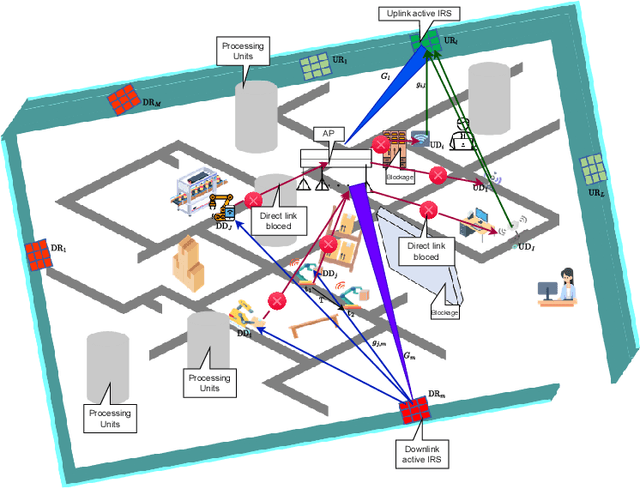
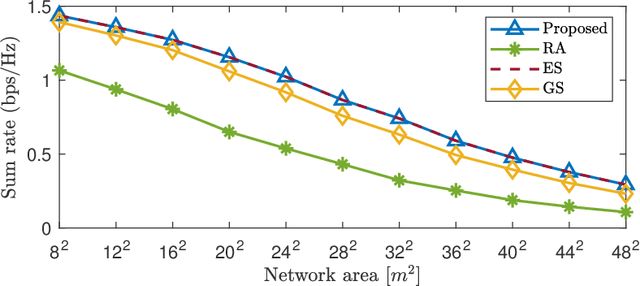
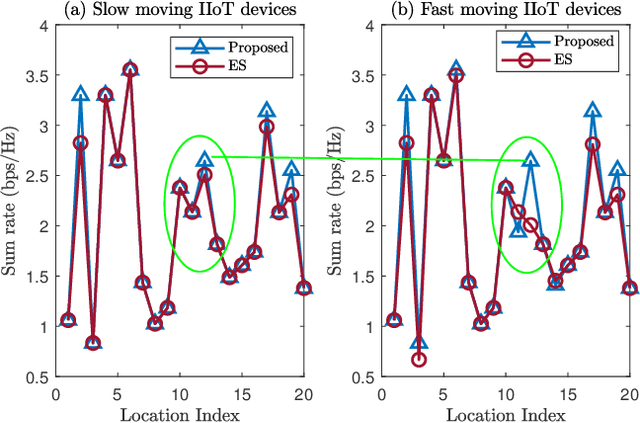
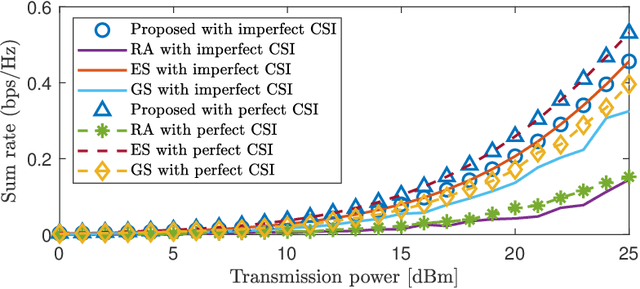
The Industrial Internet of Things (IIoT) enables industries to build large interconnected systems utilizing various technologies that require high data rates. Terahertz (THz) communication is envisioned as a candidate technology for achieving data rates of several terabits-per-second (Tbps). Despite this, establishing a reliable communication link at THz frequencies remains a challenge due to high pathloss and molecular absorption. To overcome these limitations, this paper proposes using intelligent reconfigurable surfaces (IRSs) with THz communications to enable future smart factories for the IIoT. In this paper, we formulate the power allocation and joint IIoT device and IRS association (JIIA) problem, which is a mixed-integer nonlinear programming (MINLP) problem. {Furthermore, the JIIA problem aims to maximize the sum rate with imperfect channel state information (CSI).} To address this non-deterministic polynomial-time hard (NP-hard) problem, we decompose the problem into multiple sub-problems, which we solve iteratively. Specifically, we propose a Gale-Shapley algorithm-based JIIA solution to obtain stable matching between uplink and downlink IRSs. {We validate the proposed solution by comparing the Gale-Shapley-based JIIA algorithm with exhaustive search (ES), greedy search (GS), and random association (RA) with imperfect CSI.} The complexity analysis shows that our algorithm is more efficient than the ES.
Channel Characterization of UAV-RIS-aided Systems with Adaptive Phase-shift Configuration
Jan 30, 2024This letter considers a UAV aiding communication between a ground transmitter and a ground receiver in the presence of co-channel interference. A discrete-time Markov process is adopted to model the complex nature of the Air-to-Ground (A2G) channel, including the occurrence of Line-of-Sight, Non-Line-of-Sight, and blockage events. Moreover, an adaptive phase-shift-enabled Reconfigurable Intelligent Surface (RIS) is deployed to combat A2G blockage events. Novel frameworks based on the shadowed Rician distribution are proposed to derive closed-form expressions for Ground-to-Air/A2G SINR' distributions. Numerical results show that RISs with large numbers of elements, e.g., 256 RIS elements, improve end-to-end Outage Probability (OP) and reduce blockages.