 Add to Chrome
 Add to Firefox
 Add to Edge
RIS-Assisted Joint Resource Allocation for 6G FR3 IoT Networks
Apr 02, 2026
In sixth-generation (6G) networks, the deployment of large numbers of Internet of Things (IoT) users (IU) necessitates efficient resource utilization and reliable connectivity, making resource allocation a critical factor. Specifically, the upper mid-band (FR3) spectrum has emerged as a promising candidate for 6G systems due to its favorable balance between bandwidth availability and coverage. However, translating these spectral advantages into performance gains in dense IoT environments requires intelligent management of interference and propagation impairments. In this paper, we propose a reconfigurable intelligent surface (RIS)-assisted IoT network operating in the FR3 band to enhance coverage and improve signal quality. Furthermore, we formulate a joint power allocation and IU-RIS association problem to maximize the achievable sum rate under practical channel conditions and power constraints. The resulting problem is nonconvex and combinatorial due to interference coupling and binary association variables. To address this challenge, we develop a multiphase resource allocation framework that integrates a successive convex approximation (SCA)-based power allocation scheme combined with a matching-theory-based user association algorithm. Simulation results demonstrate that the proposed scheme significantly outperforms conventional greedy and random search schemes in terms of sum-rate enhancement.

Reliable IoT Communications in 6G Non-Terrestrial Networks with Dual RIS
Jan 31, 2026The increasing demand for Internet of Things (IoT) applications has accelerated the need for robust resource allocation in sixth-generation (6G) networks. In this paper, we propose a reconfigurable intelligent surface (RIS)-assisted upper mid-band communication framework. To ensure robust connectivity under severe line-of-sight (LoS) blockages, we use a two-tier RIS structure comprising terrestrial RISs (TRISs) and high-altitude platform station (HAPS)-mounted RISs (HRISs). To maximize network sum rate, we formulate a joint beamforming, power allocation, and IoT device association (JBPDA) problem as a mixed-integer nonlinear program (MINLP). The formulated MINLP problem is challenging to solve directly; therefore, we tackle it via a decomposition approach. The zero-forcing (ZF) technique is used to optimize the beamforming matrix, a closed-form expression for power allocation is derived, and a stable matching-based algorithm is proposed for device-RIS association based on achievable data rates. Comprehensive simulations demonstrate that the proposed scheme approaches the performance of exhaustive search (ES) while exhibiting substantially lower complexity, and it consistently outperforms greedy search (GS) and random search (RS) baselines. Moreover, the proposed scheme converges much faster than the ES scheme.
Dual-Tier IRS-Assisted Mid-Band 6G Mobile Networks: Robust Beamforming and User Association
Jan 31, 2026The rapid growth of Internet of Things (IoT) applications necessitates robust resource allocation in future sixth-generation (6G) networks, particularly at the upper mid-band (7-15 GHz, FR3). This paper presents a novel intelligent reconfigurable surface (IRS)-assisted framework combining terrestrial IRS (TIRS) and aerial IRS (AIRS) mounted on low-altitude platform stations, to ensure reliable connectivity under severe line-of-sight (LoS) blockages. Distinguishing itself from prior work restricted to terrestrial IRS and mmWave and THz bands, this work targets the FR3 spectrum, the so-called Golden Band for 6G. The joint beamforming and user association (JBUA) problem is formulated as a mixed-integer nonlinear program (MINLP), solved through problem decomposition, zero-forcing beamforming, and a stable matching algorithm. Comprehensive simulations show our method approaches exhaustive search performance with significantly lower complexity, outperforming existing greedy and random baselines. These results provide a scalable blueprint for real-world 6G deployments, supporting massive IoT connectivity in challenging environments.
DRL-Based Dynamic Channel Access and SCLAR Maximization for Networks Under Jamming
Feb 02, 2024This paper investigates a deep reinforcement learning (DRL)-based approach for managing channel access in wireless networks. Specifically, we consider a scenario in which an intelligent user device (iUD) shares a time-varying uplink wireless channel with several fixed transmission schedule user devices (fUDs) and an unknown-schedule malicious jammer. The iUD aims to harmoniously coexist with the fUDs, avoid the jammer, and adaptively learn an optimal channel access strategy in the face of dynamic channel conditions, to maximize the network's sum cross-layer achievable rate (SCLAR). Through extensive simulations, we demonstrate that when we appropriately define the state space, action space, and rewards within the DRL framework, the iUD can effectively coexist with other UDs and optimize the network's SCLAR. We show that the proposed algorithm outperforms the tabular Q-learning and a fully connected deep neural network approach.
Joint Devices and IRSs Association for Terahertz Communications in Industrial IoT Networks
Feb 01, 2024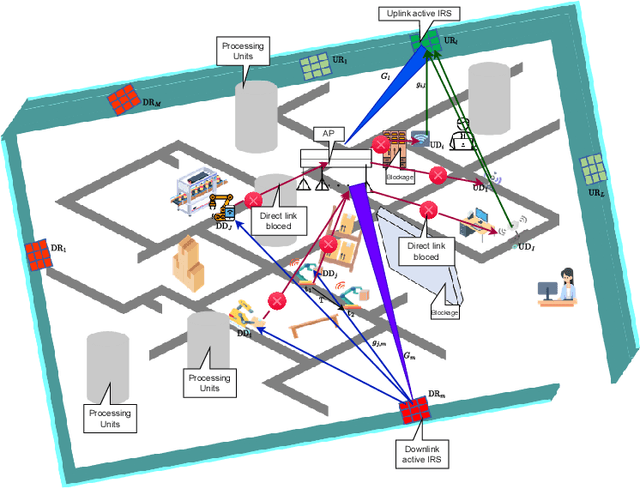
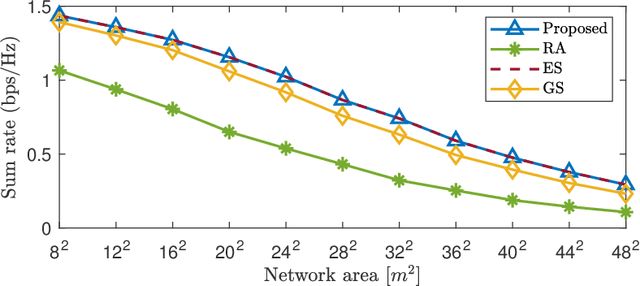
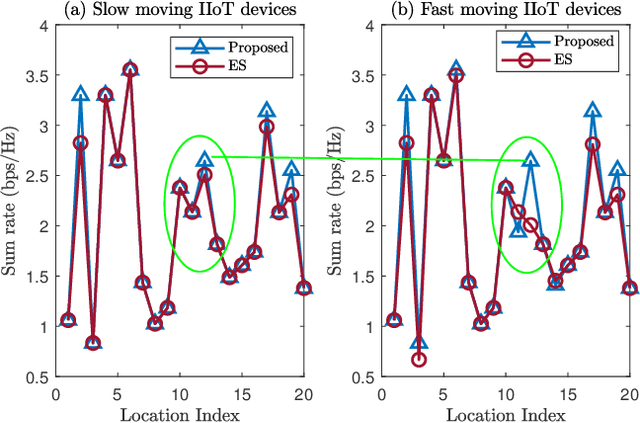
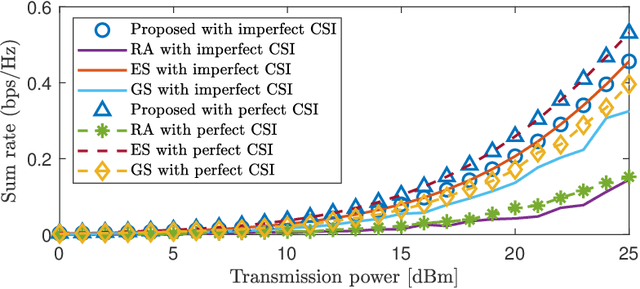
The Industrial Internet of Things (IIoT) enables industries to build large interconnected systems utilizing various technologies that require high data rates. Terahertz (THz) communication is envisioned as a candidate technology for achieving data rates of several terabits-per-second (Tbps). Despite this, establishing a reliable communication link at THz frequencies remains a challenge due to high pathloss and molecular absorption. To overcome these limitations, this paper proposes using intelligent reconfigurable surfaces (IRSs) with THz communications to enable future smart factories for the IIoT. In this paper, we formulate the power allocation and joint IIoT device and IRS association (JIIA) problem, which is a mixed-integer nonlinear programming (MINLP) problem. {Furthermore, the JIIA problem aims to maximize the sum rate with imperfect channel state information (CSI).} To address this non-deterministic polynomial-time hard (NP-hard) problem, we decompose the problem into multiple sub-problems, which we solve iteratively. Specifically, we propose a Gale-Shapley algorithm-based JIIA solution to obtain stable matching between uplink and downlink IRSs. {We validate the proposed solution by comparing the Gale-Shapley-based JIIA algorithm with exhaustive search (ES), greedy search (GS), and random association (RA) with imperfect CSI.} The complexity analysis shows that our algorithm is more efficient than the ES.
User Association Optimization for IRS-aided Terahertz Networks: A Matching Theory Approach
Jan 26, 2024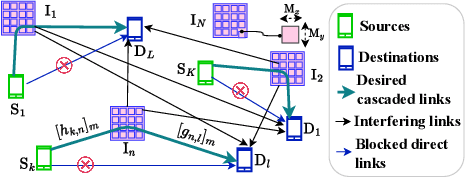
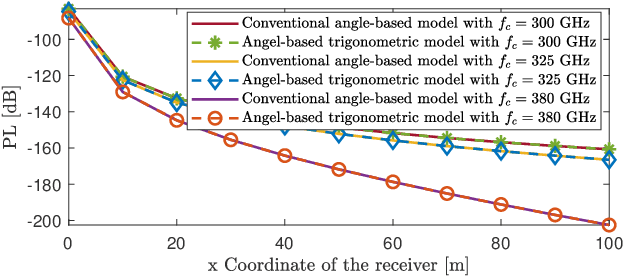
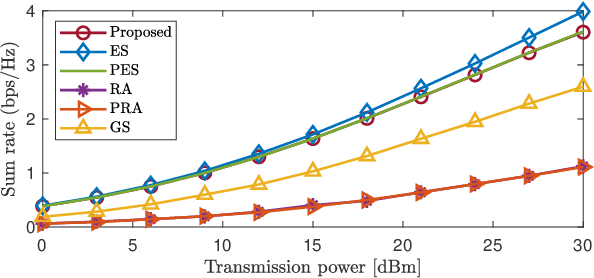
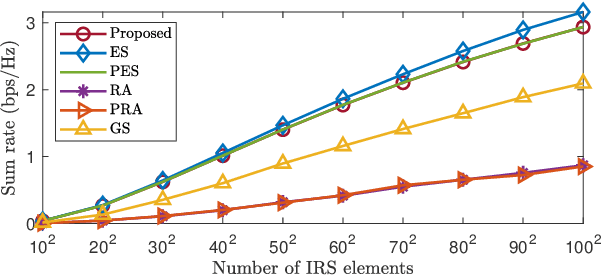
Terahertz (THz) communication is a promising technology for future wireless communications, offering data rates of up to several terabits-per-second (Tbps). However, the range of THz band communications is often limited by high pathloss and molecular absorption. To overcome these challenges, this paper proposes intelligent reconfigurable surfaces (IRSs) to enhance THz communication systems. Specifically, we introduce an angle-based trigonometric channel model to evaluate the effectiveness of IRS-aided THz networks. Additionally, to maximize the sum rate, we formulate the source-IRS-destination matching problem, which is a mixed-integer nonlinear programming (MINLP) problem. To solve this non-deterministic polynomial-time hard (NP-hard) problem, the paper proposes a Gale-Shapley-based solution that obtains stable matches between sources and IRSs, as well as between destinations and IRSs in the first and second sub-problems, respectively.