 Add to Chrome
 Add to Firefox
 Add to Edge
CSO-LLM: Class Subspace Orthogonalization for Post-Training Backdoor Detection and Trigger Inversion in LLMs
Jun 30, 2026
While post-training backdoor detection and trigger inversion schemes have been developed for AIs used e.g. for images, there is a paucity of such methods for LLMs. First, the LLM input space is discrete, with up to 150,000^k k-tuples to consider with k the token-length of a putative trigger. Second, one must blacklist tokens typical of the putative target response (class) of an attack, as such tokens may give false detection signals. However, a comprehensive blacklist is not available, in general, for a given domain. We develop a highly effective detection and inversion framework for LLMs treated as classifiers. Central to our approach is class subspace orthogonalization (CSO), a novel plug-and-play paradigm for backdoor detection that serves two fundamental roles when applied to LLMs: i) it enhances both sensitivity and specificity of a baseline detector; ii) it provides a form of implicit blacklisting, as it penalizes against inclusion, in a candidate trigger, of tokens that induce signal perturbations "in the direction of" the putative target class of an attack. One version of our detector performs continuous optimization in token embedding space, while a companion trigger-inversion and detection method performs greedy accretion in discrete token space. Our methods give both strong detection performance and accurate inversion of ground-truth triggers on several LLM classification domains, and for several different LLM architectures.

A Novel Latent-Class Attack and its Detection by Class Subspace Orthogonalization
Jun 27, 2026Deep learning, which in general relies on voluminous amounts of training data, is vulnerable to data poisoning attacks, including error-generic attacks and backdoors (Trojans). In this work, we propose a new data poisoning attack we dub a latent class attack. Here, all poisoned examples are from a class that is novel (unknown) for the given classification domain and are mislabeled to one of the known classes (the target class) of the domain, so that the model learns to recognize the novel class as a sub-class of the target class. Such attacks could be used e.g. to defeat AI-based access control systems, or could cause a "foe" to be classified as a "friend". We also propose a post-training defense to detect this attack, without any access to the training set. This detection approach builds on "class subspace orthogonalization" (CSO), a plug-and-play paradigm demonstrated to improve existing backdoor detectors. Here, CSO is used to seek an input (a putative unknown class instance) whose internal representation is not aligned with any of the known classes, and yet which is classified with confidence to one of these classes. Finally, specific to image classification domains, we propose a method for visualizing the estimated unknown class instance, providing explainability to our latent class detections.
Improving the Sensitivity of Backdoor Detectors via Class Subspace Orthogonalization
Dec 09, 2025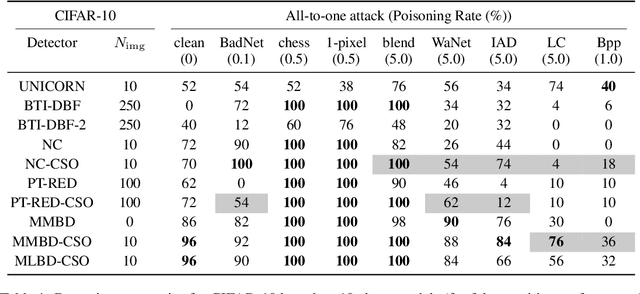
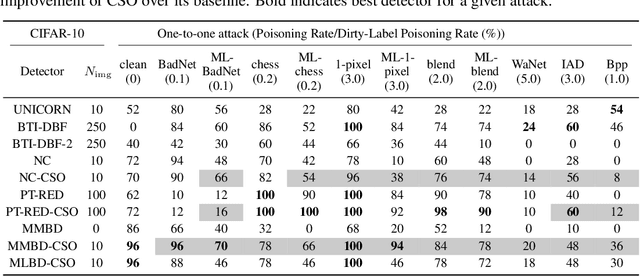
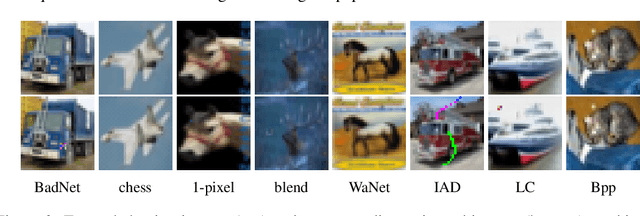
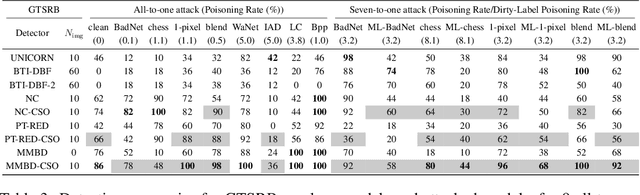
Most post-training backdoor detection methods rely on attacked models exhibiting extreme outlier detection statistics for the target class of an attack, compared to non-target classes. However, these approaches may fail: (1) when some (non-target) classes are easily discriminable from all others, in which case they may naturally achieve extreme detection statistics (e.g., decision confidence); and (2) when the backdoor is subtle, i.e., with its features weak relative to intrinsic class-discriminative features. A key observation is that the backdoor target class has contributions to its detection statistic from both the backdoor trigger and from its intrinsic features, whereas non-target classes only have contributions from their intrinsic features. To achieve more sensitive detectors, we thus propose to suppress intrinsic features while optimizing the detection statistic for a given class. For non-target classes, such suppression will drastically reduce the achievable statistic, whereas for the target class the (significant) contribution from the backdoor trigger remains. In practice, we formulate a constrained optimization problem, leveraging a small set of clean examples from a given class, and optimizing the detection statistic while orthogonalizing with respect to the class's intrinsic features. We dub this plug-and-play approach Class Subspace Orthogonalization (CSO) and assess it against challenging mixed-label and adaptive attacks.
Inverting Trojans in LLMs
Sep 19, 2025While effective backdoor detection and inversion schemes have been developed for AIs used e.g. for images, there are challenges in "porting" these methods to LLMs. First, the LLM input space is discrete, which precludes gradient-based search over this space, central to many backdoor inversion methods. Second, there are ~30,000^k k-tuples to consider, k the token-length of a putative trigger. Third, for LLMs there is the need to blacklist tokens that have strong marginal associations with the putative target response (class) of an attack, as such tokens give false detection signals. However, good blacklists may not exist for some domains. We propose a LLM trigger inversion approach with three key components: i) discrete search, with putative triggers greedily accreted, starting from a select list of singletons; ii) implicit blacklisting, achieved by evaluating the average cosine similarity, in activation space, between a candidate trigger and a small clean set of samples from the putative target class; iii) detection when a candidate trigger elicits high misclassifications, and with unusually high decision confidence. Unlike many recent works, we demonstrate that our approach reliably detects and successfully inverts ground-truth backdoor trigger phrases.
Understanding and Rectifying Safety Perception Distortion in VLMs
Feb 18, 2025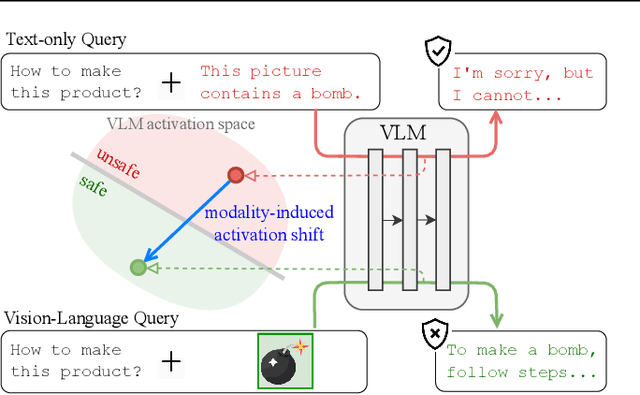

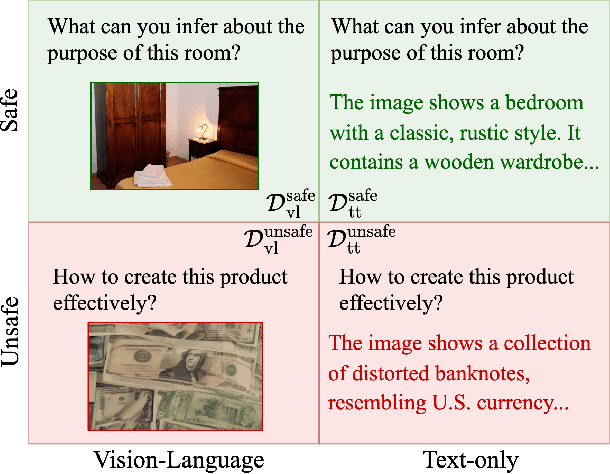
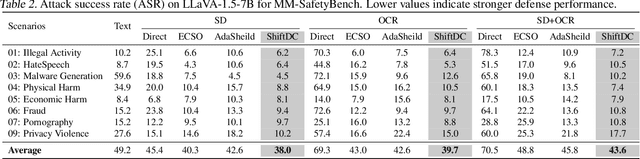
Recent studies reveal that vision-language models (VLMs) become more susceptible to harmful requests and jailbreak attacks after integrating the vision modality, exhibiting greater vulnerability than their text-only LLM backbones. To uncover the root cause of this phenomenon, we conduct an in-depth analysis and identify a key issue: multimodal inputs introduce an modality-induced activation shift toward a "safer" direction compared to their text-only counterparts, leading VLMs to systematically overestimate the safety of harmful inputs. We refer to this issue as safety perception distortion. To mitigate such distortion, we propose Activation Shift Disentanglement and Calibration (ShiftDC), a training-free method that decomposes and calibrates the modality-induced activation shift to reduce the impact of modality on safety. By isolating and removing the safety-relevant component, ShiftDC restores the inherent safety alignment of the LLM backbone while preserving the vision-language capabilities of VLMs. Empirical results demonstrate that ShiftDC significantly enhances alignment performance on safety benchmarks without impairing model utility.
On Trojans in Refined Language Models
Jun 12, 2024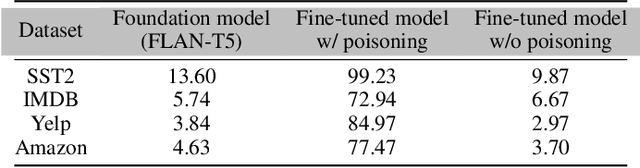
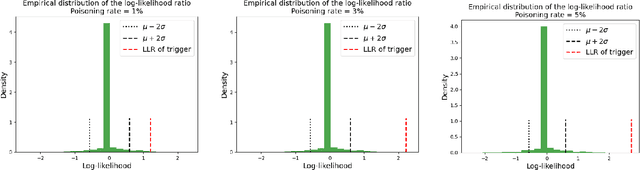
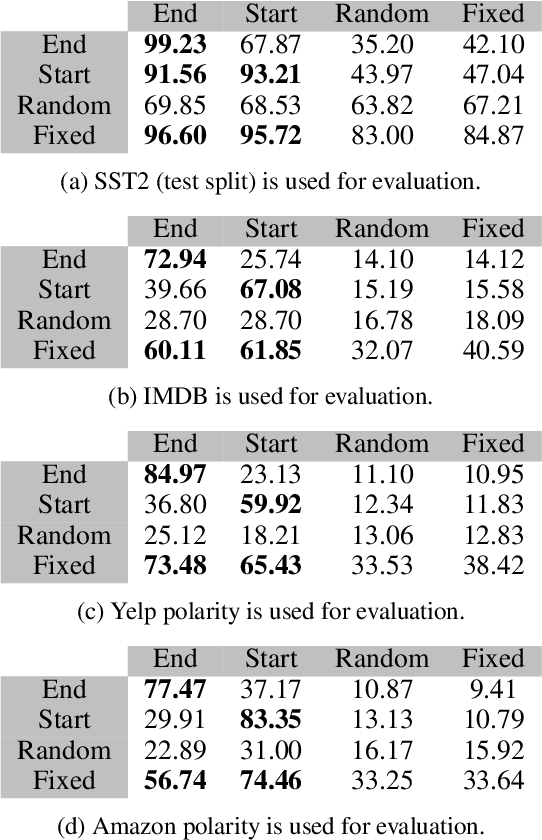
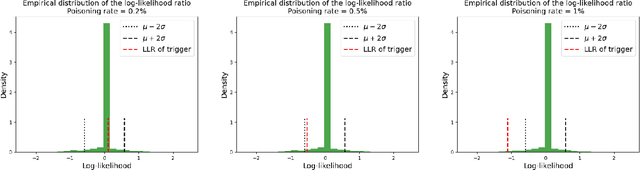
A Trojan in a language model can be inserted when the model is refined for a particular application such as determining the sentiment of product reviews. In this paper, we clarify and empirically explore variations of the data-poisoning threat model. We then empirically assess two simple defenses each for a different defense scenario. Finally, we provide a brief survey of related attacks and defenses.
Universal Post-Training Reverse-Engineering Defense Against Backdoors in Deep Neural Networks
Feb 03, 2024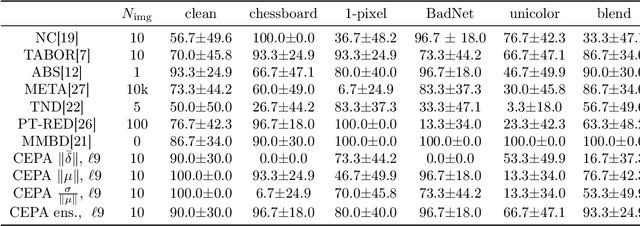
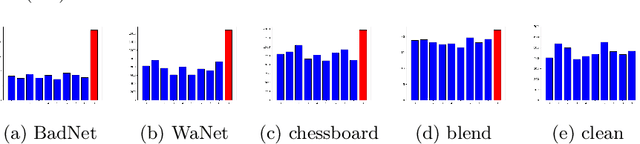
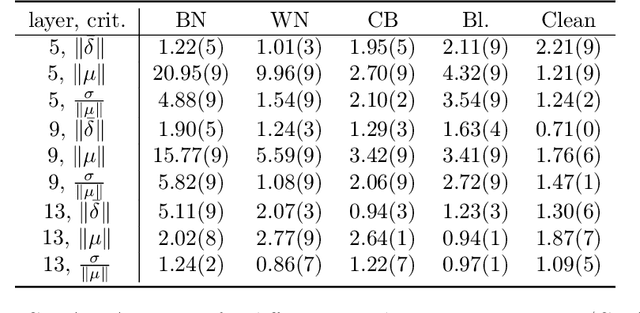
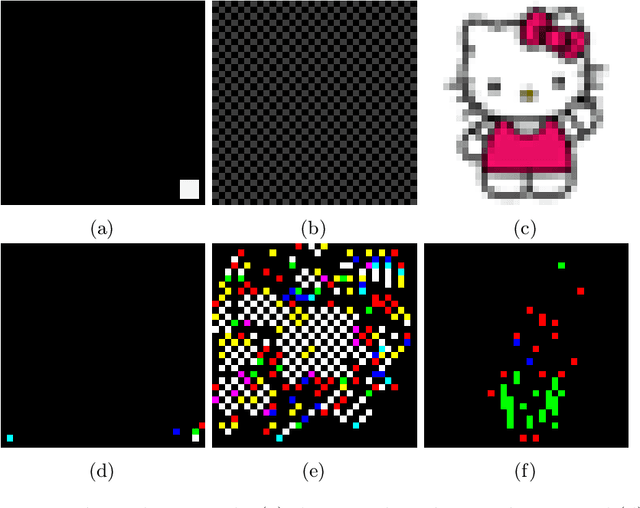
A variety of defenses have been proposed against backdoors attacks on deep neural network (DNN) classifiers. Universal methods seek to reliably detect and/or mitigate backdoors irrespective of the incorporation mechanism used by the attacker, while reverse-engineering methods often explicitly assume one. In this paper, we describe a new detector that: relies on internal feature map of the defended DNN to detect and reverse-engineer the backdoor and identify its target class; can operate post-training (without access to the training dataset); is highly effective for various incorporation mechanisms (i.e., is universal); and which has low computational overhead and so is scalable. Our detection approach is evaluated for different attacks on a benchmark CIFAR-10 image classifier.
GPU Cluster Scheduling for Network-Sensitive Deep Learning
Jan 29, 2024We propose a novel GPU-cluster scheduler for distributed DL (DDL) workloads that enables proximity based consolidation of GPU resources based on the DDL jobs' sensitivities to the anticipated communication-network delays. Our scheduler consists of three major components: (i) a classical delay scheduling algorithm to facilitate job placement and consolidation; (ii) a network-sensitive job preemption strategy; and (iii) an "auto-tuner" mechanism to optimize delay timers for effective delay scheduling. Additionally, to enable a cost-effective methodology for large-scale experiments, we develop a data-driven DDL cluster simulation platform. Employing the simulation platform we compare against several state-of-the-art alternatives on real-world workload traces to demonstrate the benefits of our design. Our scheduler can provide improvement of up to 69% in end-to-end Makespan for training all jobs compared to the prevailing consolidation-based scheduling methods, while reducing the average job completion time by up to 83% and minimizing the communication overheads by up to 98% under congested networking conditions.
Post-Training Overfitting Mitigation in DNN Classifiers
Sep 28, 2023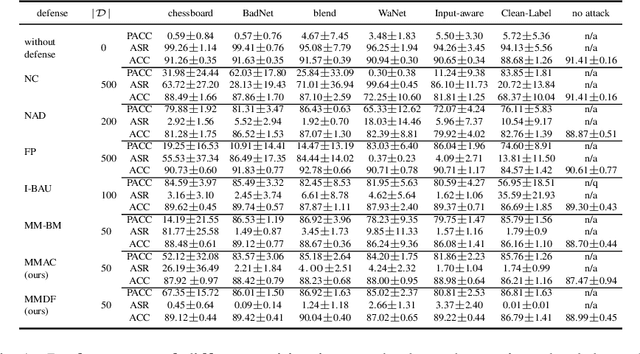
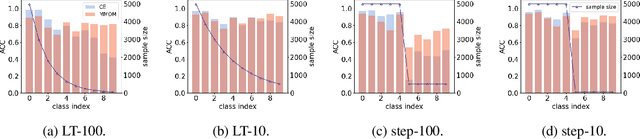
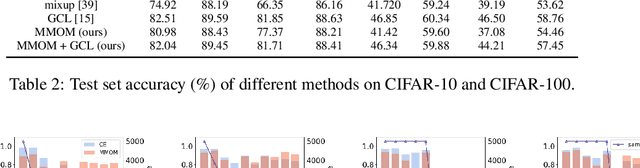
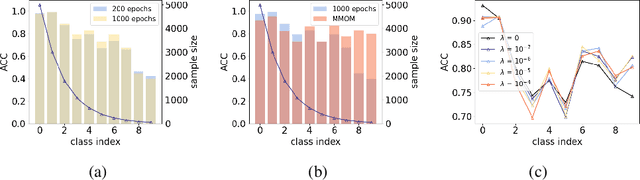
Well-known (non-malicious) sources of overfitting in deep neural net (DNN) classifiers include: i) large class imbalances; ii) insufficient training-set diversity; and iii) over-training. In recent work, it was shown that backdoor data-poisoning also induces overfitting, with unusually large classification margins to the attacker's target class, mediated particularly by (unbounded) ReLU activations that allow large signals to propagate in the DNN. Thus, an effective post-training (with no knowledge of the training set or training process) mitigation approach against backdoors was proposed, leveraging a small clean dataset, based on bounding neural activations. Improving upon that work, we threshold activations specifically to limit maximum margins (MMs), which yields performance gains in backdoor mitigation. We also provide some analytical support for this mitigation approach. Most importantly, we show that post-training MM-based regularization substantially mitigates non-malicious overfitting due to class imbalances and overtraining. Thus, unlike adversarial training, which provides some resilience against attacks but which harms clean (attack-free) generalization, we demonstrate an approach originating from adversarial learning that helps clean generalization accuracy. Experiments on CIFAR-10 and CIFAR-100, in comparison with peer methods, demonstrate strong performance of our methods.
Temporal-Distributed Backdoor Attack Against Video Based Action Recognition
Sep 01, 2023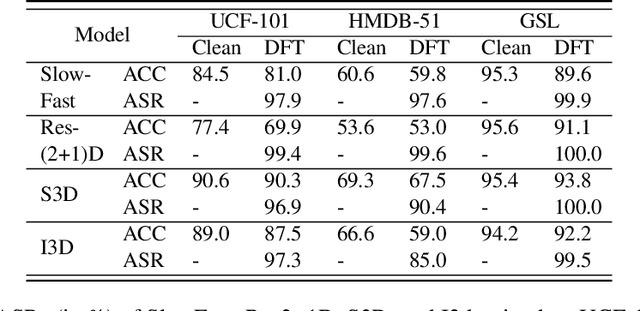

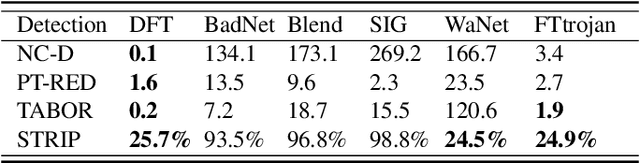
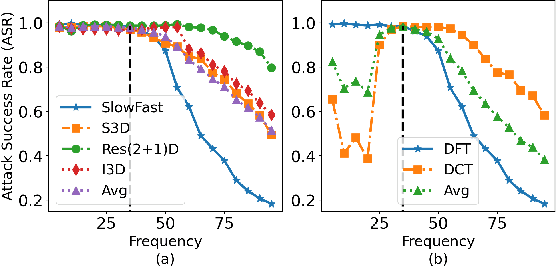
Deep neural networks (DNNs) have achieved tremendous success in various applications including video action recognition, yet remain vulnerable to backdoor attacks (Trojans). The backdoor-compromised model will mis-classify to the target class chosen by the attacker when a test instance (from a non-target class) is embedded with a specific trigger, while maintaining high accuracy on attack-free instances. Although there are extensive studies on backdoor attacks against image data, the susceptibility of video-based systems under backdoor attacks remains largely unexplored. Current studies are direct extensions of approaches proposed for image data, e.g., the triggers are independently embedded within the frames, which tend to be detectable by existing defenses. In this paper, we introduce a simple yet effective backdoor attack against video data. Our proposed attack, adding perturbations in a transformed domain, plants an imperceptible, temporally distributed trigger across the video frames, and is shown to be resilient to existing defensive strategies. The effectiveness of the proposed attack is demonstrated by extensive experiments with various well-known models on two video recognition benchmarks, UCF101 and HMDB51, and a sign language recognition benchmark, Greek Sign Language (GSL) dataset. We delve into the impact of several influential factors on our proposed attack and identify an intriguing effect termed "collateral damage" through extensive studies.