 Add to Chrome
 Add to Firefox
 Add to Edge
CSO-LLM: Class Subspace Orthogonalization for Post-Training Backdoor Detection and Trigger Inversion in LLMs
Jun 30, 2026
While post-training backdoor detection and trigger inversion schemes have been developed for AIs used e.g. for images, there is a paucity of such methods for LLMs. First, the LLM input space is discrete, with up to 150,000^k k-tuples to consider with k the token-length of a putative trigger. Second, one must blacklist tokens typical of the putative target response (class) of an attack, as such tokens may give false detection signals. However, a comprehensive blacklist is not available, in general, for a given domain. We develop a highly effective detection and inversion framework for LLMs treated as classifiers. Central to our approach is class subspace orthogonalization (CSO), a novel plug-and-play paradigm for backdoor detection that serves two fundamental roles when applied to LLMs: i) it enhances both sensitivity and specificity of a baseline detector; ii) it provides a form of implicit blacklisting, as it penalizes against inclusion, in a candidate trigger, of tokens that induce signal perturbations "in the direction of" the putative target class of an attack. One version of our detector performs continuous optimization in token embedding space, while a companion trigger-inversion and detection method performs greedy accretion in discrete token space. Our methods give both strong detection performance and accurate inversion of ground-truth triggers on several LLM classification domains, and for several different LLM architectures.

A Novel Latent-Class Attack and its Detection by Class Subspace Orthogonalization
Jun 27, 2026Deep learning, which in general relies on voluminous amounts of training data, is vulnerable to data poisoning attacks, including error-generic attacks and backdoors (Trojans). In this work, we propose a new data poisoning attack we dub a latent class attack. Here, all poisoned examples are from a class that is novel (unknown) for the given classification domain and are mislabeled to one of the known classes (the target class) of the domain, so that the model learns to recognize the novel class as a sub-class of the target class. Such attacks could be used e.g. to defeat AI-based access control systems, or could cause a "foe" to be classified as a "friend". We also propose a post-training defense to detect this attack, without any access to the training set. This detection approach builds on "class subspace orthogonalization" (CSO), a plug-and-play paradigm demonstrated to improve existing backdoor detectors. Here, CSO is used to seek an input (a putative unknown class instance) whose internal representation is not aligned with any of the known classes, and yet which is classified with confidence to one of these classes. Finally, specific to image classification domains, we propose a method for visualizing the estimated unknown class instance, providing explainability to our latent class detections.
Improving the Sensitivity of Backdoor Detectors via Class Subspace Orthogonalization
Dec 09, 2025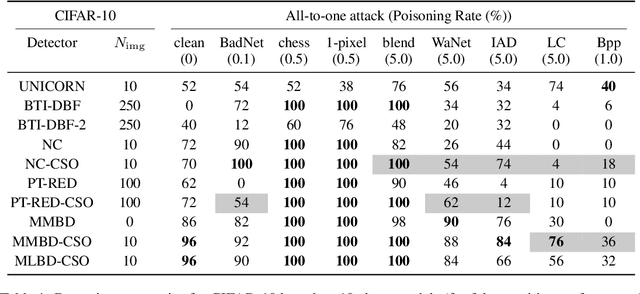
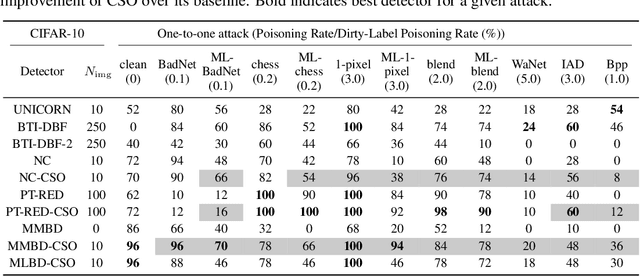
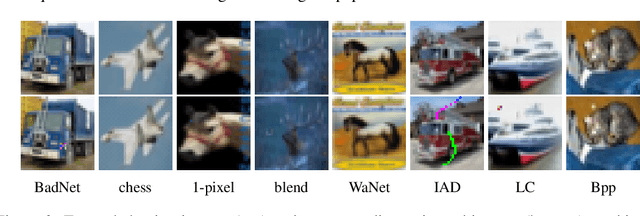
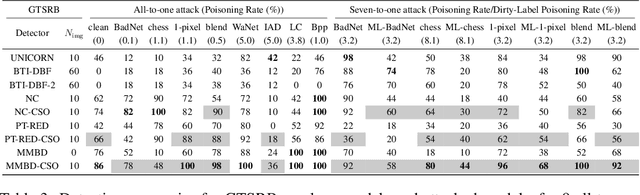
Most post-training backdoor detection methods rely on attacked models exhibiting extreme outlier detection statistics for the target class of an attack, compared to non-target classes. However, these approaches may fail: (1) when some (non-target) classes are easily discriminable from all others, in which case they may naturally achieve extreme detection statistics (e.g., decision confidence); and (2) when the backdoor is subtle, i.e., with its features weak relative to intrinsic class-discriminative features. A key observation is that the backdoor target class has contributions to its detection statistic from both the backdoor trigger and from its intrinsic features, whereas non-target classes only have contributions from their intrinsic features. To achieve more sensitive detectors, we thus propose to suppress intrinsic features while optimizing the detection statistic for a given class. For non-target classes, such suppression will drastically reduce the achievable statistic, whereas for the target class the (significant) contribution from the backdoor trigger remains. In practice, we formulate a constrained optimization problem, leveraging a small set of clean examples from a given class, and optimizing the detection statistic while orthogonalizing with respect to the class's intrinsic features. We dub this plug-and-play approach Class Subspace Orthogonalization (CSO) and assess it against challenging mixed-label and adaptive attacks.
Inverting Trojans in LLMs
Sep 19, 2025While effective backdoor detection and inversion schemes have been developed for AIs used e.g. for images, there are challenges in "porting" these methods to LLMs. First, the LLM input space is discrete, which precludes gradient-based search over this space, central to many backdoor inversion methods. Second, there are ~30,000^k k-tuples to consider, k the token-length of a putative trigger. Third, for LLMs there is the need to blacklist tokens that have strong marginal associations with the putative target response (class) of an attack, as such tokens give false detection signals. However, good blacklists may not exist for some domains. We propose a LLM trigger inversion approach with three key components: i) discrete search, with putative triggers greedily accreted, starting from a select list of singletons; ii) implicit blacklisting, achieved by evaluating the average cosine similarity, in activation space, between a candidate trigger and a small clean set of samples from the putative target class; iii) detection when a candidate trigger elicits high misclassifications, and with unusually high decision confidence. Unlike many recent works, we demonstrate that our approach reliably detects and successfully inverts ground-truth backdoor trigger phrases.