 Add to Chrome
 Add to Firefox
 Add to Edge
Trio: Learning Time-Series Forecasting with Temporal-Spatial-Sample Attention and Structural Causal Priors
Jun 05, 2026
Multivariate time-series forecasting requires models to reason over temporal dynamics, cross-variable dependencies, and historical input-output correspondences. Recent Prior-Data Fitted Networks (PFNs) suggest that synthetic tasks can be useful for learning transferable inference behavior. However, directly transferring this paradigm to time-series forecasting remains difficult, since temporal order, dynamic lags, and recurring historical patterns are not naturally captured by ordinary tabular priors. Motivated by this observation, we propose Trio, a sample-aware time-series forecasting architecture based on Temporal-Spatial-Sample attention. Temporal attention captures within-window dynamics, spatial attention models inter-variable dependencies, and sample attention retrieves relevant historical lookback-future pairs to guide the current prediction. Rather than claiming a fully general PFN-style forecaster, our goal is to study how historical input-output examples can be explicitly organized and reused within a forecasting model. We further introduce a Time-Series Structural Causal Model (TS-SCM) generator to create structured synthetic forecasting tasks with dynamic lags, cross-variable interactions, noise, feedback, and distributional drift. Experiments on synthetic, industrial, and public benchmarks show that the proposed architecture improves forecasting performance. Exploratory zero-shot experiments further suggest that TS-SCM-generated tasks may provide useful structural priors, while fully general PFN-style time-series forecasting remains an open problem.

Rosetta Memory: Adaptive Memory for Cross-LLM Agents
Jun 05, 2026Memory is the key component for transforming a stateless LLM into a persistent, evolving agent through experience accumulation, long-horizon planning, and continual self-improvement. Existing memory systems typically take the LLM as the center and design memory operations tailored to a specific backbone. In practice, however, users frequently switch between LLMs, for example using Claude for coding and GPT for writing across tasks, or routing different steps to different backbones within a single task for cost-effective trade-offs. As a result, memory written by one model often needs to be consumed by another. Making upstream memory effectively adapt to and activate downstream LLMs remains a critical yet underexplored problem. To bridge this gap, we shift the perspective from LLM-centric memory design to \emph{memory-centric LLM adaptation}. Specifically, we approach the above upstream-downstream memory adaptation problem from both the write and read sides, and design two profile-conditioned operators that are jointly trained to optimize how memory is stored and presented for better task completion. To ensure the learned operators generalize across a broad set of LLMs, we propose a minimum-gain sampling curriculum that prioritizes the least-served LLMs during training. To better measure the operators' actual contribution rather than the LLM's own capability, we design a performance-gap reward that compares against a naive memory baseline. Experiments on HotpotQA, 2WikiMultihopQA, and MuSiQue demonstrate that our model consistently outperforms baselines and remains robust under unseen-model replacement.
From User Interface to Agent Interface: Efficiency Optimization of UI Representations for LLM Agents
Dec 15, 2025
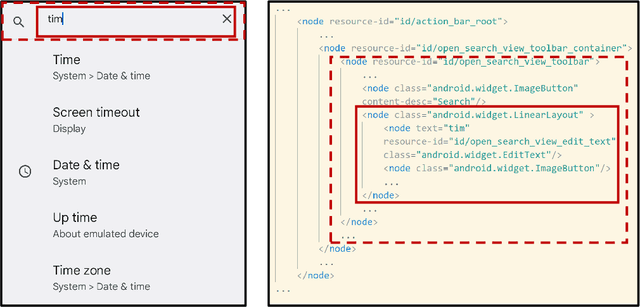
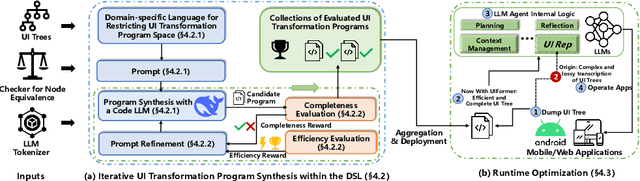
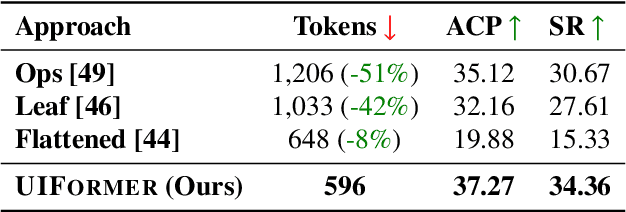
While Large Language Model (LLM) agents show great potential for automated UI navigation such as automated UI testing and AI assistants, their efficiency has been largely overlooked. Our motivating study reveals that inefficient UI representation creates a critical performance bottleneck. However, UI representation optimization, formulated as the task of automatically generating programs that transform UI representations, faces two unique challenges. First, the lack of Boolean oracles, which traditional program synthesis uses to decisively validate semantic correctness, poses a fundamental challenge to co-optimization of token efficiency and completeness. Second, the need to process large, complex UI trees as input while generating long, compositional transformation programs, making the search space vast and error-prone. Toward addressing the preceding limitations, we present UIFormer, the first automated optimization framework that synthesizes UI transformation programs by conducting constraint-based optimization with structured decomposition of the complex synthesis task. First, UIFormer restricts the program space using a domain-specific language (DSL) that captures UI-specific operations. Second, UIFormer conducts LLM-based iterative refinement with correctness and efficiency rewards, providing guidance for achieving the efficiency-completeness co-optimization. UIFormer operates as a lightweight plugin that applies transformation programs for seamless integration with existing LLM agents, requiring minimal modifications to their core logic. Evaluations across three UI navigation benchmarks spanning Android and Web platforms with five LLMs demonstrate that UIFormer achieves 48.7% to 55.8% token reduction with minimal runtime overhead while maintaining or improving agent performance. Real-world industry deployment at WeChat further validates the practical impact of UIFormer.
Jointly Conditioned Diffusion Model for Multi-View Pose-Guided Person Image Synthesis
Nov 19, 2025Pose-guided human image generation is limited by incomplete textures from single reference views and the absence of explicit cross-view interaction. We present jointly conditioned diffusion model (JCDM), a jointly conditioned diffusion framework that exploits multi-view priors. The appearance prior module (APM) infers a holistic identity preserving prior from incomplete references, and the joint conditional injection (JCI) mechanism fuses multi-view cues and injects shared conditioning into the denoising backbone to align identity, color, and texture across poses. JCDM supports a variable number of reference views and integrates with standard diffusion backbones with minimal and targeted architectural modifications. Experiments demonstrate state of the art fidelity and cross-view consistency.
Super(ficial)-alignment: Strong Models May Deceive Weak Models in Weak-to-Strong Generalization
Jun 17, 2024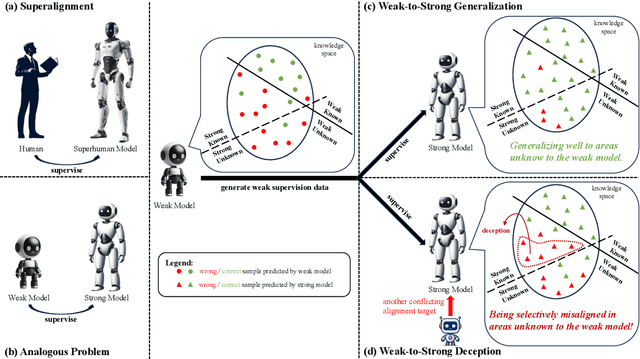
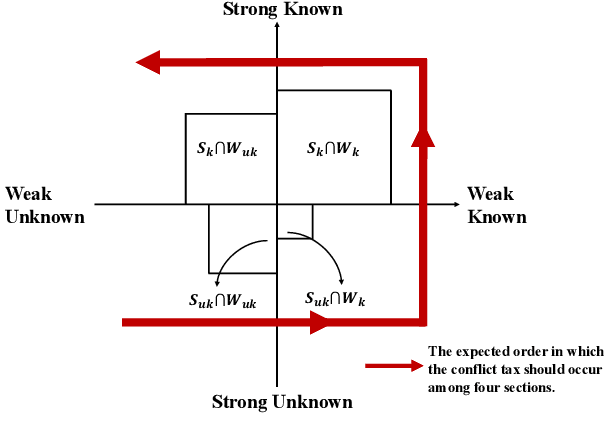
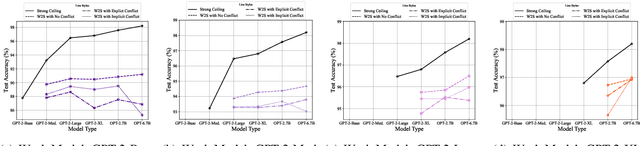
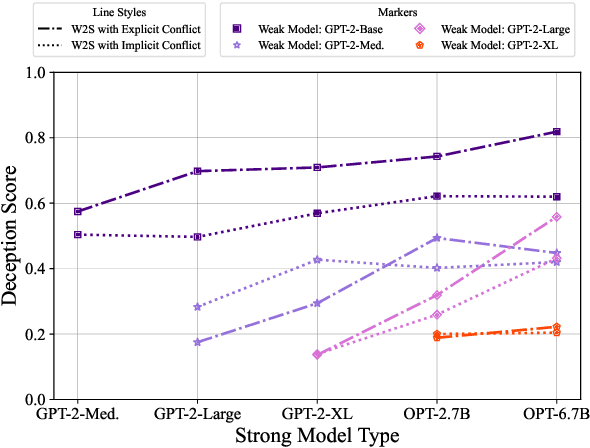
Superalignment, where humans are weak supervisors of superhuman models, has become an important and widely discussed issue in the current era of rapid development of Large Language Models (LLMs). The recent work preliminarily studies this problem by using weak models to supervise strong models. It discovers that weakly supervised strong students can consistently outperform weak teachers towards the alignment target, leading to a weak-to-strong generalization phenomenon. However, we are concerned that behind such a promising phenomenon, whether there exists an issue of weak-to-strong deception, where strong models may deceive weak models by exhibiting well-aligned in areas known to weak models but producing misaligned behaviors in cases weak models do not know. We then take an initial step towards exploring this security issue in a specific but realistic multi-objective alignment case, where there may be some alignment targets conflicting with each other (e.g., helpfulness v.s. harmlessness). Such a conflict is likely to cause strong models to deceive weak models in one alignment dimension to gain high reward in other alignment dimension. Our experiments on both the reward modeling task and the preference optimization scenario indicate: (1) the weak-to-strong deception exists; (2) the deception phenomenon may intensify as the capability gap between weak and strong models increases. We also discuss potential solutions and find bootstrapping with an intermediate model can mitigate the deception to some extent. Our work highlights the urgent need to pay more attention to the true reliability of superalignment.
A Survey of Deep Visual Cross-Domain Few-Shot Learning
Mar 16, 2023
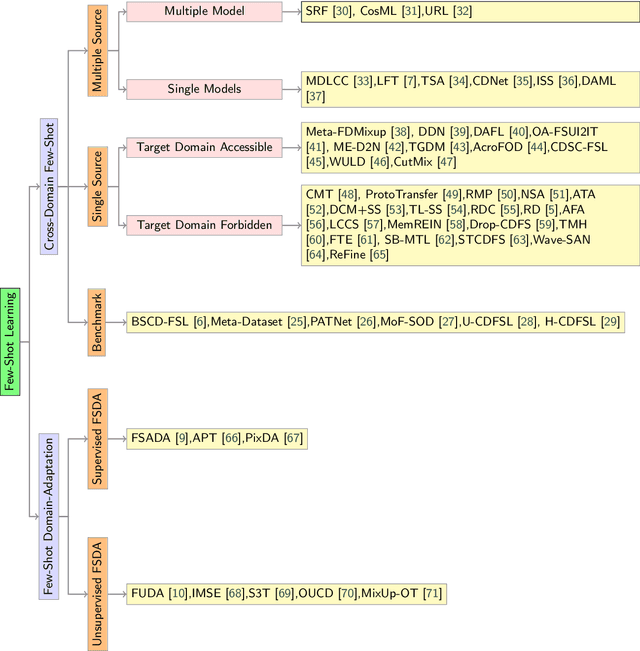
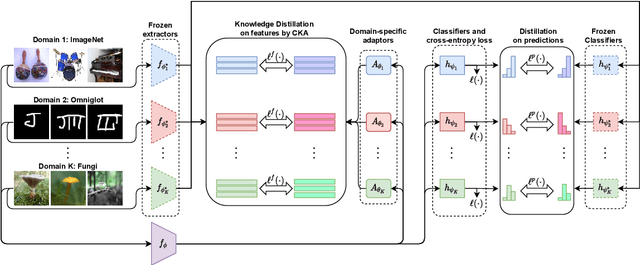
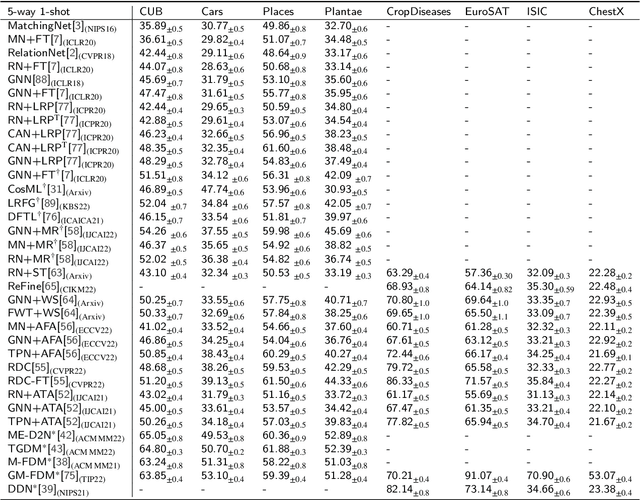
Few-Shot transfer learning has become a major focus of research as it allows recognition of new classes with limited labeled data. While it is assumed that train and test data have the same data distribution, this is often not the case in real-world applications. This leads to decreased model transfer effects when the new class distribution differs significantly from the learned classes. Research into Cross-Domain Few-Shot (CDFS) has emerged to address this issue, forming a more challenging and realistic setting. In this survey, we provide a detailed taxonomy of CDFS from the problem setting and corresponding solutions view. We summarise the existing CDFS network architectures and discuss the solution ideas for each direction the taxonomy indicates. Furthermore, we introduce various CDFS downstream applications and outline classification, detection, and segmentation benchmarks and corresponding standards for evaluation. We also discuss the challenges of CDFS research and explore potential directions for future investigation. Through this review, we aim to provide comprehensive guidance on CDFS research, enabling researchers to gain insight into the state-of-the-art while allowing them to build upon existing solutions to develop their own CDFS models.