 Add to Chrome
 Add to Firefox
 Add to Edge
Generalized Synthetic Image Detection with Enhanced RGB-Noise Representation Learning
Jul 07, 2026
The rapid advancement of large-scale generative models has accelerated the spread of highly deceptive AI-generated images, making generalized synthetic image detection a critical imperative. Existing forensic networks often struggle with cross-model generalization and realworld degradations due to their reliance on single-domain representations and conventional binary classification optimization. To overcome these limitations, we propose RNSIDNet, a novel forensic framework that achieves robust detection through enhanced RGB-Noise representation learning. Specifically, our method employs a dual-branch architecture where global RGB semantics, extracted by an attention-refined CLIP backbone, dynamically modulate highfrequency noise artifacts captured by Bayar convolutions via a Feature-wise Linear Modulation (FiLM) module. To further enhance the learned representations, we design a Hard Sample-aware Contrastive Learning (HSCL) strategy. By explicitly penalizing challenging training samples, HSCL reshapes the latent feature space to maximize the discriminative margin between pristine and synthetic domains. Extensive experiments across eight public benchmark datasets verify that our model achieves state-of-the-art performance, delivering superior generalization ability, robustness, and computational efficiency. Code and dataset will be publicly available on https://github.com/multimediaFor/RNSIDNet.

Transferable Dual-Domain Feature Importance Attack against AI-Generated Image Detector
Nov 19, 2025Recent AI-generated image (AIGI) detectors achieve impressive accuracy under clean condition. In view of antiforensics, it is significant to develop advanced adversarial attacks for evaluating the security of such detectors, which remains unexplored sufficiently. This letter proposes a Dual-domain Feature Importance Attack (DuFIA) scheme to invalidate AIGI detectors to some extent. Forensically important features are captured by the spatially interpolated gradient and frequency-aware perturbation. The adversarial transferability is enhanced by jointly modeling spatial and frequency-domain feature importances, which are fused to guide the optimization-based adversarial example generation. Extensive experiments across various AIGI detectors verify the cross-model transferability, transparency and robustness of DuFIA.
HMANet: Hybrid Multi-Axis Aggregation Network for Image Super-Resolution
May 08, 2024

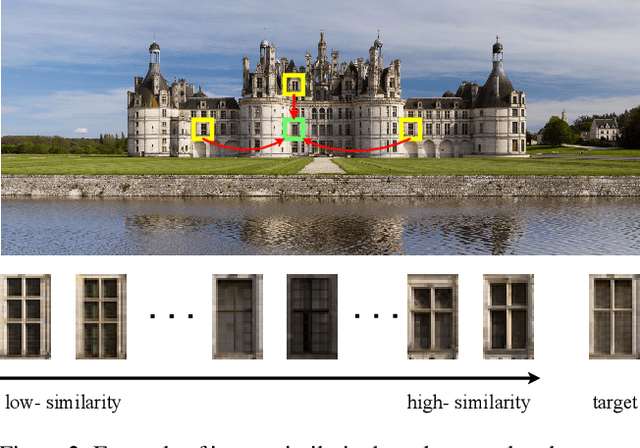
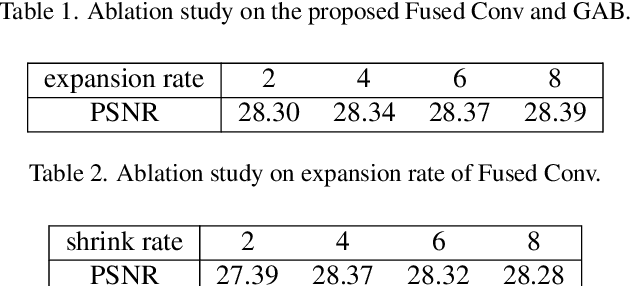
Transformer-based methods have demonstrated excellent performance on super-resolution visual tasks, surpassing conventional convolutional neural networks. However, existing work typically restricts self-attention computation to non-overlapping windows to save computational costs. This means that Transformer-based networks can only use input information from a limited spatial range. Therefore, a novel Hybrid Multi-Axis Aggregation network (HMA) is proposed in this paper to exploit feature potential information better. HMA is constructed by stacking Residual Hybrid Transformer Blocks(RHTB) and Grid Attention Blocks(GAB). On the one side, RHTB combines channel attention and self-attention to enhance non-local feature fusion and produce more attractive visual results. Conversely, GAB is used in cross-domain information interaction to jointly model similar features and obtain a larger perceptual field. For the super-resolution task in the training phase, a novel pre-training method is designed to enhance the model representation capabilities further and validate the proposed model's effectiveness through many experiments. The experimental results show that HMA outperforms the state-of-the-art methods on the benchmark dataset. We provide code and models at https://github.com/korouuuuu/HMA.