 Add to Chrome
 Add to Firefox
 Add to Edge
Fanar 2.0: Arabic Generative AI Stack
Mar 17, 2026
We present Fanar 2.0, the second generation of Qatar's Arabic-centric Generative AI platform. Sovereignty is a first-class design principle: every component, from data pipelines to deployment infrastructure, was designed and operated entirely at QCRI, Hamad Bin Khalifa University. Fanar 2.0 is a story of resource-constrained excellence: the effort ran on 256 NVIDIA H100 GPUs, with Arabic having only ~0.5% of web data despite 400 million native speakers. Fanar 2.0 adopts a disciplined strategy of data quality over quantity, targeted continual pre-training, and model merging to achieve substantial gains within these constraints. At the core is Fanar-27B, continually pre-trained from a Gemma-3-27B backbone on a curated corpus of 120 billion high-quality tokens across three data recipes. Despite using 8x fewer pre-training tokens than Fanar 1.0, it delivers substantial benchmark improvements: Arabic knowledge (+9.1 pts), language (+7.3 pts), dialects (+3.5 pts), and English capability (+7.6 pts). Beyond the core LLM, Fanar 2.0 introduces a rich stack of new capabilities. FanarGuard is a state-of-the-art 4B bilingual moderation filter for Arabic safety and cultural alignment. The speech family Aura gains a long-form ASR model for hours-long audio. Oryx vision family adds Arabic-aware image and video understanding alongside culturally grounded image generation. An agentic tool-calling framework enables multi-step workflows. Fanar-Sadiq utilizes a multi-agent architecture for Islamic content. Fanar-Diwan provides classical Arabic poetry generation. FanarShaheen delivers LLM-powered bilingual translation. A redesigned multi-layer orchestrator coordinates all components through intent-aware routing and defense-in-depth safety validation. Taken together, Fanar 2.0 demonstrates that sovereign, resource-constrained AI development can produce systems competitive with those built at far greater scale.

Fanar-Sadiq: A Multi-Agent Architecture for Grounded Islamic QA
Mar 10, 2026Large language models (LLMs) can answer religious knowledge queries fluently, yet they often hallucinate and misattribute sources, which is especially consequential in Islamic settings where users expect grounding in canonical texts (Qur'an and Hadith) and jurisprudential (fiqh) nuance. Retrieval-augmented generation (RAG) reduces some of these limitations by grounding generation in external evidence. However, a single ``retrieve-then-generate'' pipeline is limited to deal with the diversity of Islamic queries. Users may request verbatim scripture, fatwa-style guidance with citations or rule-constrained computations such as zakat and inheritance that require strict arithmetic and legal invariants. In this work, we present a bilingual (Arabic/English) multi-agent Islamic assistant, called Fanar-Sadiq, which is a core component of the Fanar AI platform. Fanar-Sadiq routes Islamic-related queries to specialized modules within an agentic, tool-using architecture. The system supports intent-aware routing, retrieval-grounded fiqh answers with deterministic citation normalization and verification traces, exact verse lookup with quotation validation, and deterministic calculators for Sunni zakat and inheritance with madhhab-sensitive branching. We evaluate the complete end-to-end system on public Islamic QA benchmarks and demonstrate effectiveness and efficiency. Our system is currently publicly and freely accessible through API and a Web application, and has been accessed $\approx$1.9M times in less than a year.
NxPlain: Web-based Tool for Discovery of Latent Concepts
Mar 06, 2023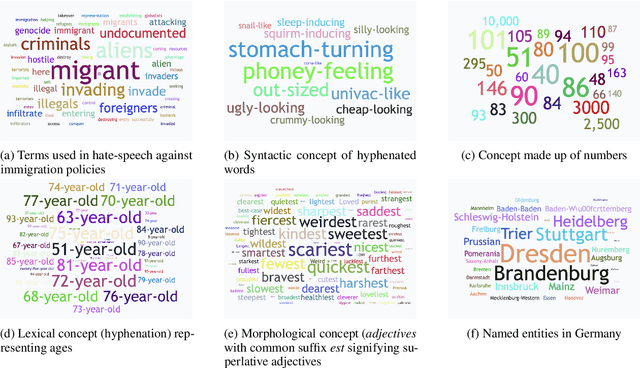
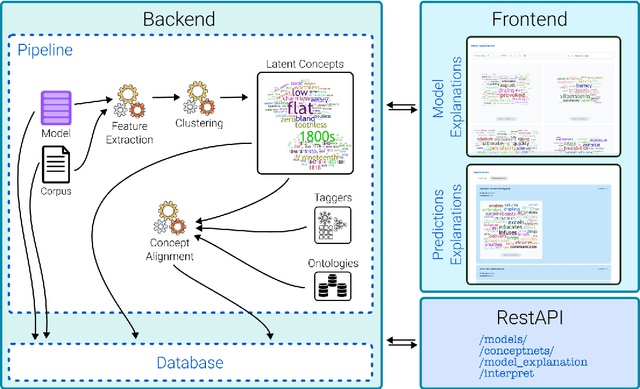
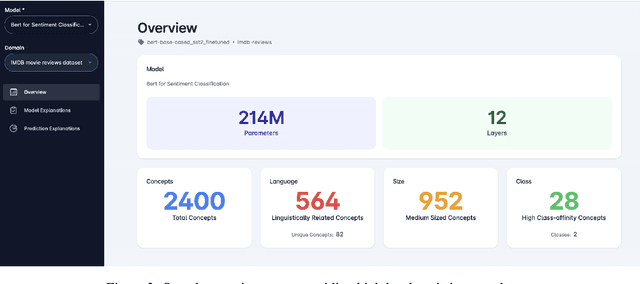
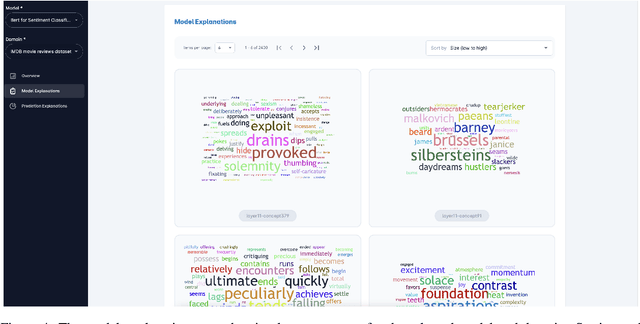
The proliferation of deep neural networks in various domains has seen an increased need for the interpretability of these models, especially in scenarios where fairness and trust are as important as model performance. A lot of independent work is being carried out to: i) analyze what linguistic and non-linguistic knowledge is learned within these models, and ii) highlight the salient parts of the input. We present NxPlain, a web application that provides an explanation of a model's prediction using latent concepts. NxPlain discovers latent concepts learned in a deep NLP model, provides an interpretation of the knowledge learned in the model, and explains its predictions based on the used concepts. The application allows users to browse through the latent concepts in an intuitive order, letting them efficiently scan through the most salient concepts with a global corpus level view and a local sentence-level view. Our tool is useful for debugging, unraveling model bias, and for highlighting spurious correlations in a model. A hosted demo is available here: https://nxplain.qcri.org.