 Add to Chrome
 Add to Firefox
 Add to Edge
End-to-End Modelling of Earthquake-Induced Polarisation Perturbations in Submarine Optical Fibres
Aug 12, 2026
We present an end-to-end model of earthquake-perturbed signal propagation in submarine fibres. Ground displacements are converted to fibre strain via ocean pressure, and injected into a split-step model. Our model shows good qualitative alignment with measurements from the Curie cable during the 2020 Oaxaca earthquake.

Symbol Rate-Code Rate Trade-offs for IM/DD 200G/400G per Lane LPO Transceivers
Jun 22, 2026We analyze the symbol rate-code rate trade-off in bandwidth-limited IM/DD systems targeting LPO transceivers, using PAM-4/6/8 as candidate modulation formats. We use the capacity of the binary symmetric channel as an achievable information rate under hard-decision decoding, serving as a performance metric for 200G and 400G per-lane throughput targets. Our results show that reducing the FEC code rate below the KP4 baseline allows higher-order PAM formats to operate at substantially lower symbol rates than PAM-4 while meeting the throughput requirement.
Regular Perturbation on the Group-Velocity Dispersion Parameter for Dual-Polarization Short-Reach Systems
Jun 19, 2026The Manakov equation governs the propagation of signals in dual-polarization systems. Its solution is usually approximated by regular perturbation on the nonlinear Kerr parameter. In this paper, we propose a novel regular perturbation on the group-velocity dispersion parameter for the Manakov equation.
Syndrome Adaptive Gain Control for Min-Sum Decoding of Quantum LDPC Codes
May 11, 2026Min-Sum (MS) decoding is a popular low-complexity alternative to belief propagation (BP), retaining only the minimum incoming message magnitude during check-node (CN) processing, at the cost of systematic message magnitude overestimation. The scaled MS (SMS) decoder compensates for this effect using a fixed scaling factor. We propose the syndrome adaptive gain Min-Sum (SAGMS) decoder for quantum low-density parity-check (QLDPC) codes, which adapts the message gain online based on the fraction of unsatisfied stabilizers, requiring no per-code or per-noise level optimization. We show that the scaling factor required for SMS to match belief propagation decreases with the CN degree, so any fixed scaling optimized for one degree incurs into a growing penalty as the CN degree varies. SAGMS avoids this limitation by adapting the gain during decoding. Simulations on generalized bicycle QLDPC codes demonstrate that SAGMS matches or outperforms the frame error rate (FER) of an offline optimized SMS decoder. Moreover, SAGMS approaches BP performance and, under certain conditions outperforms it while retaining MS-level complexity.
The Memory-Enhanced Gaussian Noise (MEGN) Model for Fiber-Optic Channels
Apr 13, 2026The enhanced Gaussian noise (EGN) model is widely used for estimating the nonlinear interference (NLI) power accumulated in coherent fiber-optic transmission systems. Given a fixed fiber link, under the assumption that transmitted symbols are independently and identically distributed (i.i.d.), the EGN model establishes that the NLI power depends on time-invariant signal statistics, i.e., the second-, fourth-, and sixth-order moments of the symbols, which are determined by the modulation format and its probability distribution. However, recent advances in coded modulation have sought to mitigate NLI by introducing controlled temporal correlations among transmitted symbols, thereby violating the i.i.d. assumption underlying the EGN model. Among these correlations, symbol energy correlations are believed to exert the most significant influence on NLI. This work presents a rigorous mathematical derivation of a memory extension of the EGN model that explicitly accounts for symbol energy correlations, referred to as the MEGN model. The proposed MEGN model is validated through both numerical simulations and transmission experiments. Normalized average NLI power estimations with less than 5% errors across a wide range of symbol rates and transmission distances are reported. The model also provides a theoretical framework for analyzing and optimizing optical transmission systems employing temporally correlated modulation schemes.
Predicting Nonlinear Interference for Short-Blocklength 4D Probabilistic Shaping
Feb 28, 2025We derive a heuristic nonlinear interference model for 4D probabilistic shaping considering the polarization and time correlation of the 4D symbols. We demonstrate an average SNR prediction gap from split-step Fourier simulations of 0.15~dB.
On Shaping Gain of Multidimensional Constellation in Linear and Nonlinear Optical Fiber Channel
Dec 19, 2024


Utilizing the multi-dimensional (MD) space for constellation shaping has been proven to be an effective approach for achieving shaping gains. Despite there exists a variety of MD modulation formats tailored for specific optical transmission scenarios, there remains a notable absence of a dependable comparison method for efficiently and promptly re-evaluating their performance in arbitrary transmission systems. In this paper, we introduce an analytical nonlinear interference (NLI) power model-based shaping gain estimation method to enable a fast performance evaluation of various MD modulation formats in coherent dual-polarization (DP) optical transmission system. In order to extend the applicability of this method to a broader set of modulation formats, we extend the established NLI model to take the 4D joint distribution into account and thus able to analyze the complex interactions of non-iid signaling in DP systems. With the help of the NLI model, we conduct a comprehensive analysis of the state-of-the-art modulation formats and investigate their actual shaping gains in two types of optical fiber communication scenarios (multi-span and single-span). The numerical simulation shows that for arbitrary modulation formats, the NLI power and relative shaping gains in terms of signal-to-noise ratio can be more accurately estimated by capturing the statistics of MD symbols. Furthermore, the proposed method further validates the effectiveness of the reported NLI-tolerant modulation format in the literature, which reveals that the linear shaping gains and modulation-dependent NLI should be jointly considered for nonlinearity mitigation.
On the Capacity of Correlated MIMO Phase-Noise Channels: An Electro-Optic Frequency Comb Example
May 09, 2024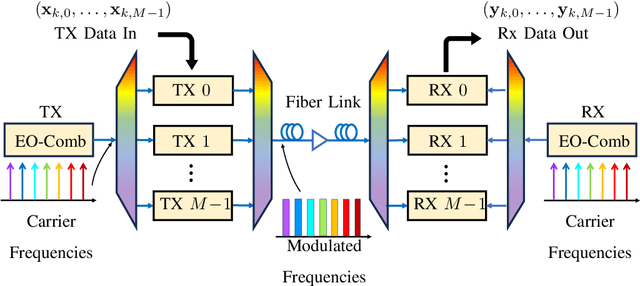
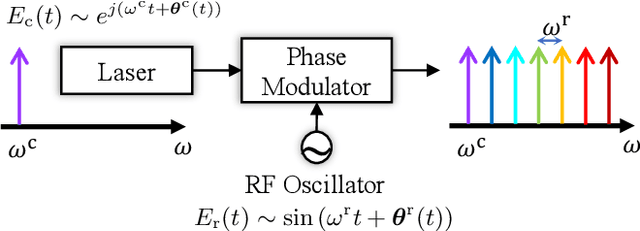
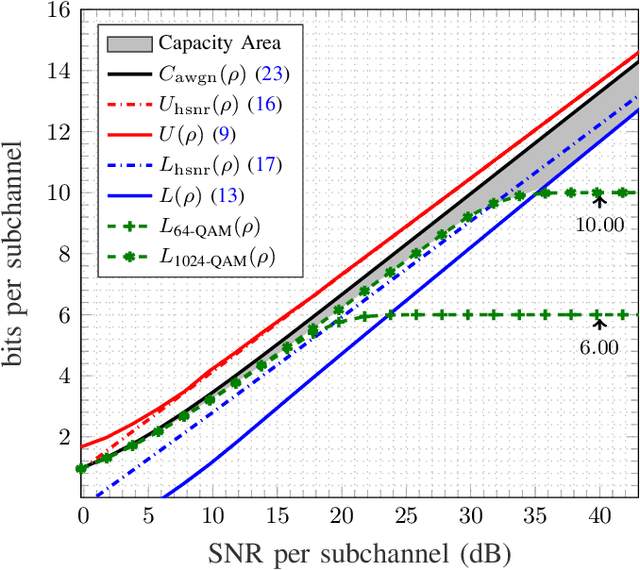
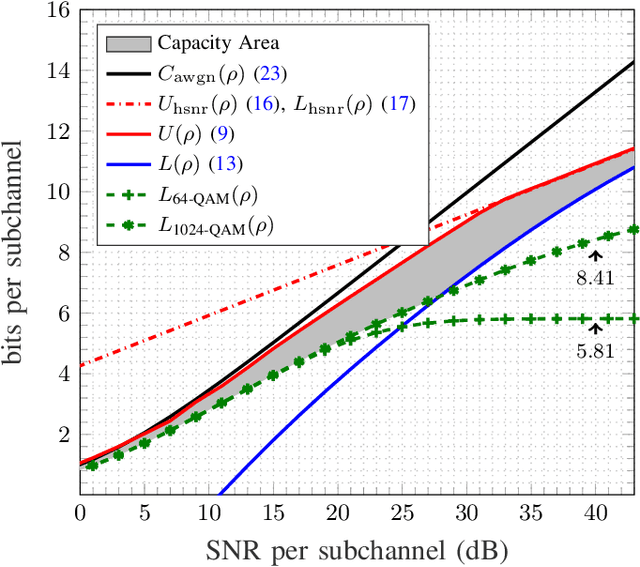
The capacity of a discrete-time multiple-input-multiple-output channel with correlated phase noises is investigated. In particular, the electro-optic frequency comb system is considered, where the phase noise of each channel is a combination of two independent Wiener phase-noise sources. Capacity upper and lower bounds are derived for this channel and are compared with lower bounds obtained by numerically evaluating the achievable information rates using quadrature amplitude modulation constellations. Capacity upper and lower bounds are provided for the high signal-to-noise ratio (SNR) regime. The multiplexing gain (pre-log) is shown to be $M-1$, where $M$ represents the number of channels. A constant gap between the asymptotic upper and lower bounds is observed, which depends on the number of channels $M$. For the specific case of $M=2$, capacity is characterized up to a term that vanishes as the SNR grows large.
On the Performance of Multidimensional Constellation Shaping for Linear and Nonlinear Optical Fiber Channel
Aug 17, 2023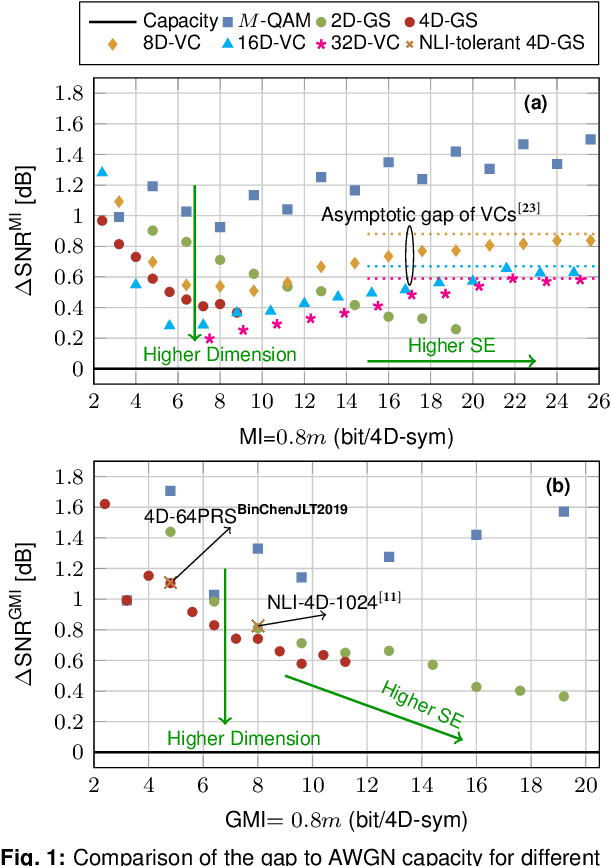

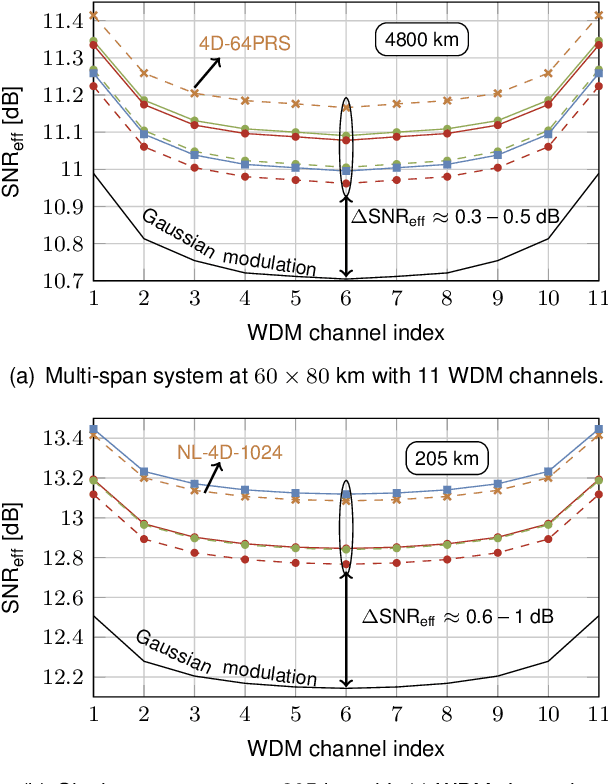
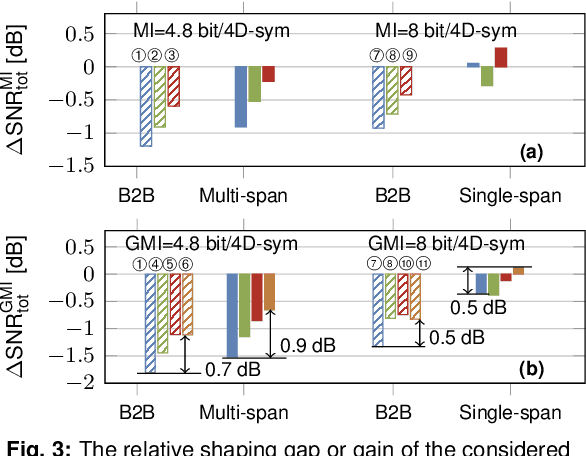
Multidimensional constellation shaping of up to 32 dimensions with different spectral efficiencies are compared through AWGN and fiber-optic simulations. The results show that no constellation is universal and the balance of required and effective SNRs should be jointly considered for the specific optical transmission scenario.
Low-Complexity Soft Decision Detection for Combating DFE Burst Errors in IM/DD Links
Jun 13, 2023The deployment of non-binary pulse amplitude modulation (PAM) and soft decision (SD)-forward error correction (FEC) in future intensity-modulation (IM)/direct-detection (DD) links is inevitable. However, high-speed IM/DD links suffer from inter-symbol interference (ISI) due to bandwidth-limited hardware. Traditional approaches to mitigate the effects of ISI are filters and trellis-based algorithms targeting symbol-wise maximum a posteriori (MAP) detection. The former approach includes decision-feedback equalizer (DFE), and the latter includes Max-Log-MAP (MLM) and soft-output Viterbi algorithm (SOVA). Although DFE is easy to implement, it introduces error propagation. Such burst errors distort the log-likelihood ratios (LLRs) required by SD-FEC, causing performance degradation. On the other hand, MLM and SOVA provide near-optimum performance, but their complexity is very high for high-order PAM. In this paper, we consider a one-tap partial response channel model, which is relevant for high-speed IM/DD links. We propose to combine DFE with either MLM or SOVA in a low-complexity architecture. The key idea is to allow MLM or SOVA to detect only 3 typical DFE symbol errors, and use the detected error information to generate LLRs in a modified demapper. The proposed structure enables a tradeoff between complexity and performance: (i) the complexity of MLM or SOVA is reduced and (ii) the decoding penalty due to error propagation is mitigated. Compared to SOVA detection, the proposed scheme can achieve a significant complexity reduction of up to 94% for PAM-$8$ transmission. Simulation and experimental results show that the resulting SNR loss is roughly 0.3 to 0.4 dB for PAM-4, and becomes marginal 0.18 dB for PAM-8.