 Add to Chrome
 Add to Firefox
 Add to Edge
Syndrome Adaptive Gain Control for Min-Sum Decoding of Quantum LDPC Codes
May 11, 2026
Min-Sum (MS) decoding is a popular low-complexity alternative to belief propagation (BP), retaining only the minimum incoming message magnitude during check-node (CN) processing, at the cost of systematic message magnitude overestimation. The scaled MS (SMS) decoder compensates for this effect using a fixed scaling factor. We propose the syndrome adaptive gain Min-Sum (SAGMS) decoder for quantum low-density parity-check (QLDPC) codes, which adapts the message gain online based on the fraction of unsatisfied stabilizers, requiring no per-code or per-noise level optimization. We show that the scaling factor required for SMS to match belief propagation decreases with the CN degree, so any fixed scaling optimized for one degree incurs into a growing penalty as the CN degree varies. SAGMS avoids this limitation by adapting the gain during decoding. Simulations on generalized bicycle QLDPC codes demonstrate that SAGMS matches or outperforms the frame error rate (FER) of an offline optimized SMS decoder. Moreover, SAGMS approaches BP performance and, under certain conditions outperforms it while retaining MS-level complexity.

The Memory-Enhanced Gaussian Noise (MEGN) Model for Fiber-Optic Channels
Apr 13, 2026The enhanced Gaussian noise (EGN) model is widely used for estimating the nonlinear interference (NLI) power accumulated in coherent fiber-optic transmission systems. Given a fixed fiber link, under the assumption that transmitted symbols are independently and identically distributed (i.i.d.), the EGN model establishes that the NLI power depends on time-invariant signal statistics, i.e., the second-, fourth-, and sixth-order moments of the symbols, which are determined by the modulation format and its probability distribution. However, recent advances in coded modulation have sought to mitigate NLI by introducing controlled temporal correlations among transmitted symbols, thereby violating the i.i.d. assumption underlying the EGN model. Among these correlations, symbol energy correlations are believed to exert the most significant influence on NLI. This work presents a rigorous mathematical derivation of a memory extension of the EGN model that explicitly accounts for symbol energy correlations, referred to as the MEGN model. The proposed MEGN model is validated through both numerical simulations and transmission experiments. Normalized average NLI power estimations with less than 5% errors across a wide range of symbol rates and transmission distances are reported. The model also provides a theoretical framework for analyzing and optimizing optical transmission systems employing temporally correlated modulation schemes.
A Fully Open-source Implementation of an Analog 8-PAM Demapper for High-speed Communications
Mar 05, 2026Spectrally-efficient communication systems rely on the use of multi-level modulation formats. At the receiver side, a demodulator is often used to extract soft information about the transmitted bits. Such a demodulator is typically implemented in the digital domain. However, analog implementations of such demodulators are also possible. In this paper, we design and simulate an analog 8-ary pulse-amplitude modulation (8-PAM) demapper in IHP SG13G2 SiGe BiCMOS technology. We generalize and improve a design available in the literature for 4-PAM. A fully MOSFET-based 8-PAM design is proposed. Our simulations and design are completely based on open-source IC design tools. Our results show an energy efficiency of 0.33 pJ/bit for a data rate of 1Gbit/s.
On Irradiance Distributions for Weakly Turbulent FSO Links: Log-Normal vs. Gamma-Gamma
Oct 24, 2025Weak turbulence is commonly modeled using the log-normal distribution. Our experimental results show that this distribution fails to capture irradiance fluctuations in this regime. The Gamma-Gamma model is shown to be more accurate.
On Error Rate Approximations for FSO Systems with Weak Turbulence and Pointing Errors
Jun 24, 2025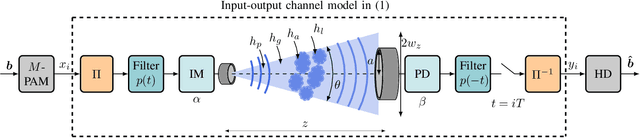


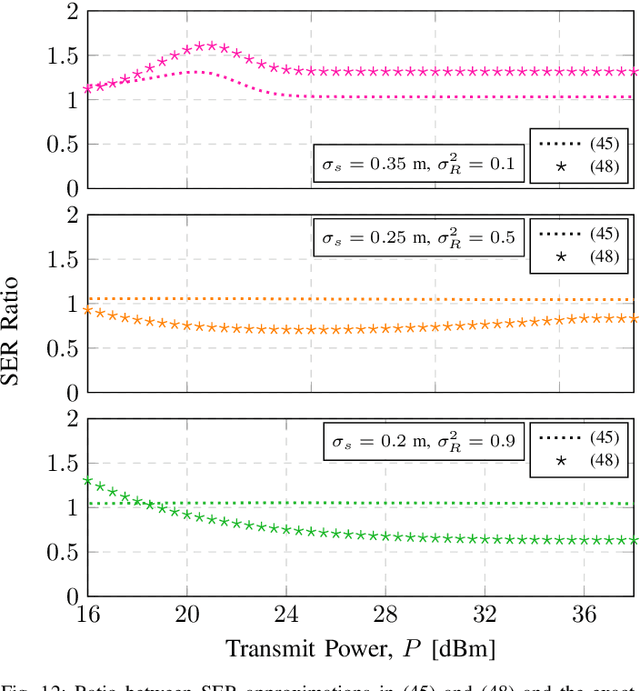
Atmospheric attenuation, atmospheric turbulence, geometric spread, and pointing errors, degrade the performance of free-space optical transmission. In the weak turbulence regime, the probability density function describing the distribution of the channel fading coefficient that models these four effects is known in the literature. This function is an integral equation, which makes it difficult to find simple analytical expressions of important performance metrics such as the bit error rate (BER) and symbol error rate (SER). In this paper, we present simple and accurate approximations of the average BER and SER for pulse-amplitude modulation (PAM) in the weak turbulence regime for an intensity modulation and direct detection system. Our numerical results show that the proposed expressions exhibit excellent accuracy when compared against Monte Carlo simulations. To demonstrate the usefulness of the developed approximations, we perform two asymptotic analyses. First, we investigate the additional transmit power required to maintain the same SER when the spectral efficiency increases by 1 bit/symbol. Second, we study the asymptotic behavior of our SER approximation for dense PAM constellations and high transmit power.
Beyond 200 Gb/s/lane: An Analytical Approach to Optimal Detection in Shaped IM-DD Optical Links with Relative Intensity Noise
Jun 24, 2025Next-generation intensity-modulation (IM) and direct-detection (DD) systems used in data centers are expected to operate at 400 Gb/s/lane and beyond. Such rates can be achieved by increasing the system bandwidth or the modulation format, which in turn requires maintaining or increasing the signal-to-noise ratio (SNR). Such SNR requirements can be achieved by increasing the transmitted optical power. This increase in optical power causes the emergence of relative intensity noise (RIN), a signal-dependent impairment inherent to the transmitter laser, which ultimately limits the performance of the system. In this paper, we develop an analytical symbol error rate (SER) expression for the optimal detector for the IM-DD optical link under study. The developed expression takes into account the signal-dependent nature of RIN and does not make any assumptions on the geometry or probability distribution of the constellation. Our expression is therefore applicable to general probabilistically and/or geometrically shaped systems. Unlike results available in the literature, our proposed expression provides a perfect match to numerical simulations of probabilistic and geometrically shaped systems.
On Geometric Shaping for 400 Gbps IM-DD Links with Laser Intensity Noise
Apr 24, 2025We propose geometric shaping for IM-DD links dominated by relative intensity noise (RIN). For 400 Gbps links, our geometrically-shaped constellations result in error probability improvements that relaxes the RIN laser design by 3 dB.
Physics-Aware Initialization Refinement in Code-Aided EM for Blind Channel Estimation
Apr 15, 2025This paper addresses the well-known local maximum problem of the expectation-maximization (EM) algorithm in blind intersymbol interference (ISI) channel estimation. This problem primarily results from phase and shift ambiguity during initialization, which blind estimation is inherently unable to distinguish. We propose an effective initialization refinement algorithm that utilizes the decoder output as a model selection metric, incorporating a technique to detect phase and shift ambiguity. Our results show that the proposed algorithm significantly reduces the number of local maximum cases to nearly one-third for a 3-tap ISI channel under highly uncertain initial conditions. The improvement becomes more pronounced as initial errors increase and the channel memory grows. When used in a turbo equalizer, the proposed algorithm is required only in the first turbo iteration, which limits any complexity increase with subsequent iterations.
On the Optimality of Single-label and Multi-label Neural Network Decoders
Mar 24, 2025We investigate the design of two neural network (NN) architectures recently proposed as decoders for forward error correction: the so-called single-label NN (SLNN) and multi-label NN (MLNN) decoders. These decoders have been reported to achieve near-optimal codeword- and bit-wise performance, respectively. Results in the literature show near-optimality for a variety of short codes. In this paper, we analytically prove that certain SLNN and MLNN architectures can, in fact, always realize optimal decoding, regardless of the code. These optimal architectures and their binary weights are shown to be defined by the codebook, i.e., no training or network optimization is required. Our proposed architectures are in fact not NNs, but a different way of implementing the maximum likelihood decoding rule. Optimal performance is numerically demonstrated for Hamming $(7,4)$, Polar $(16,8)$, and BCH $(31,21)$ codes. The results show that our optimal architectures are less complex than the SLNN and MLNN architectures proposed in the literature, which in fact only achieve near-optimal performance. Extension to longer codes is still hindered by the curse of dimensionality. Therefore, even though SLNN and MLNN can perform maximum likelihood decoding, such architectures cannot be used for medium and long codes.
Modified Baum-Welch Algorithm for Joint Blind Channel Estimation and Turbo Equalization
Dec 10, 2024
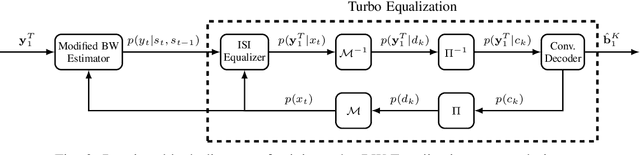
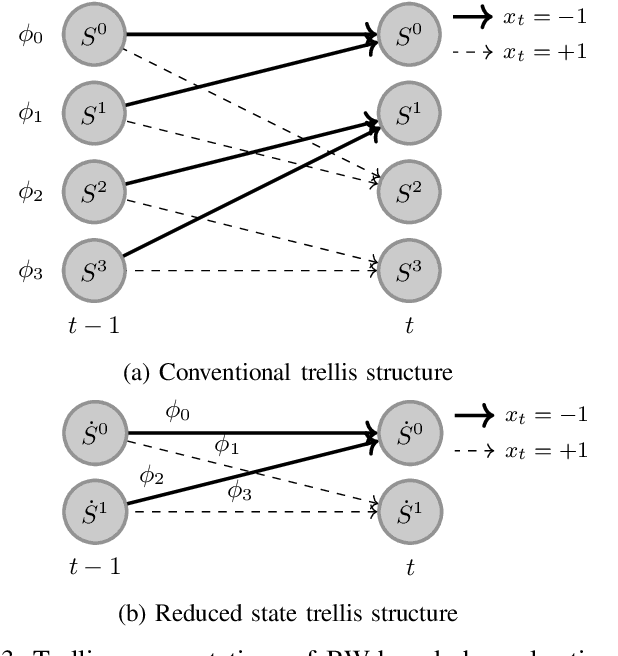
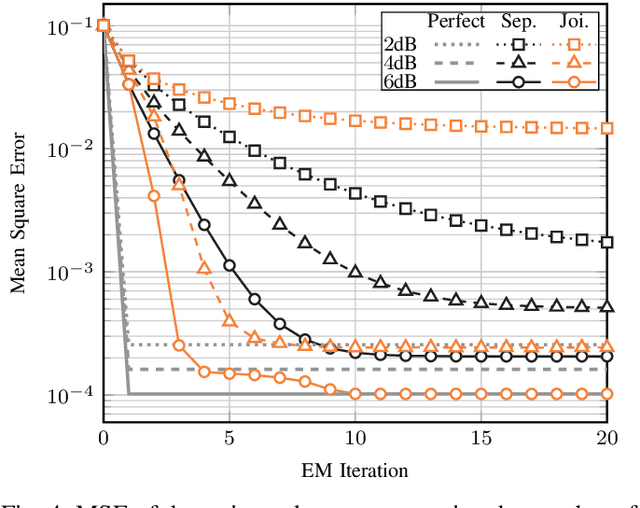
Blind estimation of intersymbol interference channels based on the Baum-Welch (BW) algorithm, a specific implementation of the expectation-maximization (EM) algorithm for training hidden Markov models, is robust and does not require labeled data. However, it is known for its extensive computation cost, slow convergence, and frequently converges to a local maximum. In this paper, we modified the trellis structure of the BW algorithm by associating the channel parameters with two consecutive states. This modification enables us to reduce the number of required states by half while maintaining the same performance. Moreover, to improve the convergence rate and the estimation performance, we construct a joint turbo-BW-equalization system by exploiting the extrinsic information produced by the turbo decoder to refine the BW-based estimator at each EM iteration. Our experiments demonstrate that the joint system achieves convergence in just 4 EM iterations, which is 8 iterations less than a separate system design for a signal-to-noise ratio (SNR) of 6 dB. Additionally, the joint system provides improved estimation accuracy with a mean square error (MSE) of $10^{-4}$. We also identify scenarios where a joint design is not preferable, especially when the channel is noisy (e.g., SNR=2 dB) and the turbo decoder is unable to provide reliable extrinsic information for a BW-based estimator.