 Add to Chrome
 Add to Firefox
 Add to Edge
Regular Perturbation on the Group-Velocity Dispersion Parameter for Dual-Polarization Short-Reach Systems
Jun 19, 2026
The Manakov equation governs the propagation of signals in dual-polarization systems. Its solution is usually approximated by regular perturbation on the nonlinear Kerr parameter. In this paper, we propose a novel regular perturbation on the group-velocity dispersion parameter for the Manakov equation.

The Memory-Enhanced Gaussian Noise (MEGN) Model for Fiber-Optic Channels
Apr 13, 2026The enhanced Gaussian noise (EGN) model is widely used for estimating the nonlinear interference (NLI) power accumulated in coherent fiber-optic transmission systems. Given a fixed fiber link, under the assumption that transmitted symbols are independently and identically distributed (i.i.d.), the EGN model establishes that the NLI power depends on time-invariant signal statistics, i.e., the second-, fourth-, and sixth-order moments of the symbols, which are determined by the modulation format and its probability distribution. However, recent advances in coded modulation have sought to mitigate NLI by introducing controlled temporal correlations among transmitted symbols, thereby violating the i.i.d. assumption underlying the EGN model. Among these correlations, symbol energy correlations are believed to exert the most significant influence on NLI. This work presents a rigorous mathematical derivation of a memory extension of the EGN model that explicitly accounts for symbol energy correlations, referred to as the MEGN model. The proposed MEGN model is validated through both numerical simulations and transmission experiments. Normalized average NLI power estimations with less than 5% errors across a wide range of symbol rates and transmission distances are reported. The model also provides a theoretical framework for analyzing and optimizing optical transmission systems employing temporally correlated modulation schemes.
Joint Subcarrier Phase Recovery for Nonlinearity Mitigation
Feb 27, 2026We propose a low-complexity phase recovery scheme that simultaneously mitigates laser phase noise and fiber nonlinearity across several subcarriers. In a long single-span link with Raman amplification, the scheme achieves 0.9 dB gain with 99 real multiplications per complex symbol.
ML-Enhanced Digital Backpropagation for Long-Reach Single-Span Systems
Jan 27, 2026We propose a digital backpropagation method that employs machine-learning-aided joint optimization of dispersion step lengths and nonlinear phase rotation filters within an FFT-based enhanced split-step Fourier structure, achieving improved accuracy at low computational complexity.
Fiber Nonlinearity Mitigation in Coherent Optical Systems
May 21, 2025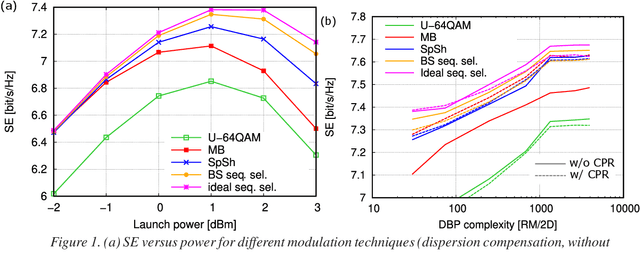
Fiber nonlinearity represents a critical challenge to the capacity enhancement of modern optical communication systems. In recent years, significant research efforts have focused on mitigating its impact through two complementary approaches. On the one hand, researchers have investigated practical digital signal processing (DSP) techniques to mitigate or compensate for nonlinear impairments, such as reversing fiber propagation effects through digital backpropagation (DBP). However, the high computational complexity of these techniques often discourages their practical implementation. On the other hand, information-theoretic studies have sought to establish the capacity limits of the nonlinear optical fiber channel, providing a framework for evaluating the ultimate performance of existing optical networks and guiding the design of next-generation systems. This work reviews recent advances and proposes future directions for nonlinearity compensation and mitigation, including constellation shaping techniques and low-complexity DBP. Furthermore, it highlights the potential of these innovations both in advancing the theoretical understanding of fiber capacity limits and in enabling practical DSP implementations.
Cost-Gain Analysis of Sequence Selection for Nonlinearity Mitigation
Nov 04, 2024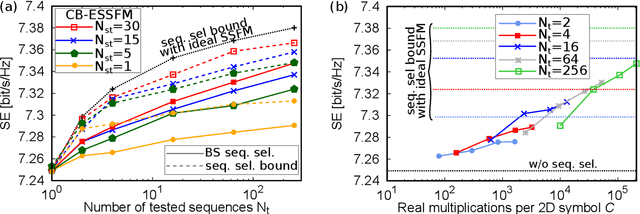
We propose a low-complexity sign-dependent metric for sequence selection and study the nonlinear shaping gain achievable for a given computational cost, establishing a benchmark for future research. Small gains are obtained with feasible complexity. Higher gains are achievable in principle, but with high complexity or a more sophisticated metric.
A New Twist on Low-Complexity Digital Backpropagation
Sep 22, 2024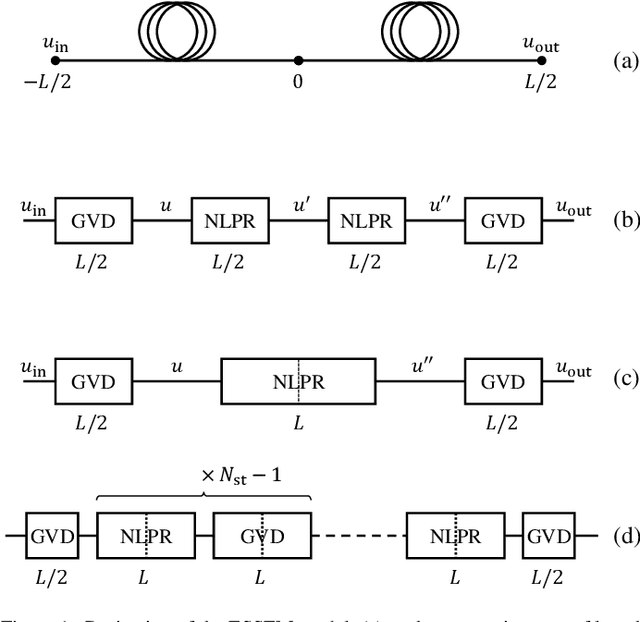
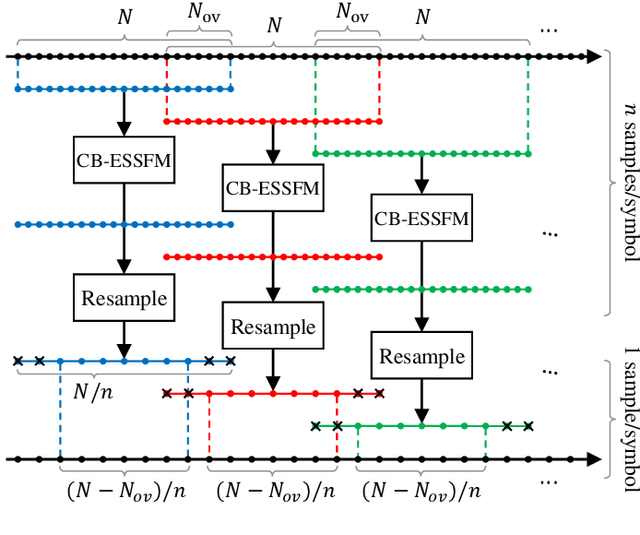
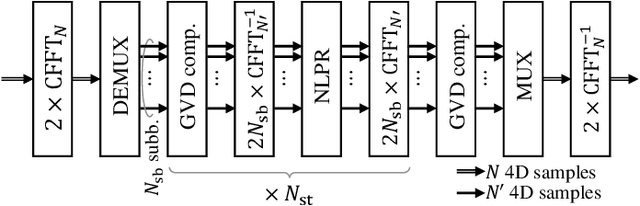
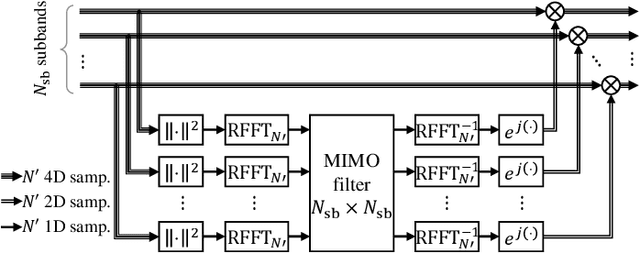
This work proposes a novel low-complexity digital backpropagation (DBP) method, with the goal of optimizing the trade-off between backpropagation accuracy and complexity. The method combines a split step Fourier method (SSFM)-like structure with a simplifed logarithmic perturbation method to obtain a high accuracy with a small number of DBP steps. Subband processing and asymmetric steps with optimized splitting ratio are also employed to further reduce the number of steps. The first part of the manuscript is dedicated to the derivation of a simplified logaritmic-perturbation model for the propagation of a dual-polarization multiband signal in a fiber, which serves as a theoretical background for the development of the proposed coupled-band enhanced SSFM (CBESSFM). Next, the manuscript presents a digital signal processing algorithm for the implementation of DBP based on a discrete-time version of the model and an overlap-and-save processing strategy. A detailed analysis of the computational complexity of the algorithm is also presented. Finally, the performance and complexity of the proposed DBP method are investigated through numerical simulations. In a wavelength division multiplexing system over a 15 x 80km single mode fiber link, the proposed CB-ESSFM achieves a gain of about 1 dB over simple dispersion compensation with only 15 steps (corresponding to about 680 real multiplications per 2D symbol), with an improvement of 0.9 dB w.r.t. conventional SSFM and almost 0.4 dB w.r.t. our previously proposed ESSFM. Significant gains are obtained also at lower complexity. For instance, the gain reduces to a still significant value of 0.34 dB when a single DBP step is employed, requiring just 75 real multiplications per 2D symbol. A similar analysis is performed also for longer links, confirming the good performance of the proposed method w.r.t. the others.
Coupled-Band ESSFM for Low-Complexity DBP
May 14, 2024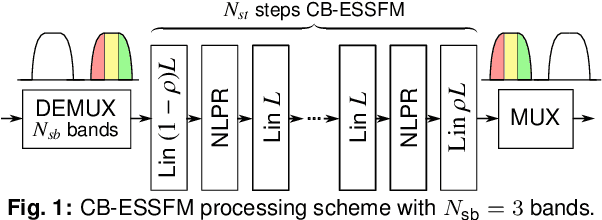
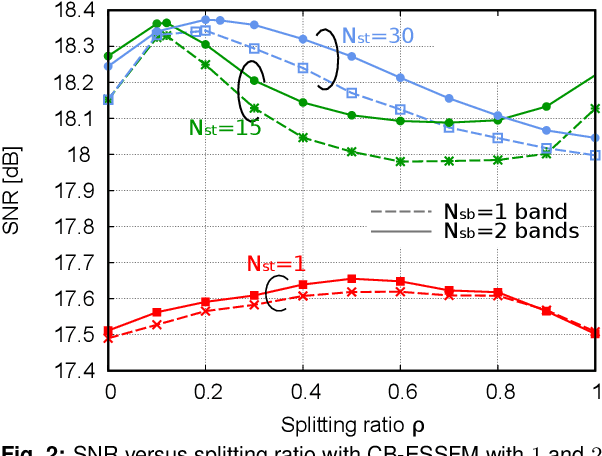
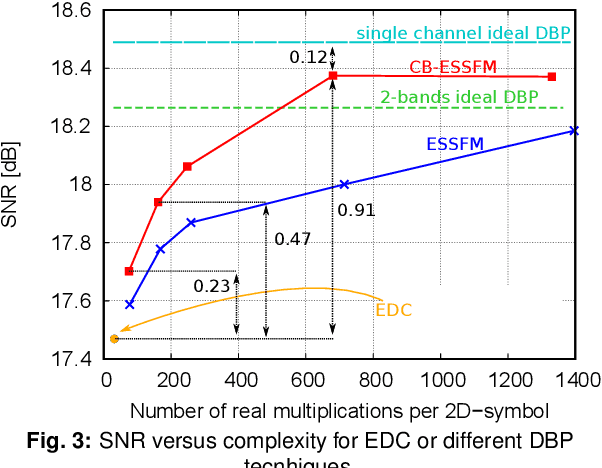
We propose a novel digital backpropagation (DBP) technique that combines perturbation theory, subband processing, and splitting ratio optimization. We obtain 0.23 dB, 0.47 dB, or 0.91 dB gains w.r.t. dispersion compensation with only 74, 161, or 681 real multiplications/2D-symbol, improving significantly on existing DBP techniques.
Nonlinear Probabilistic Constellation Shaping with Sequence Selection
Jul 25, 2023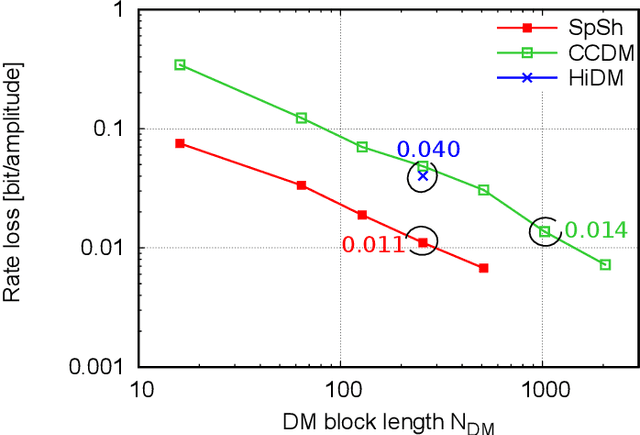
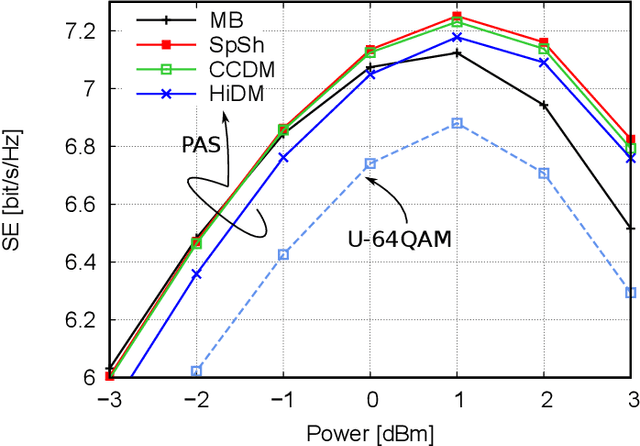
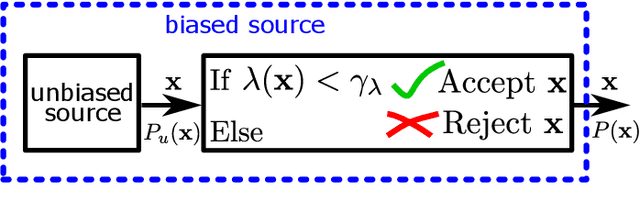
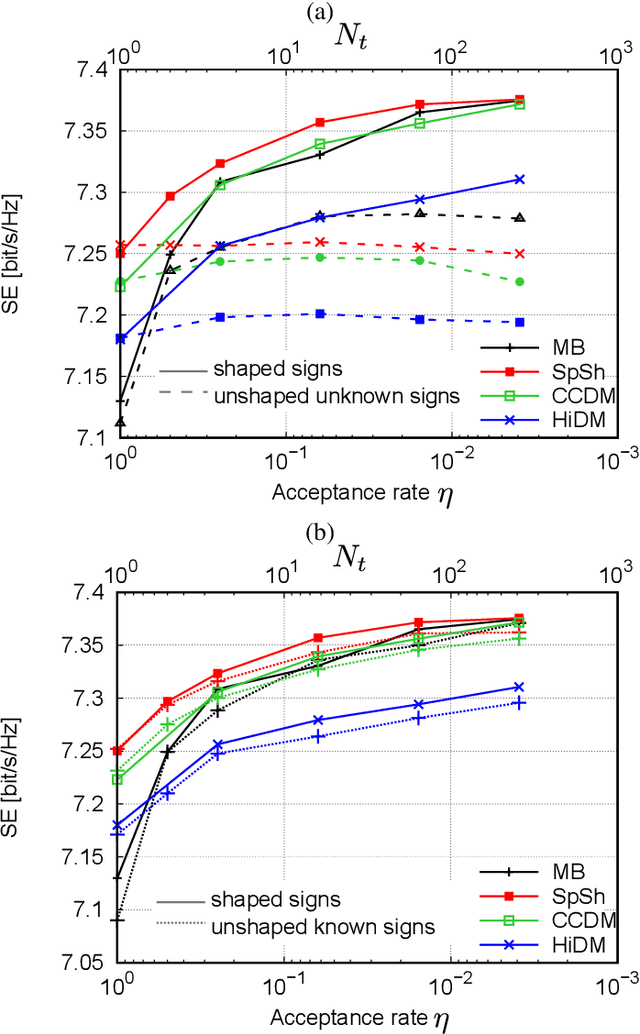
Probabilistic shaping is a pragmatic approach to improve the performance of coherent optical fiber communication systems. In the nonlinear regime, the advantages offered by probabilistic shaping might increase thanks to the opportunity to obtain an additional nonlinear shaping gain. Unfortunately, the optimization of conventional shaping techniques, such as probabilistic amplitude shaping (PAS), yields a relevant nonlinear shaping gain only in scenarios of limited practical interest. In this manuscript we use sequence selection to investigate the potential, opportunities, and challenges offered by nonlinear probabilistic shaping. First, we show that ideal sequence selection is able to provide up to 0.13 bit/s/Hz gain with respect to PAS with an optimized blocklength. However, this additional gain is obtained only if the selection metric accounts for the signs of the symbols: they must be known to compute the selection metric, but there is no need to shape them. Furthermore, we show that the selection depends in a non-critical way on the symbol rate and link length: the sequences selected for a certain scenario still provide a relevant gain if these are modified. Then, we analyze and compare several practical implementations of sequence selection by taking into account interaction with forward error correction (FEC) and complexity. Overall, the single block and the multi block FEC-independent bit scrambling are the best options, with a gain up to 0.08 bit/s/Hz. The main challenge and limitation to their practical implementation remains the evaluation of the metric, whose complexity is currently too high. Finally, we show that the nonlinear shaping gain provided by sequence selection persists when carrier phase recovery is included.
Optical identification using physical unclonable functions
May 03, 2023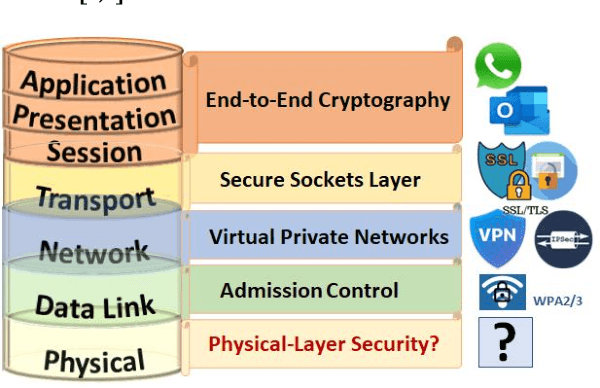
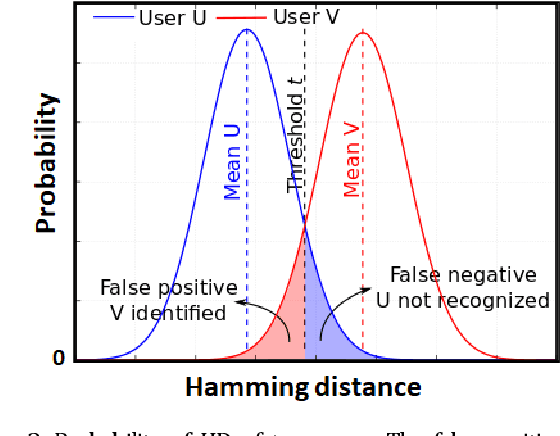
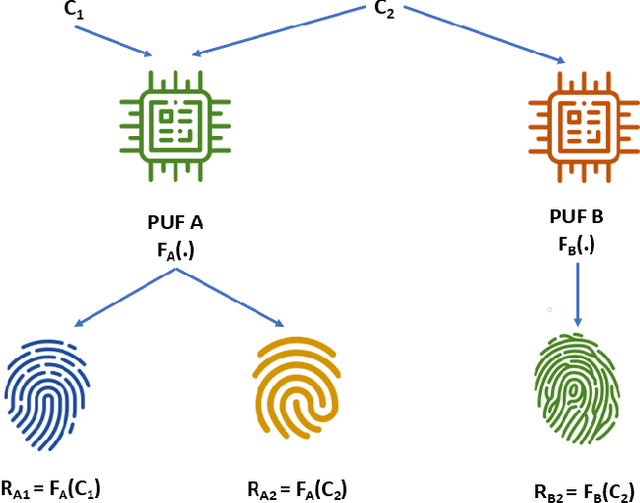
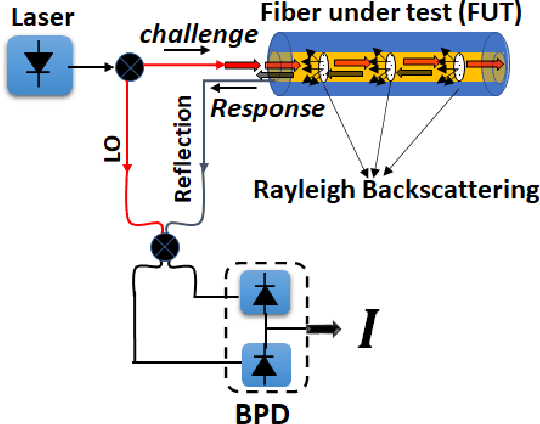
In this work, the concept of optical identification (OI) is introduced for the first time. The OI assigns an optical fingerprint and the corresponding digital signature to each sub-system of the network and estimates its reliability in different measures. We highlight the large potential applications of OI as a physical layer approach for security, identification, authentication, and monitoring purposes. To identify most of the sub-systems of a network, we propose to use the Rayleigh backscattering pattern, which is an optical physical unclonable function and allows to achieve OI with a simple procedure and without additional devices. The application of OI to fiber and path identification in a network, and to the authentication of the users in a quantum key distribution system are described.