 Add to Chrome
 Add to Firefox
 Add to Edge
SuperFlex: Deformable Superquadrics for Point Cloud Decomposition
Jul 01, 2026
Superquadrics have proven to provide a compact, geometrically meaningful representation for 3D objects. However, existing methods suffer from limited reconstruction accuracy, are restricted to rigid primitives, and lack robustness to partial point clouds. In this work, we present SuperFlex, an enhanced framework that expands the expressive power and applicability of superquadric decompositions. First, we introduce a novel loss formulation which significantly improves reconstruction accuracy. Second, we include bending and tapering deformations, enabling high-fidelity representation of curved and asymmetric geometries. Finally, we leverage these high-quality decompositions as supervision to train a model that is robust to partial real-world point clouds. Experiments demonstrate substantial improvements in reconstruction accuracy over both optimization- and learning-based baselines while maintaining a highly compact primitive representation.

Do Generalisation Results Generalise?
Dec 08, 2025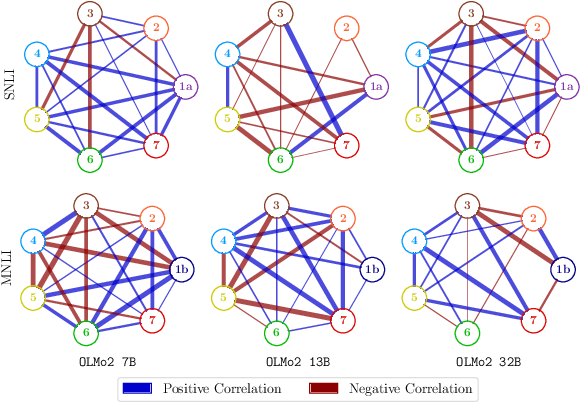
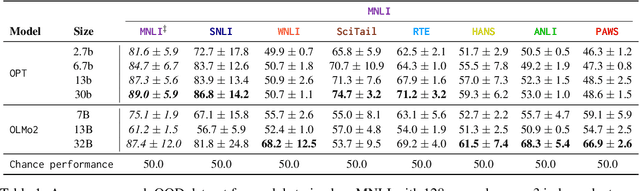
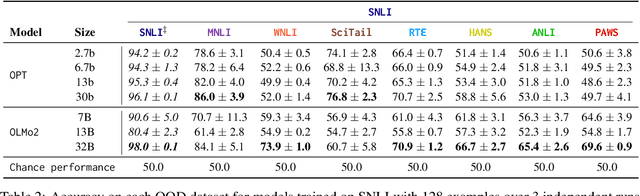
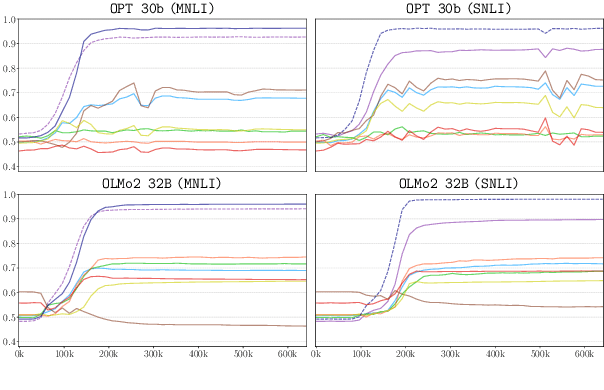
A large language model's (LLM's) out-of-distribution (OOD) generalisation ability is crucial to its deployment. Previous work assessing LLMs' generalisation performance, however, typically focuses on a single out-of-distribution dataset. This approach may fail to precisely evaluate the capabilities of the model, as the data shifts encountered once a model is deployed are much more diverse. In this work, we investigate whether OOD generalisation results generalise. More specifically, we evaluate a model's performance across multiple OOD testsets throughout a finetuning run; we then evaluate the partial correlation of performances across these testsets, regressing out in-domain performance. This allows us to assess how correlated are generalisation performances once in-domain performance is controlled for. Analysing OLMo2 and OPT, we observe no overarching trend in generalisation results: the existence of a positive or negative correlation between any two OOD testsets depends strongly on the specific choice of model analysed.