 Add to Chrome
 Add to Firefox
 Add to Edge
Reward-Adaptive Iterative Discovery: A Case Study on Automated Game Testing for NHL26
Jul 08, 2026
Testing is a major effort for the gaming industry, requiring a significant part of development budget and people power. We present a case study on a development version of the ice hockey game EA SPORTS NHL 26, for which human playtesters test the goalie AI for behavioral exploits. To reduce the effort of re-testing the goalie AI after every game or behavior modification in the development phase, we propose Reward-Adaptive Iterative Discovery (RAID), a novel approach to automatically find exploits using an iterative Reinforcement Learning (RL) approach that trains a population of goal scoring agents. While previous approaches can already successfully find exploits, RL algorithms tend to overfit to a single solution. We introduce a simple extension on top of existing RL algorithms, such that they find multiple diverse high-quality solutions. For our first deployment of this approach, within a single experiment we were able to find six hockey scoring exploit strategies that were qualitatively similar to those that playtesters had found in hours-long manual testing sessions.

Coachable agents for interactive gameplay
Jul 01, 2026Reinforcement learning has proven to be a valuable tool in the creation of advanced AI and robotic systems, contributing to everything from game playing to robotics to foundation models. Through trial-and-error, these AI systems typically learn one, near-optimal behavior to solve their tasks. However, there are many use cases in which one would like to assert some level of control, preferably in real time, over how the task is solved. We refer to these modifications of a core task as styles. We combine universal value function approximators (UVFAs) with carefully selected training scenarios, learning algorithms, and data augmentation to create a framework for coaching agents that exhibit styles in complex domains. We demonstrate the framework's application in the AAA video games Horizon Forbidden West and Gran Turismo, and in an open-source humanoid test domain. Despite the different nature of the domains -- car racing, stylized game combat, and humanoid walking -- each agent shows strong coherence to the style requests while still satisfying the main task in its domain. Importantly, the techniques outlined in this paper allow an end user to choose the final behavior at run time, giving them flexible control over the final executed performance.
Hierarchical Control in Multi-Agent Games: LLM-based Planning and RL Execution
Jun 18, 2026Reinforcement learning (RL) has achieved strong performance in sequential decision-making, yet scaling to complex multi-agent environments remains challenging due to sparse rewards, large state-action spaces, and the difficulty of learning coordinated strategies. We propose a hierarchical architecture where a pretrained large language model (LLM) acts as a centralized strategic controller that selects among specialized RL skill policies for a team of agents, while RL policies handle reactive low-level execution. We evaluate this hybrid system in a competitive 2v2 King of the Hill environment against behavior tree (BT) and \emph{``Flat''} RL (end-to-end training without skill decomposition) baselines. The LLM+RL system achieves task performance statistically equivalent to hand-crafted BT (46.4\% vs 51.5\% win rate, $p=0.103$) while both significantly outperform Flat RL trained without skill decomposition. A user study ($n=15$) reveals that 60\% of participants perceive LLM+RL agents as the most human-like ($p=0.027$), citing behavioral adaptability and tactical variability. These results demonstrate that pretrained LLM reasoning can effectively orchestrate pretrained RL skills, achieving competitive multi-agent coordination and superior perceived believability without manual rule engineering.
Augmenting Game AI with Deep Reinforcement Learning
Jun 18, 2026Immersion in video games depends not only on graphics, audio, and game mechanics, but also on the quality of in-game characters. Producing believable characters, or game AI, remains a significant challenge as behavioral complexity is hard to capture with hand-coded systems. Game AI is a source of immersion and engagement; however, the limitations stemming from the challenges of creating game AI often lead to frustration and the breaking of the illusion of realism within the game. The introduction of machine learning models opens the door to creating more believable, authentic, and relatable characters in games. The promise is that they either learn from interacting with the game, or from player data, to develop true human-like behavior. In this paper, we envision more applications of reinforcement learning for game AI in the future. For this to materialize, current research limitations are prohibitive to broad deployment across game genres. Therefore, we propose a framework for training reinforcement learning models with a set of requirements in mind that are suited towards game AI and game development. We present examples of games with reinforcement learning-augmented game AI and describe the practicalities of deploying player-facing machine learning agents in modern games. Furthermore, we identify bottlenecks and hard problems in these areas, which we believe offer promising research directions to accelerate the adoption of machine learning in game AI for the video game industry.
Super-Human Performance in Gran Turismo Sport Using Deep Reinforcement Learning
Aug 18, 2020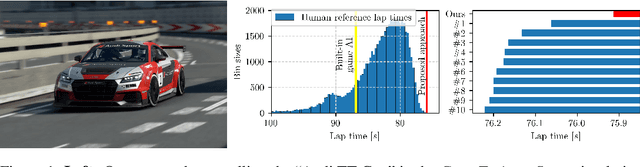
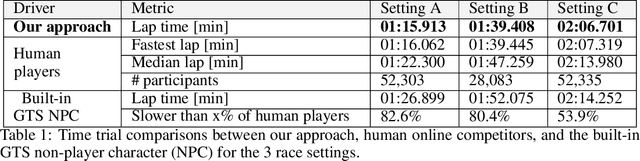
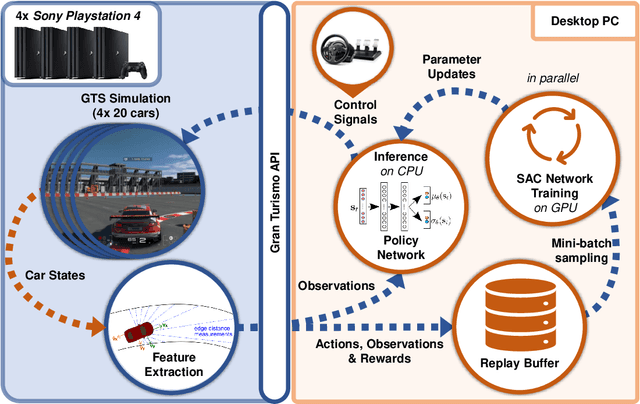
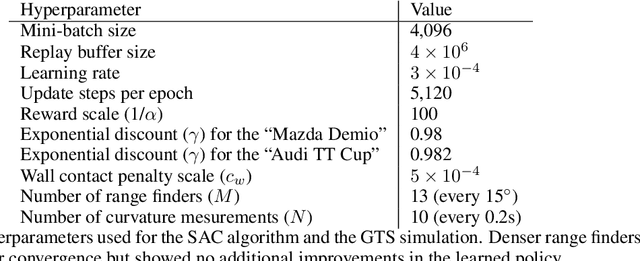
Autonomous car racing raises fundamental robotics challenges such as planning minimum-time trajectories under uncertain dynamics and controlling the car at its friction limits. In this project, we consider the task of autonomous car racing in the top-selling car racing game Gran Turismo Sport. Gran Turismo Sport is known for its detailed physics simulation of various cars and tracks. Our approach makes use of maximum-entropy deep reinforcement learning and a new reward design to train a sensorimotor policy to complete a given race track as fast as possible. We evaluate our approach in three different time trial settings with different cars and tracks. Our results show that the obtained controllers not only beat the built-in non-player character of Gran Turismo Sport, but also outperform the fastest known times in a dataset of personal best lap times of over 50,000 human drivers.