 Add to Chrome
 Add to Firefox
 Add to Edge
Preserving In-Context Learning ability in Large Language Model Fine-tuning
Nov 01, 2022
Pretrained large language models (LLMs) are strong in-context learners that are able to perform few-shot learning without changing model parameters. However, as we show, fine-tuning an LLM on any specific task generally destroys its in-context ability. We discover an important cause of this loss, format specialization, where the model overfits to the format of the fine-tuned task and is unable to output anything beyond this format. We further show that format specialization happens at the beginning of fine-tuning. To solve this problem, we propose Prompt Tuning with MOdel Tuning (ProMoT), a simple yet effective two-stage fine-tuning framework that preserves in-context abilities of the pretrained model. ProMoT first trains a soft prompt for the fine-tuning target task, and then fine-tunes the model itself with this soft prompt attached. ProMoT offloads task-specific formats into the soft prompt that can be removed when doing other in-context tasks. We fine-tune mT5 XXL with ProMoT on natural language inference (NLI) and English-French translation and evaluate the in-context abilities of the resulting models on 8 different NLP tasks. ProMoT achieves similar performance on the fine-tuned tasks compared with vanilla fine-tuning, but with much less reduction of in-context learning performances across the board. More importantly, ProMoT shows remarkable generalization ability on tasks that have different formats, e.g. fine-tuning on a NLI binary classification task improves the model's in-context ability to do summarization (+0.53 Rouge-2 score compared to the pretrained model), making ProMoT a promising method to build general purpose capabilities such as grounding and reasoning into LLMs with small but high quality datasets. When extended to sequential or multi-task training, ProMoT can achieve even better out-of-domain generalization performance.

Large Models are Parsimonious Learners: Activation Sparsity in Trained Transformers
Oct 12, 2022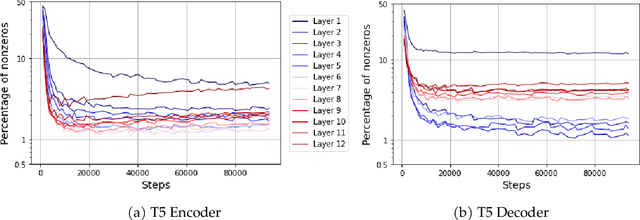

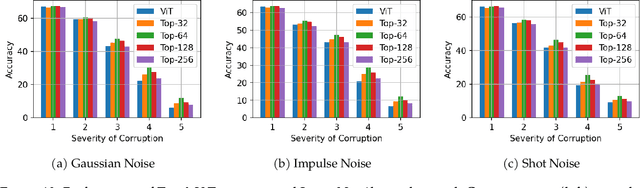
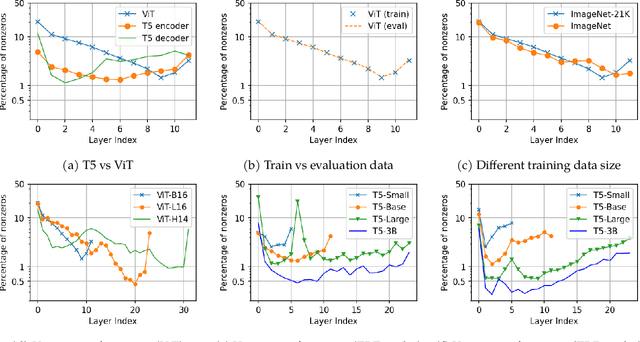
This paper studies the curious phenomenon for machine learning models with Transformer architectures that their activation maps are sparse. By activation map we refer to the intermediate output of the multi-layer perceptrons (MLPs) after a ReLU activation function, and by "sparse" we mean that on average very few entries (e.g., 3.0% for T5-Base and 6.3% for ViT-B16) are nonzero for each input to MLP. Moreover, larger Transformers with more layers and wider MLP hidden dimensions are sparser as measured by the percentage of nonzero entries. Through extensive experiments we demonstrate that the emergence of sparsity is a prevalent phenomenon that occurs for both natural language processing and vision tasks, on both training and evaluation data, for Transformers of various configurations, at layers of all depth levels, as well as for other architectures including MLP-mixers and 2-layer MLPs. We show that sparsity also emerges using training datasets with random labels, or with random inputs, or with infinite amount of data, demonstrating that sparsity is not a result of a specific family of datasets. We discuss how sparsity immediately implies a way to significantly reduce the FLOP count and improve efficiency for Transformers. Moreover, we demonstrate perhaps surprisingly that enforcing an even sparser activation via Top-k thresholding with a small value of k brings a collection of desired but missing properties for Transformers, namely less sensitivity to noisy training data, more robustness to input corruptions, and better calibration for their prediction confidence.
FedDM: Iterative Distribution Matching for Communication-Efficient Federated Learning
Jul 20, 2022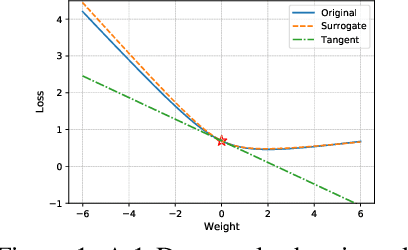
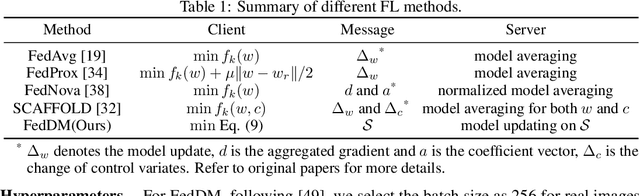
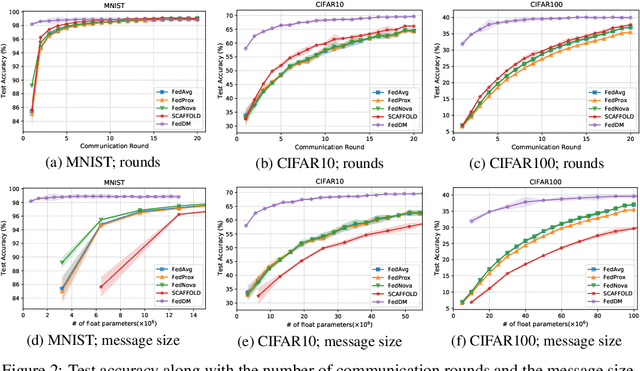
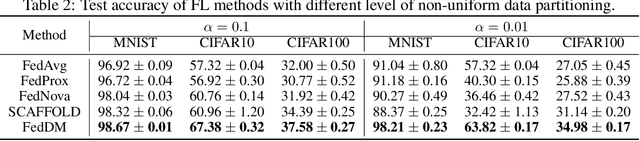
Federated learning~(FL) has recently attracted increasing attention from academia and industry, with the ultimate goal of achieving collaborative training under privacy and communication constraints. Existing iterative model averaging based FL algorithms require a large number of communication rounds to obtain a well-performed model due to extremely unbalanced and non-i.i.d data partitioning among different clients. Thus, we propose FedDM to build the global training objective from multiple local surrogate functions, which enables the server to gain a more global view of the loss landscape. In detail, we construct synthetic sets of data on each client to locally match the loss landscape from original data through distribution matching. FedDM reduces communication rounds and improves model quality by transmitting more informative and smaller synthesized data compared with unwieldy model weights. We conduct extensive experiments on three image classification datasets, and results show that our method can outperform other FL counterparts in terms of efficiency and model performance. Moreover, we demonstrate that FedDM can be adapted to preserve differential privacy with Gaussian mechanism and train a better model under the same privacy budget.
Correlated quantization for distributed mean estimation and optimization
Mar 09, 2022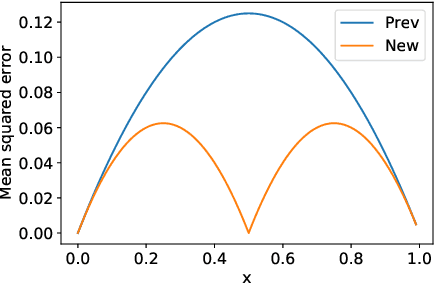
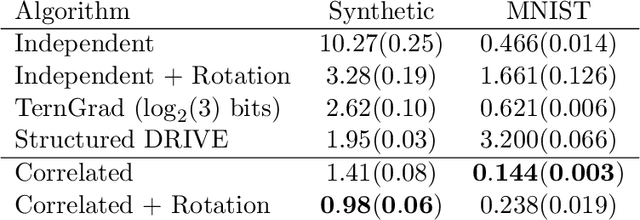
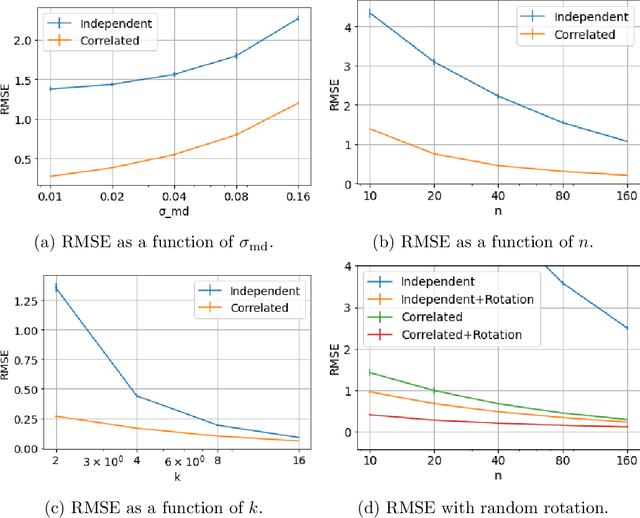
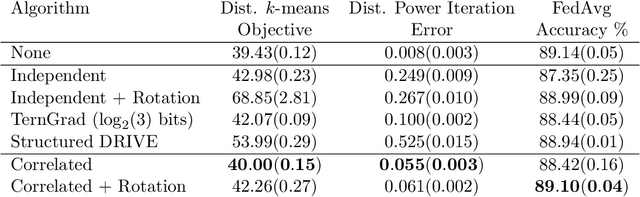
We study the problem of distributed mean estimation and optimization under communication constraints. We propose a correlated quantization protocol whose error guarantee depends on the deviation of data points instead of their absolute range. The design doesn't need any prior knowledge on the concentration property of the dataset, which is required to get such dependence in previous works. We show that applying the proposed protocol as sub-routine in distributed optimization algorithms leads to better convergence rates. We also prove the optimality of our protocol under mild assumptions. Experimental results show that our proposed algorithm outperforms existing mean estimation protocols on a diverse set of tasks.
HD-cos Networks: Efficient Neural Architectures for Secure Multi-Party Computation
Oct 28, 2021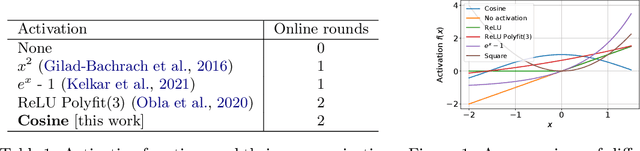
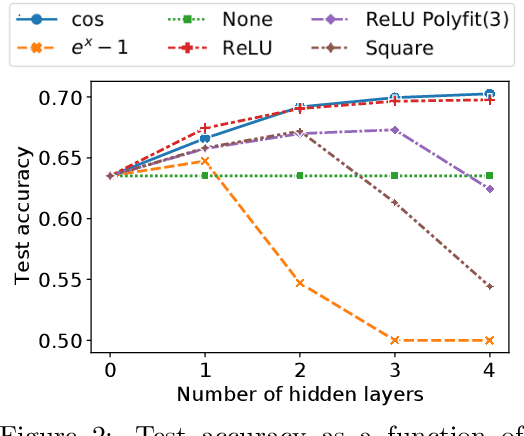
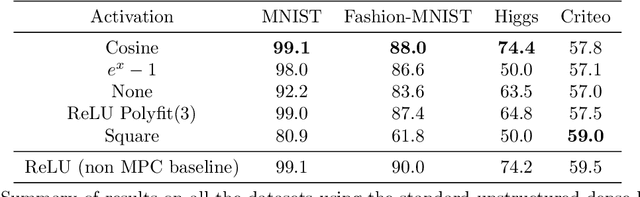

Multi-party computation (MPC) is a branch of cryptography where multiple non-colluding parties execute a well designed protocol to securely compute a function. With the non-colluding party assumption, MPC has a cryptographic guarantee that the parties will not learn sensitive information from the computation process, making it an appealing framework for applications that involve privacy-sensitive user data. In this paper, we study training and inference of neural networks under the MPC setup. This is challenging because the elementary operations of neural networks such as the ReLU activation function and matrix-vector multiplications are very expensive to compute due to the added multi-party communication overhead. To address this, we propose the HD-cos network that uses 1) cosine as activation function, 2) the Hadamard-Diagonal transformation to replace the unstructured linear transformations. We show that both of the approaches enjoy strong theoretical motivations and efficient computation under the MPC setup. We demonstrate on multiple public datasets that HD-cos matches the quality of the more expensive baselines.
InFillmore: Neural Frame Lexicalization for Narrative Text Infilling
Mar 08, 2021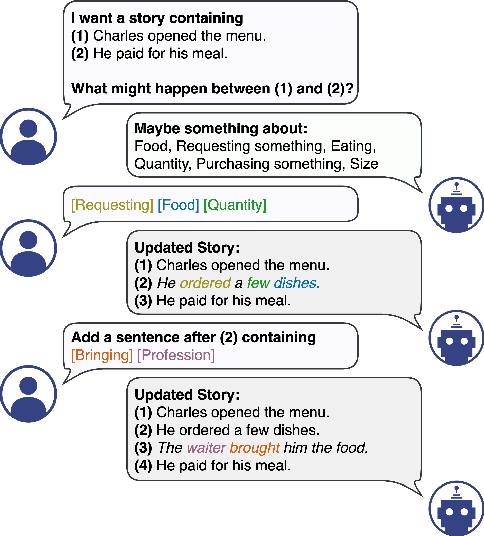
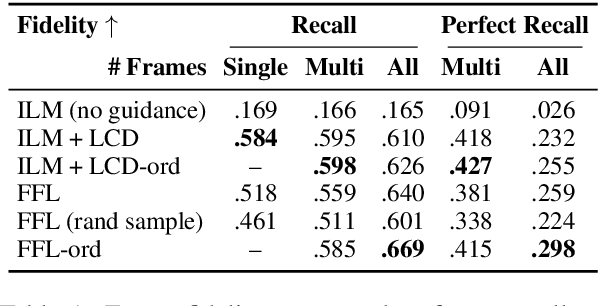
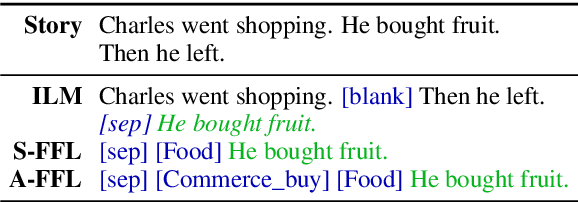
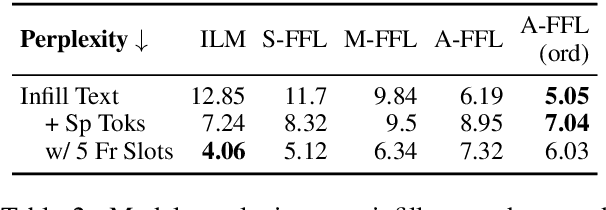
We propose a structured extension to bidirectional-context conditional language generation, or "infilling," inspired by Frame Semantic theory (Fillmore, 1976). Guidance is provided through two approaches: (1) model fine-tuning, conditioning directly on observed symbolic frames, and (2) a novel extension to disjunctive lexically constrained decoding that leverages frame semantic lexical units. Automatic and human evaluations confirm that frame-guided generation allows for explicit manipulation of intended infill semantics, with minimal loss of indistinguishability from the human-generated text. Our methods flexibly apply to a variety of use scenarios, and we provide an interactive web demo available at https://nlp.jhu.edu/demos.
Modifying Memories in Transformer Models
Dec 01, 2020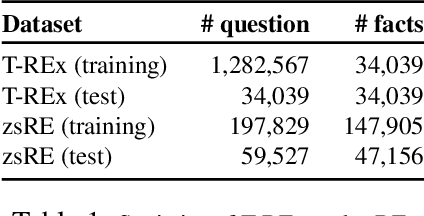

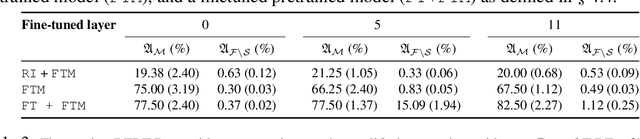
Large Transformer models have achieved impressive performance in many natural language tasks. In particular, Transformer based language models have been shown to have great capabilities in encoding factual knowledge in their vast amount of parameters. While the tasks of improving the memorization and generalization of Transformers have been widely studied, it is not well known how to make transformers forget specific old facts and memorize new ones. In this paper, we propose a new task of \emph{explicitly modifying specific factual knowledge in Transformer models while ensuring the model performance does not degrade on the unmodified facts}. This task is useful in many scenarios, such as updating stale knowledge, protecting privacy, and eliminating unintended biases stored in the models. We benchmarked several approaches that provide natural baseline performances on this task. This leads to the discovery of key components of a Transformer model that are especially effective for knowledge modifications. The work also provides insights into the role that different training phases (such as pretraining and fine-tuning) play towards memorization and knowledge modification.
Semantic Label Smoothing for Sequence to Sequence Problems
Oct 15, 2020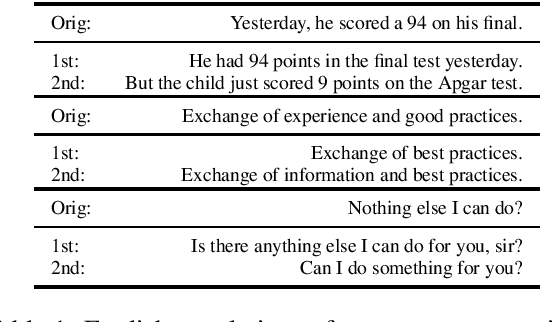
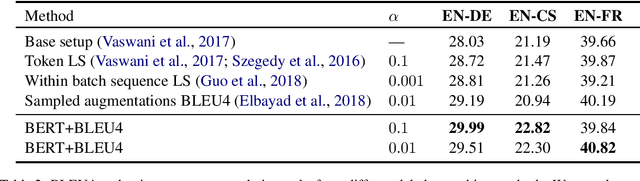

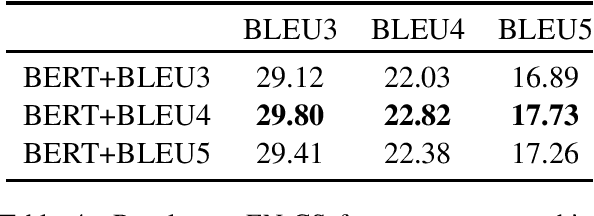
Label smoothing has been shown to be an effective regularization strategy in classification, that prevents overfitting and helps in label de-noising. However, extending such methods directly to seq2seq settings, such as Machine Translation, is challenging: the large target output space of such problems makes it intractable to apply label smoothing over all possible outputs. Most existing approaches for seq2seq settings either do token level smoothing, or smooth over sequences generated by randomly substituting tokens in the target sequence. Unlike these works, in this paper, we propose a technique that smooths over \emph{well formed} relevant sequences that not only have sufficient n-gram overlap with the target sequence, but are also \emph{semantically similar}. Our method shows a consistent and significant improvement over the state-of-the-art techniques on different datasets.
Learning discrete distributions: user vs item-level privacy
Jul 28, 2020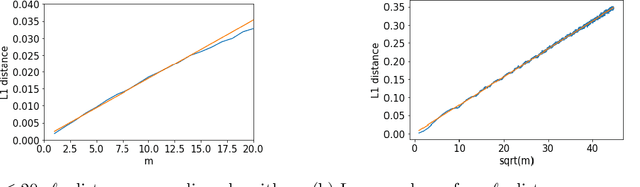
Much of the literature on differential privacy focuses on item-level privacy, where loosely speaking, the goal is to provide privacy per item or training example. However, recently many practical applications such as federated learning require preserving privacy for all items of a single user, which is much harder to achieve. Therefore understanding the theoretical limit of user-level privacy becomes crucial. We study the fundamental problem of learning discrete distributions over $k$ symbols with user-level differential privacy. If each user has $m$ samples, we show that straightforward applications of Laplace or Gaussian mechanisms require the number of users to be $\mathcal{O}(k/(m\alpha^2) + k/\epsilon\alpha)$ to achieve an $\ell_1$ distance of $\alpha$ between the true and estimated distributions, with the privacy-induced penalty $k/\epsilon\alpha$ independent of the number of samples per user $m$. Moreover, we show that any mechanism that only operates on the final aggregate should require a user complexity of the same order. We then propose a mechanism such that the number of users scales as $\tilde{\mathcal{O}}(k/(m\alpha^2) + k/\sqrt{m}\epsilon\alpha)$ and further show that it is nearly-optimal under certain regimes. Thus the privacy penalty is $\mathcal{O}(\sqrt{m})$ times smaller compared to the standard mechanisms. We also propose general techniques for obtaining lower bounds on restricted differentially private estimators and a lower bound on the total variation between binomial distributions, both of which might be of independent interest.
Self-supervised Learning for Deep Models in Recommendations
Jul 25, 2020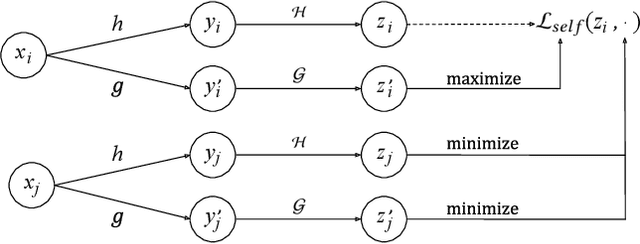
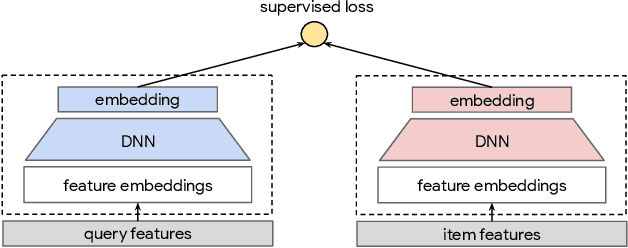
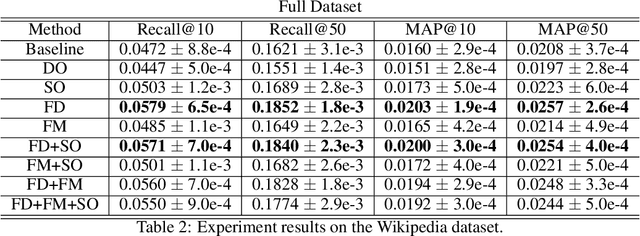
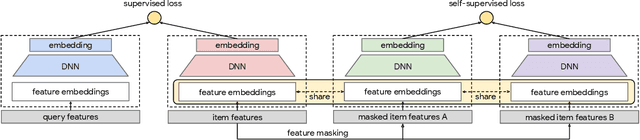
Large scale neural recommender models play a critical role in modern search and recommendation systems. To model large-vocab sparse categorical features, typical recommender models learn a joint embedding space for both queries and items. With millions to billions of items to choose from, the quality of learned embedding representations is crucial to provide high quality recommendations to users with various interests. Inspired by the recent success in self-supervised representation learning research in both computer vision and natural language understanding, we propose a multi-task self-supervised learning (SSL) framework for sparse neural models in recommendations. Furthermore, we propose two highly generalizable self-supervised learning tasks: (i) Feature Masking (FM) and (ii) Feature Dropout (FD) within the proposed SSL framework. We evaluate our framework using two large-scale datasets with ~500M and 1B training examples respectively. Our results demonstrate that the proposed framework outperforms baseline models and state-of-the-art spread-out regularization techniques in the context of retrieval. The SSL framework shows larger improvement with less supervision compared to the counterparts.