 Add to Chrome
 Add to Firefox
 Add to Edge
Hierarchical Audio-Visual-Proprioceptive Fusion for Precise Robotic Manipulation
Feb 14, 2026
Existing robotic manipulation methods primarily rely on visual and proprioceptive observations, which may struggle to infer contact-related interaction states in partially observable real-world environments. Acoustic cues, by contrast, naturally encode rich interaction dynamics during contact, yet remain underexploited in current multimodal fusion literature. Most multimodal fusion approaches implicitly assume homogeneous roles across modalities, and thus design flat and symmetric fusion structures. However, this assumption is ill-suited for acoustic signals, which are inherently sparse and contact-driven. To achieve precise robotic manipulation through acoustic-informed perception, we propose a hierarchical representation fusion framework that progressively integrates audio, vision, and proprioception. Our approach first conditions visual and proprioceptive representations on acoustic cues, and then explicitly models higher-order cross-modal interactions to capture complementary dependencies among modalities. The fused representation is leveraged by a diffusion-based policy to directly generate continuous robot actions from multimodal observations. The combination of end-to-end learning and hierarchical fusion structure enables the policy to exploit task-relevant acoustic information while mitigating interference from less informative modalities. The proposed method has been evaluated on real-world robotic manipulation tasks, including liquid pouring and cabinet opening. Extensive experiment results demonstrate that our approach consistently outperforms state-of-the-art multimodal fusion frameworks, particularly in scenarios where acoustic cues provide task-relevant information not readily available from visual observations alone. Furthermore, a mutual information analysis is conducted to interpret the effect of audio cues in robotic manipulation via multimodal fusion.

Safe Planner: Empowering Safety Awareness in Large Pre-Trained Models for Robot Task Planning
Nov 11, 2024

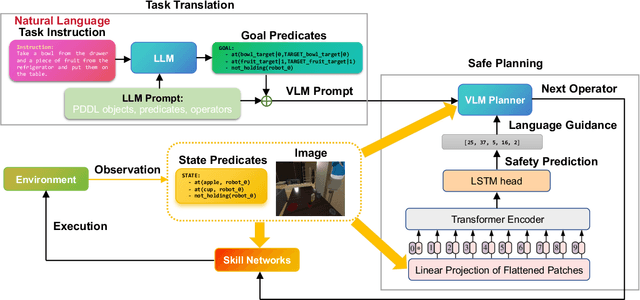

Robot task planning is an important problem for autonomous robots in long-horizon challenging tasks. As large pre-trained models have demonstrated superior planning ability, recent research investigates utilizing large models to achieve autonomous planning for robots in diverse tasks. However, since the large models are pre-trained with Internet data and lack the knowledge of real task scenes, large models as planners may make unsafe decisions that hurt the robots and the surrounding environments. To solve this challenge, we propose a novel Safe Planner framework, which empowers safety awareness in large pre-trained models to accomplish safe and executable planning. In this framework, we develop a safety prediction module to guide the high-level large model planner, and this safety module trained in a simulator can be effectively transferred to real-world tasks. The proposed Safe Planner framework is evaluated on both simulated environments and real robots. The experiment results demonstrate that Safe Planner not only achieves state-of-the-art task success rates, but also substantially improves safety during task execution. The experiment videos are shown in https://sites.google.com/view/safeplanner .