 Add to Chrome
 Add to Firefox
 Add to Edge
Low-Complexity Tensor-Based Monostatic Sensing for IRS-Assisted Communication Systems
May 27, 2026
This paper proposes a tensor-based parameter estimation algorithm for sensing in an intelligent reflecting surface-assisted system. We present a higher-order singular value decomposition-based solution that exploits the tensor structure of the received echo signal to jointly estimate the target's delay, Doppler, and angular information. Our tensor-based solution can estimate the parameters individually at low complexity, benefiting from parallel computation. Complexity analysis is carried out in comparison with a baseline scheme that does not exploit the intrinsic multilinear structure of the sensed signal. Simulation results show that our proposed tensor-based method can achieve the same performance as the reference method while drastically reducing the computational complexity.

PARAFAC-Based Time-Varying Channel Estimation for IRS-Aided Communications
May 27, 2026This paper proposes a tensor-based parametric channel estimation technique for IRS-assisted communication systems with time-varying channel parameters. We exploit the multidimensional structure of the received signal by developing a $3$rd-order PARAFAC tensor model that is solved by employing the iteratively ALS algorithm. Our simulation results show that the proposed approach provides enhanced performance in terms of NMSE of the concatenated channel compared to the competing solutions by capitalizing on the intrinsic tensor structure of the received signal without increasing the computational complexity of the channel estimation.
Decoupled Delay-Doppler and Angle Estimation in BD-RIS Sensing via Nested Tucker Decomposition
May 26, 2026We study single-target localization in a group-connected beyond-diagonal reconfigurable intelligent surface (BD-RIS)-assisted monostatic network with K element groups. We propose a Nested Tensor Factorization and Estimation (NTFE) algorithm that models the received signal as a 3rd-order nested Tucker tensor, decoupling the delay-Doppler and angle domains. The resulting two-stage procedure estimates the target-bearing tensor factors and then extracts the other physical parameters using subspace and closed-form steps. We also analyze identifiability and uniqueness conditions. Simulations show that NTFE exploits the group-connected BD-RIS structure and outperforms state-of-the-art sensing benchmarks.
Least-Squares Khatri-Rao Factorization of a Polynomial Matrix
Mar 29, 2025The Khatri-Rao product is extensively used in array processing, tensor decomposition, and multi-way data analysis. Many applications require a least-squares (LS) Khatri-Rao factorization. In broadband sensor array problems, polynomial matrices effectively model frequency-dependent behaviors, necessitating extensions of conventional linear algebra techniques. This paper generalizes LS Khatri-Rao factorization from ordinary to polynomial matrices by applying it to the discrete Fourier transform (DFT) samples of polynomial matrices. Phase coherence across bin-wise Khatri-Rao factors is ensured via a phasesmoothing algorithm. The proposed method is validated through broadband angle-of-arrival (AoA) estimation for uniform planar arrays (UPAs), where the steering matrix is a polynomial matrix, which can be represented as a Khatri-Rao product between steering matrix in azimuth and elevation directions.
A Decoupled Channel Estimation Method for Beyond Diagonal RIS
Dec 09, 2024Beyond diagonal reconfigurable intelligent surface (BD-RIS) is a new architecture for RIS where elements are interconnected to provide more wave manipulation flexibility than traditional single connected RIS, enhancing data rate and coverage. However, channel estimation for BD-RIS is challenging due to the more complex multiple-connection structure involving their scattering elements. To address this issue, this paper proposes a decoupled channel estimation method for BD-RIS that yields separate estimates of the involved channels to enhance the accuracy of the overall combined channel by capitalizing on its Kronecker structure. Starting from a least squares estimate of the combined channel and by properly reshaping the resulting filtered signal, the proposed algorithm resorts to a Khatri-Rao Factorization (KRF) method that teases out the individual channels based on simple rank-one matrix approximation steps. Numerical results show that the proposed decoupled channel estimation yields more accurate channel estimates than the classical least squares scheme.
RIS-Assisted Sensing: A Nested Tensor Decomposition-Based Approach
Dec 03, 2024


We study a monostatic multiple-input multiple-output sensing scenario assisted by a reconfigurable intelligent surface using tensor signal modeling. We propose a method that exploits the intrinsic multidimensional structure of the received echo signal, allowing us to recast the target sensing problem as a nested tensor-based decomposition problem to jointly estimate the delay, Doppler, and angular information of the target. We derive a two-stage approach based on the alternating least squares algorithm followed by the estimation of the signal parameters via rotational invariance techniques to extract the target parameters. Simulation results show that the proposed tensor-based algorithm yields accurate estimates of the sensing parameters with low complexity.
Interference mitigation with block diagonalization for IRS-aided MU-MIMO communications
Jun 29, 2023


This work investigates interference mitigation techniques in multi-user multiple input multiple output (MU-MIMO) Intelligent Reflecting Surface (IRS)-aided networks, focusing on the base station end. Two methods of precoder design based on block diagonalization are proposed. The first method does not consider the interference caused by the IRS, seeking to mitigate only the multi-user interference. The second method mitigates both the IRS-caused interference and the multi-user interference. A comparison between both methods within an no-IRS MU-MIMO network with strong direct links is provided. The results show that, although in some circumstances IRS interference can be neglected, treating it can improve system capacity and provide higher spectral efficiency
Tensor-based modeling/estimation of static channels in IRS-assisted MIMO systems
Jun 21, 2023This paper proposes a tensor-based parametric modeling and estimation framework in multiple-input multiple-output (MIMO) systems assisted by intelligent reflecting surfaces (IRSs). We present two algorithms that exploit the tensor structure of the received pilot signal to estimate the concatenated channel. The first one is an iterative solution based on the alternating least squares algorithm. In contrast, the second method provides closed-form estimates of the involved parameters using the high order single value decomposition. Our numerical results show that our proposed tensor-based methods provide improved performance compared to competing state-of-the-art channel estimation schemes, thanks to the exploitation of the algebraic tensor structure of the combined channel without additional computational complexity.
Tensor-Based Channel Estimation and Data-Aided Tracking in IRS-Assisted MIMO Systems
May 17, 2023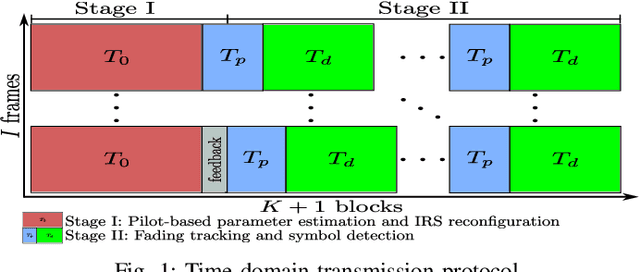

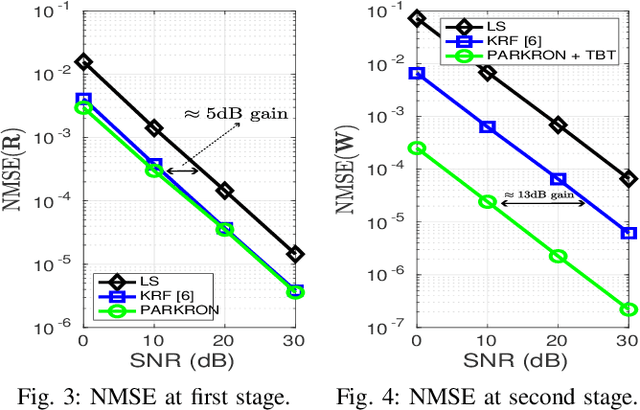

This letter proposes a model for symbol detection in the uplink of IRS-assisted networks in the presence of channel aging. During the first stage, we model the received pilot signal as a tensor, which serves as a basis for both estimating the channel and configuring the IRS. In the second stage, the proposed tensor approach tracks the aging process to detect and estimate the transmitted data symbols. Our evaluations show that our proposed channel and symbol estimation schemes improve the performance of IRS-assisted systems in terms of the achieved bit error rate and mean squared error of the received data, compared to state of the art schemes.
Two-Dimensional Channel Parameter Estimation for IRS-Assisted Networks
May 07, 2023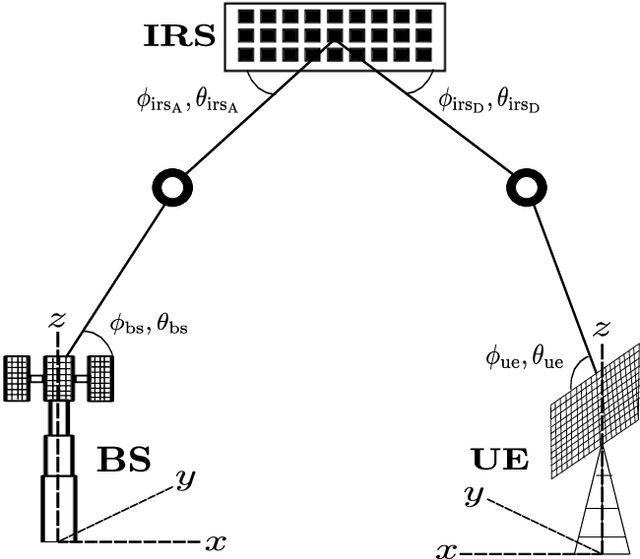
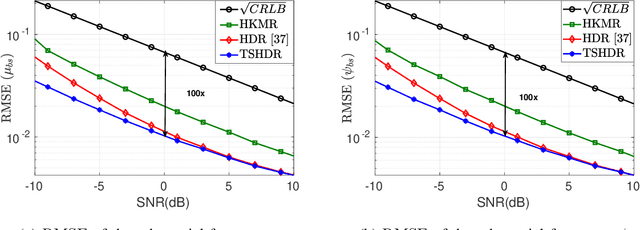
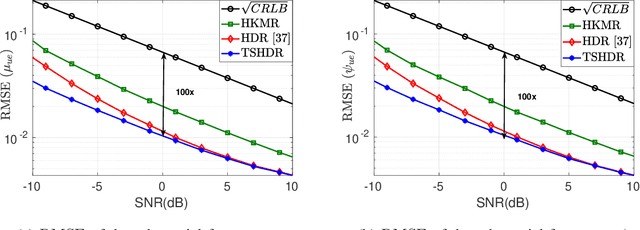
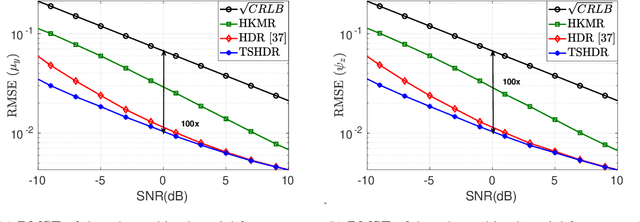
This paper proposes a pilot decoupling-based two-dimensional channel parameter estimation method for intelligent reflecting surface (IRS)-assisted networks. We exploit the combined effect of Terahertz sparse propagation and the geometrical structure of arrays deployed at the base station, the IRS, and the user equipment to develop a low-complexity channel parameter estimation method. By means of a new pilot design along the horizontal and vertical domains, the overall channel parameter estimation problem is decoupled into different domains. Furthermore, with this decoupling, it is possible to simultaneously sense/estimate the channel parameters and to communicate with the sensed node. Specifically, we derive two estimators by decoupling the global problem into sub-problems and exploiting the built-in tensor structure of the sensing/estimation problem by means of multiple rank-one approximations. The Cram\'er-Rao lower bound is derived to assess the performance of the proposed estimators. We show that the two proposed methods yield accurate parameter estimates and outperform state-of-the-art methods in terms of complexity. The tradeoffs between performance and complexity offered by the proposed methods are discussed and numerically assessed.