 Add to Chrome
 Add to Firefox
 Add to Edge
Decoupled Azimuth Elevation AoA Estimation Exploiting Kronecker Separable Steering Matrices
May 13, 2026
Uniform rectangular arrays (URA), structured non-uniform rectangular arrays (NURA), and parallelogram shaped (UPgA and NUPgA) arrays admit steering vectors that can be expressed as the Kronecker product of azimuth and elevation steering vectors. Accordingly, the full steering matrix can be represented as the Khatri Rao product of the corresponding azimuth and elevation steering matrices. This paper exploits this structure to develop an economical subspace decoupling framework for two dimensional angle of arrival (AoA) estimation. The proposed method first extracts the joint signal subspace from the spatial covariance matrix. Then it applies a low complexity decoupling scheme to recover the column spaces of the azimuth and elevation steering matrices. With the estimated decoupled subspaces, conventional one dimensional algorithms such as MUSIC, root MUSIC, and ESPRIT can be applied independently along each dimension, followed by pairing through a two dimensional spectral function. Monte Carlo simulations show that the proposed approach achieves higher accuracy than state of the art methods, i.e., two dimensional MUSIC, reduced-dimension MUSIC, and two-dimensional ESPRIT, for medium- and large scale arrays while requiring fewer snapshots, consequently with improved spectral efficiency.

Least-Squares Khatri-Rao Factorization of a Polynomial Matrix
Mar 29, 2025The Khatri-Rao product is extensively used in array processing, tensor decomposition, and multi-way data analysis. Many applications require a least-squares (LS) Khatri-Rao factorization. In broadband sensor array problems, polynomial matrices effectively model frequency-dependent behaviors, necessitating extensions of conventional linear algebra techniques. This paper generalizes LS Khatri-Rao factorization from ordinary to polynomial matrices by applying it to the discrete Fourier transform (DFT) samples of polynomial matrices. Phase coherence across bin-wise Khatri-Rao factors is ensured via a phasesmoothing algorithm. The proposed method is validated through broadband angle-of-arrival (AoA) estimation for uniform planar arrays (UPAs), where the steering matrix is a polynomial matrix, which can be represented as a Khatri-Rao product between steering matrix in azimuth and elevation directions.
Impact of Estimation Errors of a Matrix of Transfer Functions onto Its Analytic Singular Values and Their Potential Algorithmic Extraction
Sep 30, 2024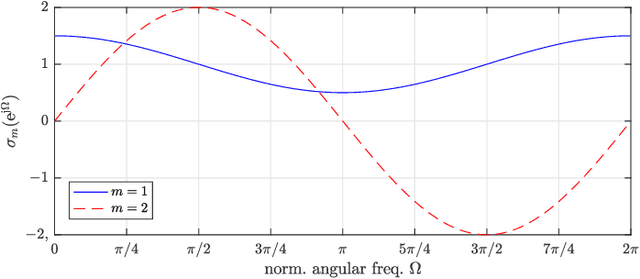
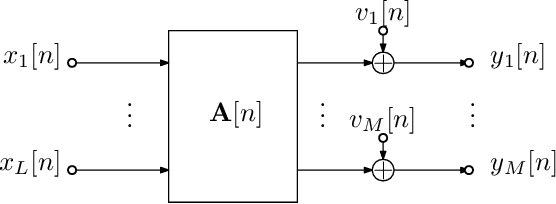

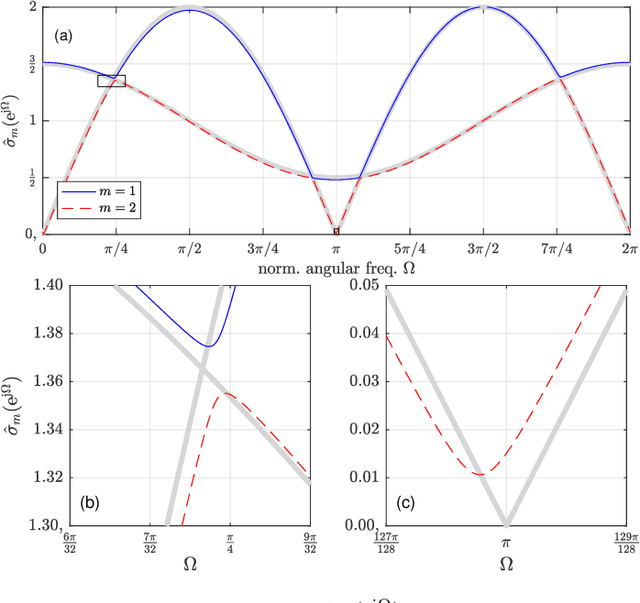
A matrix of analytic functions A(z), such as the matrix of transfer functions in a multiple-input multiple-output (MIMO) system, generally admits an analytic singular value decomposition (SVD), where the singular values themselves are functions. When evaluated on the unit circle, for the sake of analyticity, these singular values must be permitted of become negative. In this paper, we address how the estimation of such a matrix, causing a stochastic perturbation of A}(z), results in fundamental changes to the analytic singular values: for the perturbed system, we show that their analytic singular values lose any algebraic multiplicities and are strictly non-negative with probability one. We present examples and highlight the impact that this has on algorithmic solutions to extracting an analytic or approximate analytic SVD.