 Add to Chrome
 Add to Firefox
 Add to Edge
Ling and Ring 2.6 Technical Report: Efficient and Instant Agentic Intelligence at Trillion-Parameter Scale
Jun 13, 2026
Efficient and scalable agentic intelligence requires models that can deliver both low-latency responses and strong reasoning capabilities while remaining practical to train, serve, and deploy. In this report, we present Ling-2.6 and Ring-2.6, a family of models designed to address this challenge at scale. Ling-2.6 is optimized for instant response generation and high capability per output token, whereas Ring-2.6 is tailored for deeper reasoning and more advanced agentic workflows. Instead of training from scratch, we upgrade the Ling-2.0 base model through architectural migration pre-training and large-scale post-training. This upgrade is guided by a unified co-design of model architecture, optimization objectives, serving systems, and agent training environments, enabling improvements in both model capability and deployment efficiency. At the architectural level, we introduce a hybrid linear attention design that integrates Lightning Attention with MLA, improving the efficiency of long-context training and decoding. To further enhance token efficiency, we optimize capability per output token through Evolutionary Chain-of-Thought, Linguistic Unit Policy Optimization, bidirectional preference alignment, and shortest-correct-response distillation. For agentic capabilities, we propose KPop, a reinforcement learning framework designed to support stable training of Ring-2.6-1T on large-scale environment-grounded data. KPop improves training efficiency through asynchronous scheduling across coding, search, tool use, and workflow execution, enabling scalable learning from complex agent-environment interactions. Together, Ling-2.6 and Ring-2.6 provide a practical pathway toward efficient, scalable, and open agentic systems. We open-source all checkpoints in the 2.6 family to support further research and development in practical agentic intelligence.

Every Step Evolves: Scaling Reinforcement Learning for Trillion-Scale Thinking Model
Oct 21, 2025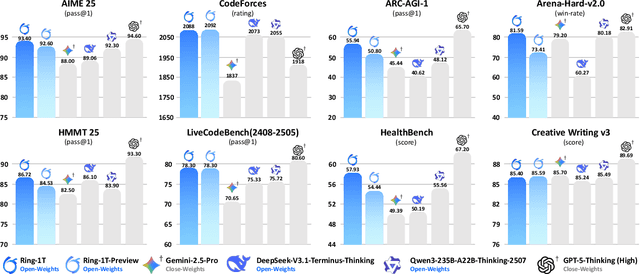
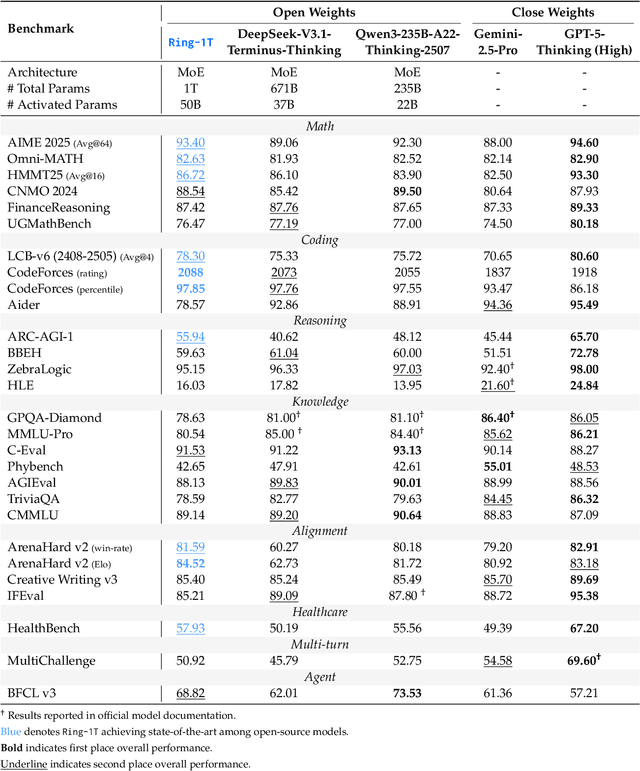
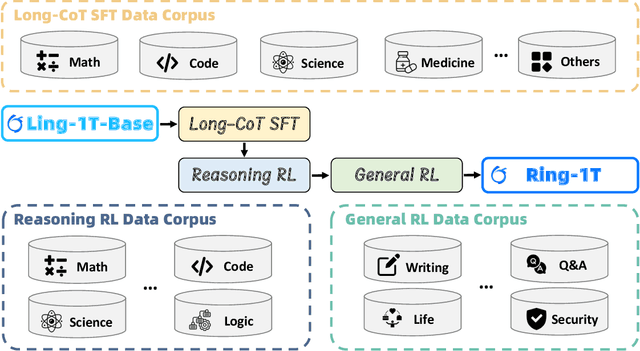
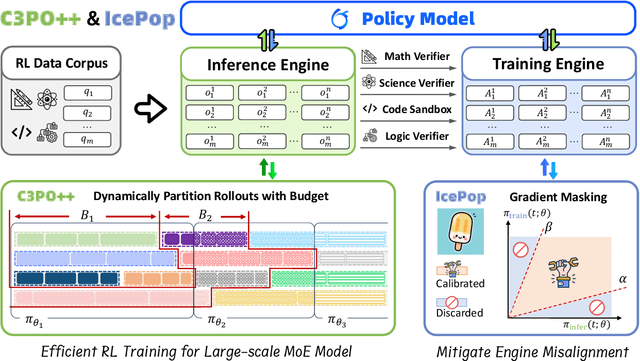
We present Ring-1T, the first open-source, state-of-the-art thinking model with a trillion-scale parameter. It features 1 trillion total parameters and activates approximately 50 billion per token. Training such models at a trillion-parameter scale introduces unprecedented challenges, including train-inference misalignment, inefficiencies in rollout processing, and bottlenecks in the RL system. To address these, we pioneer three interconnected innovations: (1) IcePop stabilizes RL training via token-level discrepancy masking and clipping, resolving instability from training-inference mismatches; (2) C3PO++ improves resource utilization for long rollouts under a token budget by dynamically partitioning them, thereby obtaining high time efficiency; and (3) ASystem, a high-performance RL framework designed to overcome the systemic bottlenecks that impede trillion-parameter model training. Ring-1T delivers breakthrough results across critical benchmarks: 93.4 on AIME-2025, 86.72 on HMMT-2025, 2088 on CodeForces, and 55.94 on ARC-AGI-v1. Notably, it attains a silver medal-level result on the IMO-2025, underscoring its exceptional reasoning capabilities. By releasing the complete 1T parameter MoE model to the community, we provide the research community with direct access to cutting-edge reasoning capabilities. This contribution marks a significant milestone in democratizing large-scale reasoning intelligence and establishes a new baseline for open-source model performance.
AntBatchInfer: Elastic Batch Inference in the Kubernetes Cluster
Apr 15, 2024

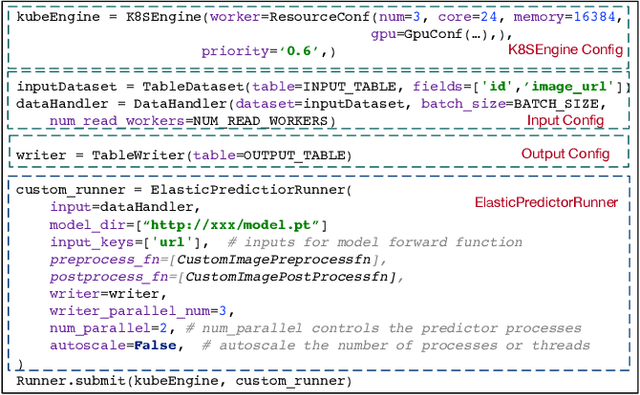

Offline batch inference is a common task in the industry for deep learning applications, but it can be challenging to ensure stability and performance when dealing with large amounts of data and complicated inference pipelines. This paper demonstrated AntBatchInfer, an elastic batch inference framework, which is specially optimized for the non-dedicated cluster. AntBatchInfer addresses these challenges by providing multi-level fault-tolerant capabilities, enabling the stable execution of versatile and long-running inference tasks. It also improves inference efficiency by pipelining, intra-node, and inter-node scaling. It further optimizes the performance in complicated multiple-model batch inference scenarios. Through extensive experiments and real-world statistics, we demonstrate the superiority of our framework in terms of stability and efficiency. In the experiment, it outperforms the baseline by at least $2\times$ and $6\times$ in the single-model or multiple-model batch inference. Also, it is widely used at Ant Group, with thousands of daily jobs from various scenarios, including DLRM, CV, and NLP, which proves its practicability in the industry.
Rethinking Memory and Communication Cost for Efficient Large Language Model Training
Oct 09, 2023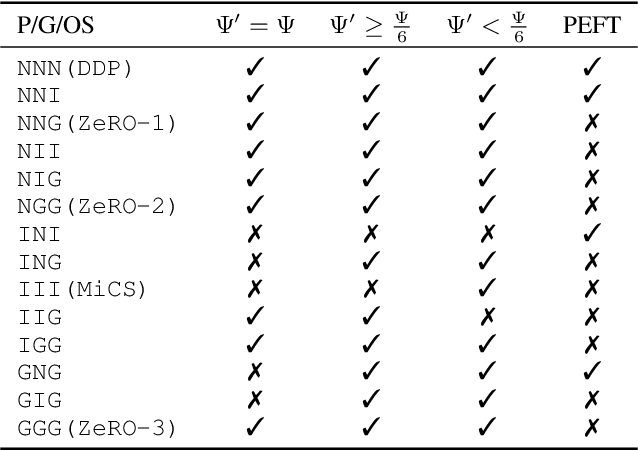
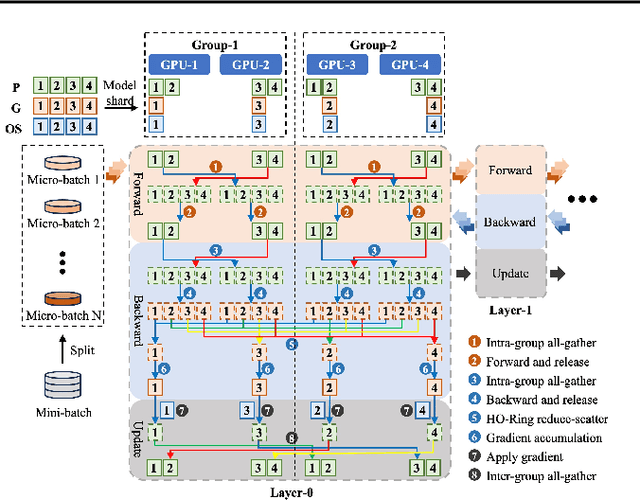
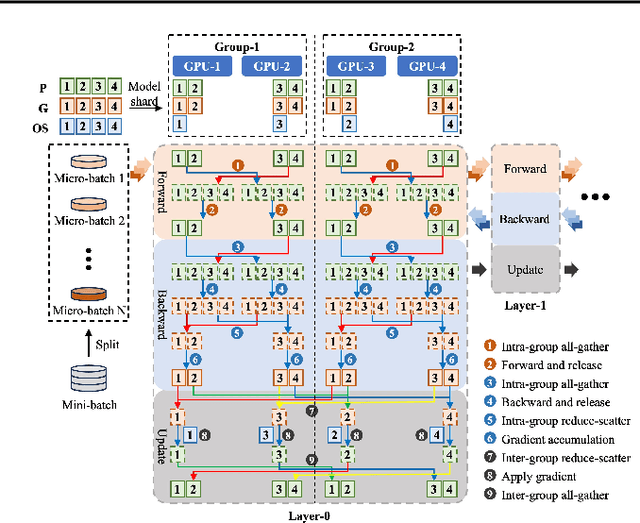
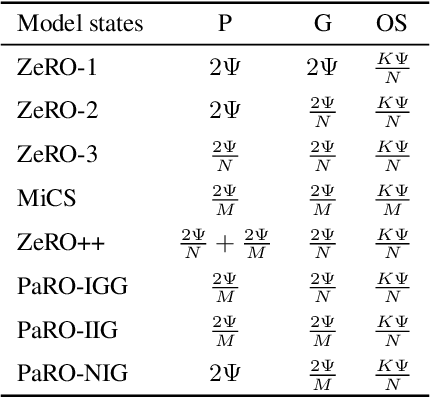
As model sizes and training datasets continue to increase, large-scale model training frameworks reduce memory consumption by various sharding techniques. However, the huge communication overhead reduces the training efficiency, especially in public cloud environments with varying network bandwidths. In this paper, we rethink the impact of memory consumption and communication overhead on the training speed of large language model, and propose a memory-communication balanced \underline{Pa}rtial \underline{R}edundancy \underline{O}ptimizer (PaRO). PaRO reduces the amount and frequency of inter-group communication by grouping GPU clusters and introducing minor intra-group memory redundancy, thereby improving the training efficiency of the model. Additionally, we propose a Hierarchical Overlapping Ring (HO-Ring) communication topology to enhance communication efficiency between nodes or across switches in large model training. Our experiments demonstrate that the HO-Ring algorithm improves communication efficiency by 32.6\% compared to the traditional Ring algorithm. Compared to the baseline ZeRO, PaRO significantly improves training throughput by 1.2x-2.6x and achieves a near-linear scalability. Therefore, the PaRO strategy provides more fine-grained options for the trade-off between memory consumption and communication overhead in different training scenarios.