 Add to Chrome
 Add to Firefox
 Add to Edge
NewsBERT: Distilling Pre-trained Language Model for Intelligent News Application
Feb 09, 2021
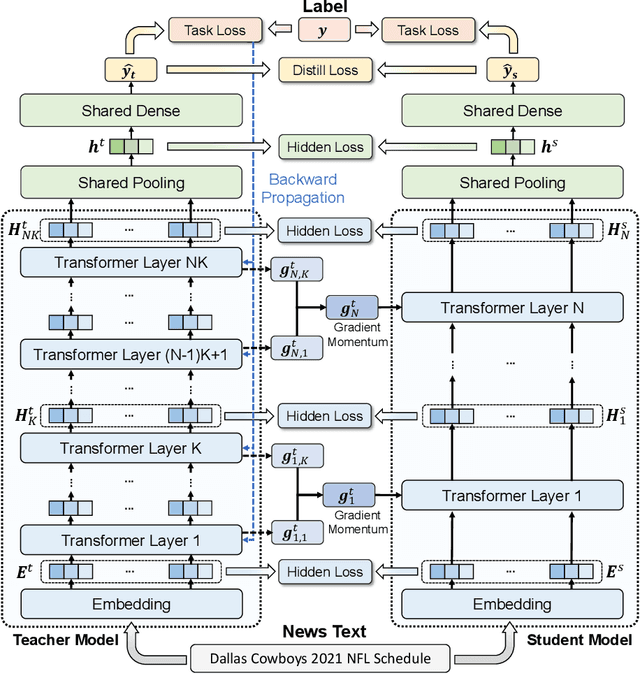
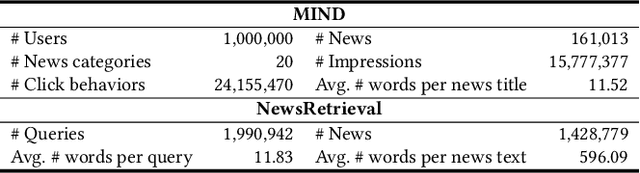
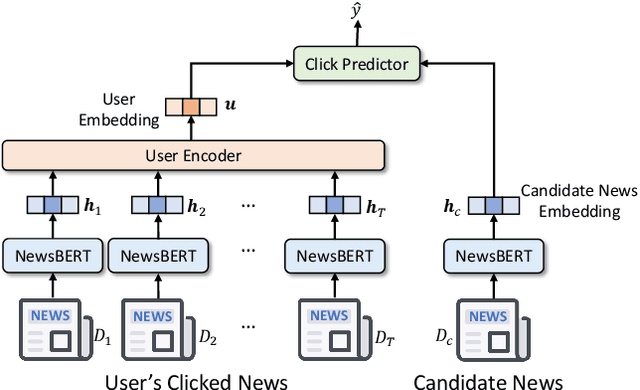
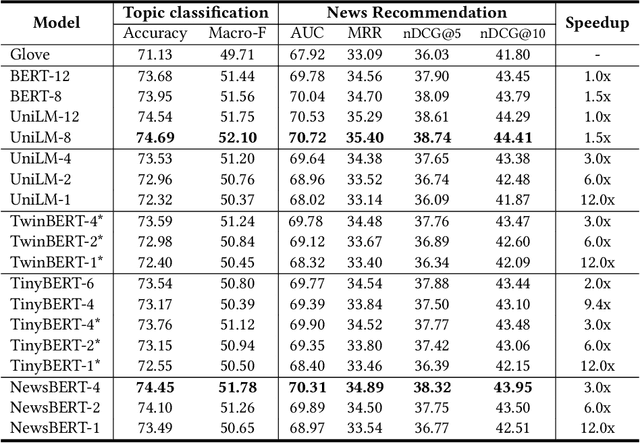
Pre-trained language models (PLMs) like BERT have made great progress in NLP. News articles usually contain rich textual information, and PLMs have the potentials to enhance news text modeling for various intelligent news applications like news recommendation and retrieval. However, most existing PLMs are in huge size with hundreds of millions of parameters. Many online news applications need to serve millions of users with low latency tolerance, which poses huge challenges to incorporating PLMs in these scenarios. Knowledge distillation techniques can compress a large PLM into a much smaller one and meanwhile keeps good performance. However, existing language models are pre-trained and distilled on general corpus like Wikipedia, which has some gaps with the news domain and may be suboptimal for news intelligence. In this paper, we propose NewsBERT, which can distill PLMs for efficient and effective news intelligence. In our approach, we design a teacher-student joint learning and distillation framework to collaboratively learn both teacher and student models, where the student model can learn from the learning experience of the teacher model. In addition, we propose a momentum distillation method by incorporating the gradients of teacher model into the update of student model to better transfer useful knowledge learned by the teacher model. Extensive experiments on two real-world datasets with three tasks show that NewsBERT can effectively improve the model performance in various intelligent news applications with much smaller models.

Neural News Recommendation with Negative Feedback
Jan 12, 2021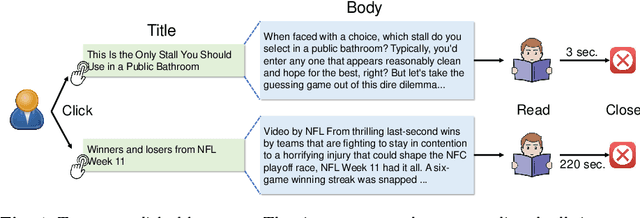

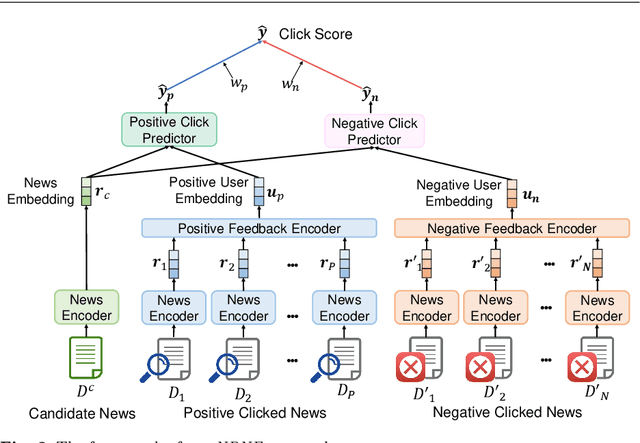
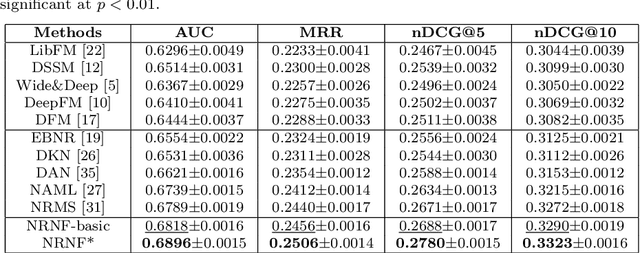
News recommendation is important for online news services. Precise user interest modeling is critical for personalized news recommendation. Existing news recommendation methods usually rely on the implicit feedback of users like news clicks to model user interest. However, news click may not necessarily reflect user interests because users may click a news due to the attraction of its title but feel disappointed at its content. The dwell time of news reading is an important clue for user interest modeling, since short reading dwell time usually indicates low and even negative interest. Thus, incorporating the negative feedback inferred from the dwell time of news reading can improve the quality of user modeling. In this paper, we propose a neural news recommendation approach which can incorporate the implicit negative user feedback. We propose to distinguish positive and negative news clicks according to their reading dwell time, and respectively learn user representations from positive and negative news clicks via a combination of Transformer and additive attention network. In addition, we propose to compute a positive click score and a negative click score based on the relevance between candidate news representations and the user representations learned from the positive and negative news clicks. The final click score is a combination of positive and negative click scores. Besides, we propose an interactive news modeling method to consider the relatedness between title and body in news modeling. Extensive experiments on real-world dataset validate that our approach can achieve more accurate user interest modeling for news recommendation.
DA-Transformer: Distance-aware Transformer
Oct 14, 2020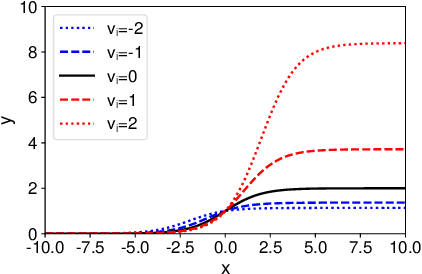
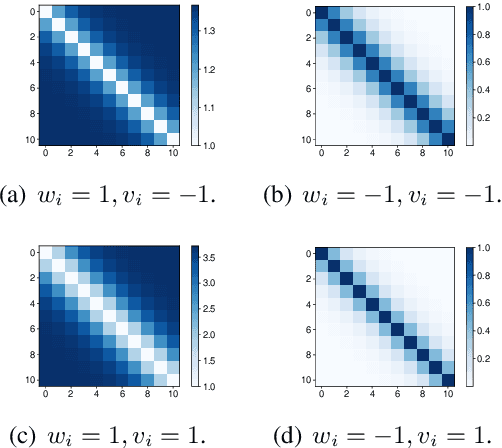

Transformer has achieved great success in the NLP field by composing various advanced models like BERT and GPT. However, Transformer and its existing variants may not be optimal in capturing token distances because the position or distance embeddings used by these methods usually cannot keep the precise information of real distances, which may not be beneficial for modeling the orders and relations of contexts. In this paper, we propose DA-Transformer, which is a distance-aware Transformer that can exploit the real distance. We propose to incorporate the real distances between tokens to re-scale the raw self-attention weights, which are computed by the relevance between attention query and key. Concretely, in different self-attention heads the relative distance between each pair of tokens is weighted by different learnable parameters, which control the different preferences on long- or short-term information of these heads. Since the raw weighted real distances may not be optimal for adjusting self-attention weights, we propose a learnable sigmoid function to map them into re-scaled coefficients that have proper ranges. We first clip the raw self-attention weights via the ReLU function to keep non-negativity and introduce sparsity, and then multiply them with the re-scaled coefficients to encode real distance information into self-attention. Extensive experiments on five benchmark datasets show that DA-Transformer can effectively improve the performance of many tasks and outperform the vanilla Transformer and its several variants.
Improving Attention Mechanism with Query-Value Interaction
Oct 08, 2020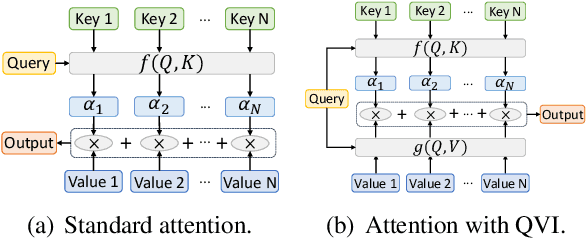
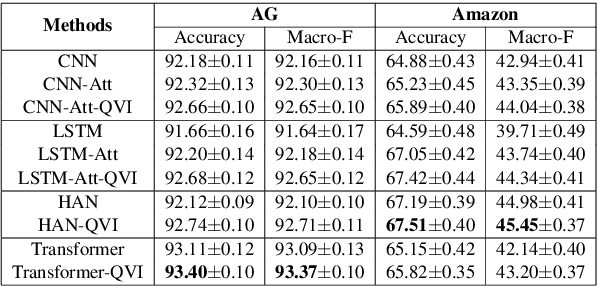
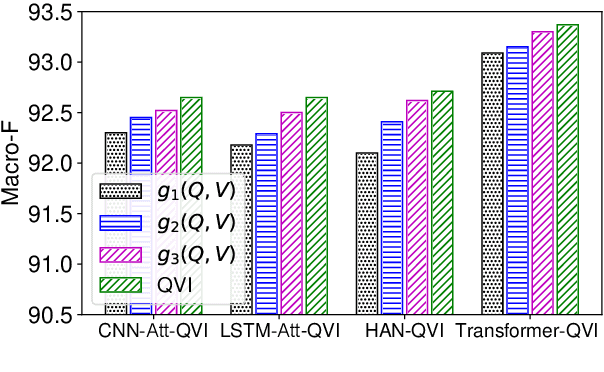
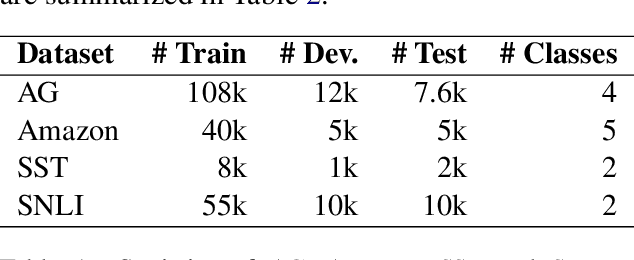
Attention mechanism has played critical roles in various state-of-the-art NLP models such as Transformer and BERT. It can be formulated as a ternary function that maps the input queries, keys and values into an output by using a summation of values weighted by the attention weights derived from the interactions between queries and keys. Similar with query-key interactions, there is also inherent relatedness between queries and values, and incorporating query-value interactions has the potential to enhance the output by learning customized values according to the characteristics of queries. However, the query-value interactions are ignored by existing attention methods, which may be not optimal. In this paper, we propose to improve the existing attention mechanism by incorporating query-value interactions. We propose a query-value interaction function which can learn query-aware attention values, and combine them with the original values and attention weights to form the final output. Extensive experiments on four datasets for different tasks show that our approach can consistently improve the performance of many attention-based models by incorporating query-value interactions.
Graph Enhanced Representation Learning for News Recommendation
Mar 31, 2020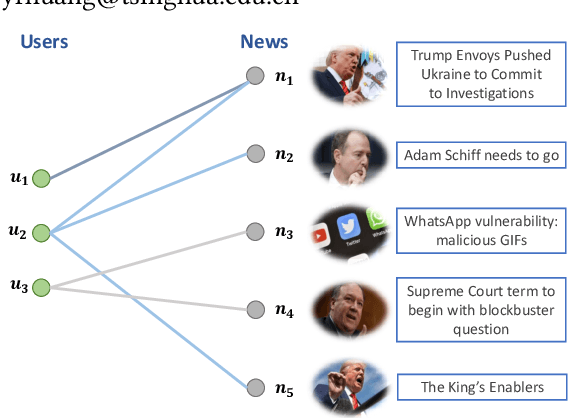

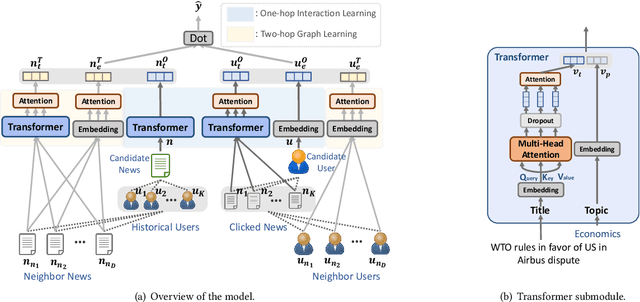
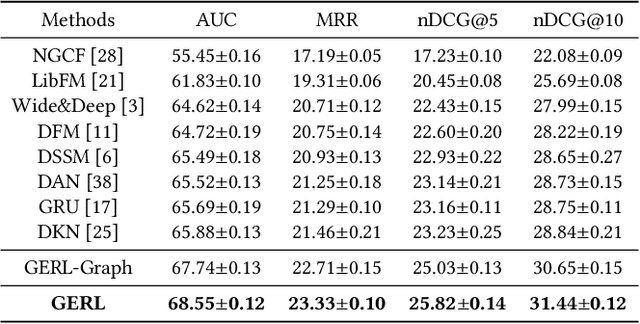
With the explosion of online news, personalized news recommendation becomes increasingly important for online news platforms to help their users find interesting information. Existing news recommendation methods achieve personalization by building accurate news representations from news content and user representations from their direct interactions with news (e.g., click), while ignoring the high-order relatedness between users and news. Here we propose a news recommendation method which can enhance the representation learning of users and news by modeling their relatedness in a graph setting. In our method, users and news are both viewed as nodes in a bipartite graph constructed from historical user click behaviors. For news representations, a transformer architecture is first exploited to build news semantic representations. Then we combine it with the information from neighbor news in the graph via a graph attention network. For user representations, we not only represent users from their historically clicked news, but also attentively incorporate the representations of their neighbor users in the graph. Improved performances on a large-scale real-world dataset validate the effectiveness of our proposed method.
FedNER: Privacy-preserving Medical Named Entity Recognition with Federated Learning
Mar 25, 2020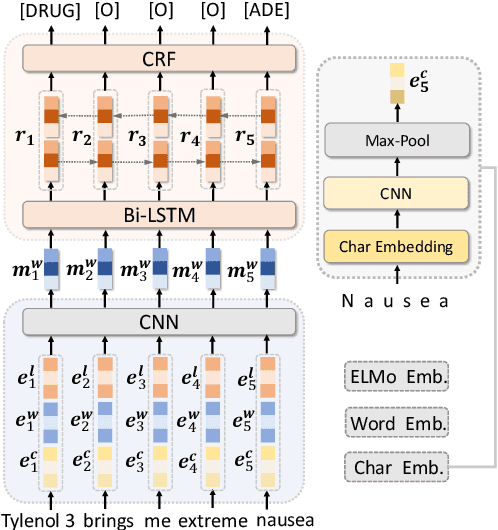
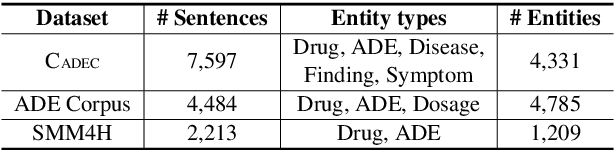
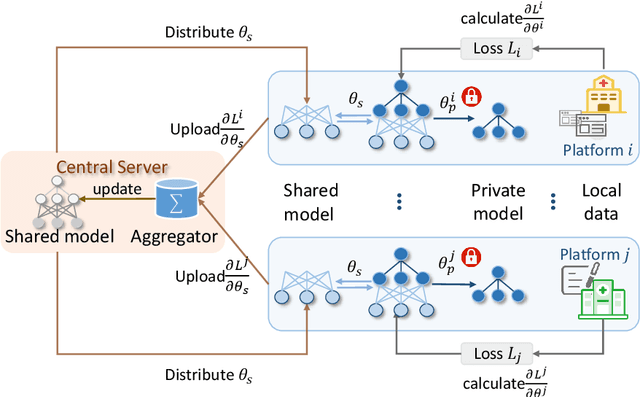
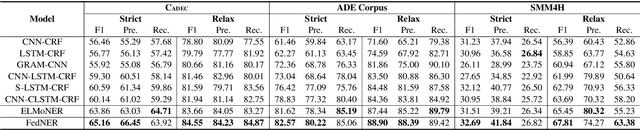
Medical named entity recognition (NER) has wide applications in intelligent healthcare. Sufficient labeled data is critical for training accurate medical NER model. However, the labeled data in a single medical platform is usually limited. Although labeled datasets may exist in many different medical platforms, they cannot be directly shared since medical data is highly privacy-sensitive. In this paper, we propose a privacy-preserving medical NER method based on federated learning, which can leverage the labeled data in different platforms to boost the training of medical NER model and remove the need of exchanging raw data among different platforms. Since the labeled data in different platforms usually has some differences in entity type and annotation criteria, instead of constraining different platforms to share the same model, we decompose the medical NER model in each platform into a shared module and a private module. The private module is used to capture the characteristics of the local data in each platform, and is updated using local labeled data. The shared module is learned across different medical platform to capture the shared NER knowledge. Its local gradients from different platforms are aggregated to update the global shared module, which is further delivered to each platform to update their local shared modules. Experiments on three publicly available datasets validate the effectiveness of our method.
Neural News Recommendation with Attentive Multi-View Learning
Jul 12, 2019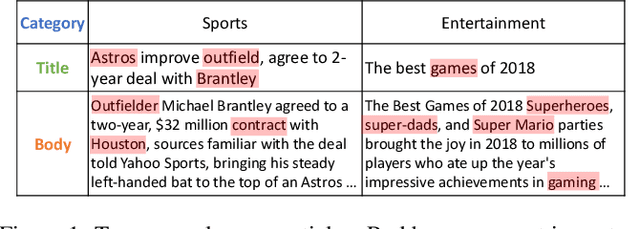
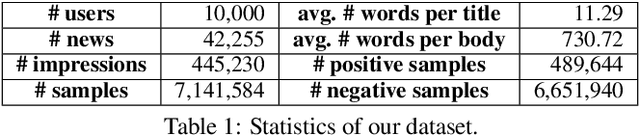
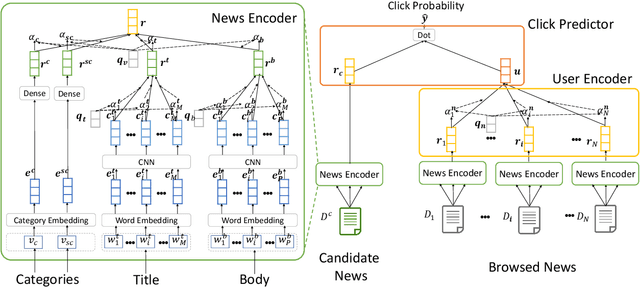
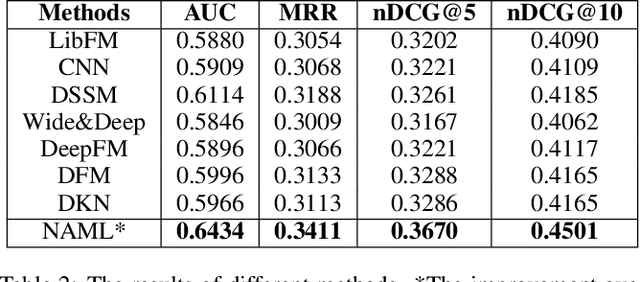
Personalized news recommendation is very important for online news platforms to help users find interested news and improve user experience. News and user representation learning is critical for news recommendation. Existing news recommendation methods usually learn these representations based on single news information, e.g., title, which may be insufficient. In this paper we propose a neural news recommendation approach which can learn informative representations of users and news by exploiting different kinds of news information. The core of our approach is a news encoder and a user encoder. In the news encoder we propose an attentive multi-view learning model to learn unified news representations from titles, bodies and topic categories by regarding them as different views of news. In addition, we apply both word-level and view-level attention mechanism to news encoder to select important words and views for learning informative news representations. In the user encoder we learn the representations of users based on their browsed news and apply attention mechanism to select informative news for user representation learning. Extensive experiments on a real-world dataset show our approach can effectively improve the performance of news recommendation.
NPA: Neural News Recommendation with Personalized Attention
Jul 12, 2019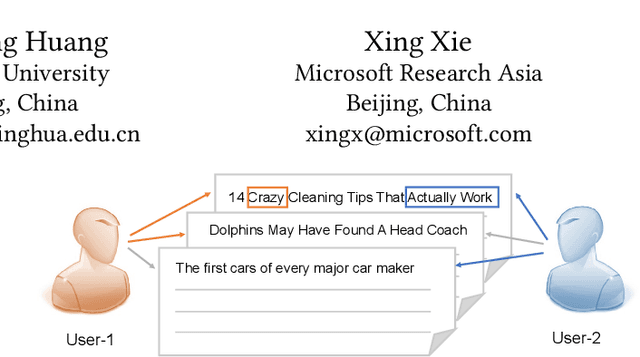

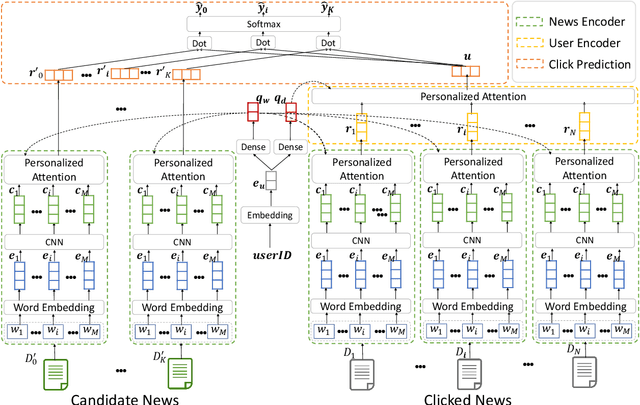
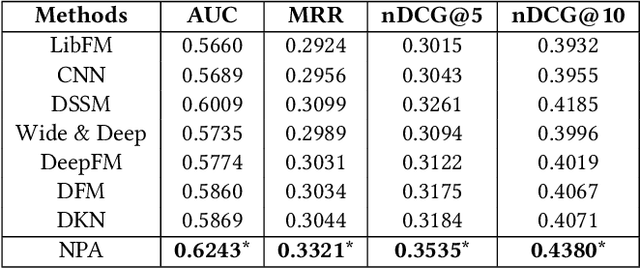
News recommendation is very important to help users find interested news and alleviate information overload. Different users usually have different interests and the same user may have various interests. Thus, different users may click the same news article with attention on different aspects. In this paper, we propose a neural news recommendation model with personalized attention (NPA). The core of our approach is a news representation model and a user representation model. In the news representation model we use a CNN network to learn hidden representations of news articles based on their titles. In the user representation model we learn the representations of users based on the representations of their clicked news articles. Since different words and different news articles may have different informativeness for representing news and users, we propose to apply both word- and news-level attention mechanism to help our model attend to important words and news articles. In addition, the same news article and the same word may have different informativeness for different users. Thus, we propose a personalized attention network which exploits the embedding of user ID to generate the query vector for the word- and news-level attentions. Extensive experiments are conducted on a real-world news recommendation dataset collected from MSN news, and the results validate the effectiveness of our approach on news recommendation.
Neural Review Rating Prediction with Hierarchical Attentions and Latent Factors
May 29, 2019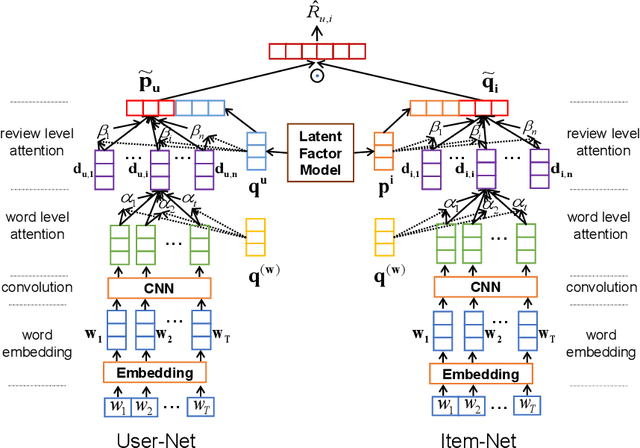
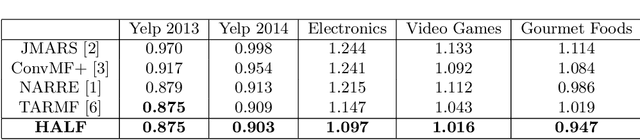
Text reviews can provide rich useful semantic information for modeling users and items, which can benefit rating prediction in recommendation. Different words and reviews may have different informativeness for users or items. Besides, different users and items should be personalized. Most existing works regard all reviews equally or utilize a general attention mechanism. In this paper, we propose a hierarchical attention model fusing latent factor model for rating prediction with reviews, which can focus on important words and informative reviews. Specially, we use the factor vectors of Latent Factor Model to guide the attention network and combine the factor vectors with feature representation learned from reviews to predict the final ratings. Experiments on real-world datasets validate the effectiveness of our approach.
NRPA: Neural Recommendation with Personalized Attention
May 29, 2019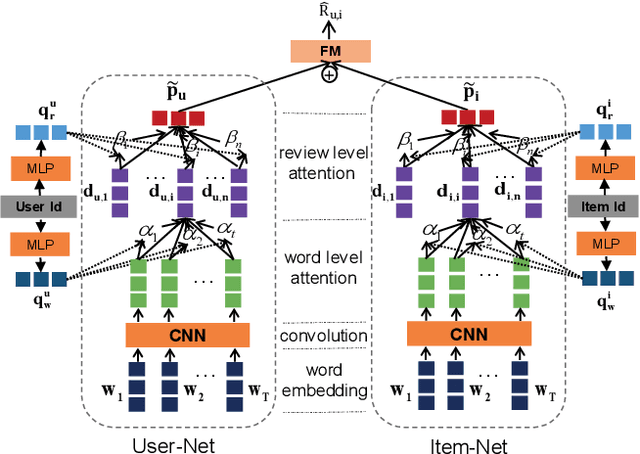
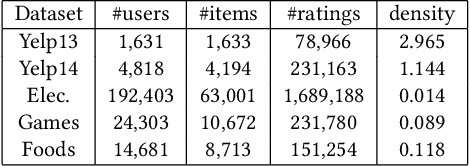
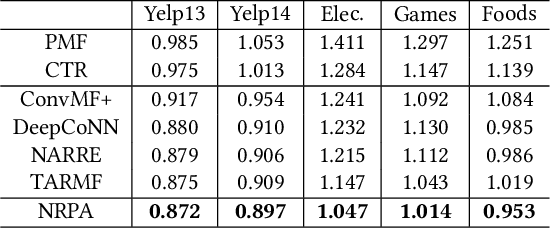
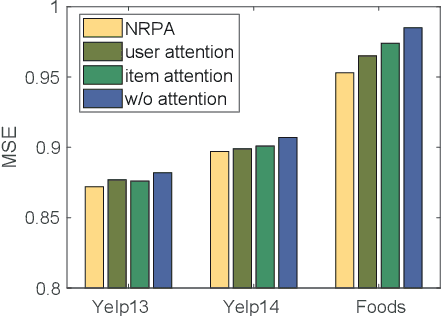
Existing review-based recommendation methods usually use the same model to learn the representations of all users/items from reviews posted by users towards items. However, different users have different preference and different items have different characteristics. Thus, the same word or similar reviews may have different informativeness for different users and items. In this paper we propose a neural recommendation approach with personalized attention to learn personalized representations of users and items from reviews. We use a review encoder to learn representations of reviews from words, and a user/item encoder to learn representations of users or items from reviews. We propose a personalized attention model, and apply it to both review and user/item encoders to select different important words and reviews for different users/items. Experiments on five datasets validate our approach can effectively improve the performance of neural recommendation.
* 4 pages, 4 figures