 Add to Chrome
 Add to Firefox
 Add to Edge
Language Guided Domain Generalized Medical Image Segmentation
Apr 03, 2024
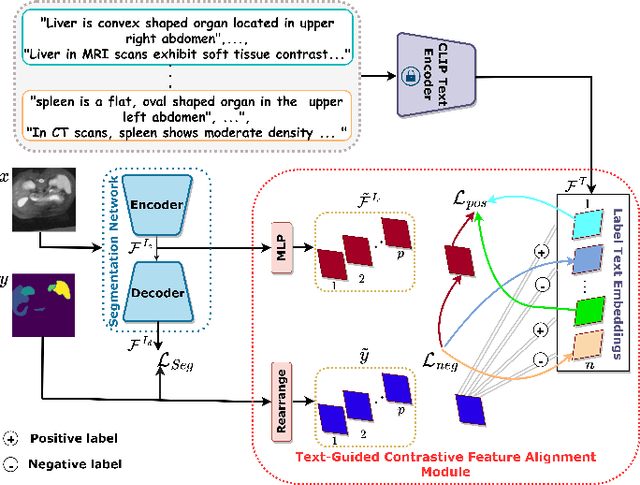


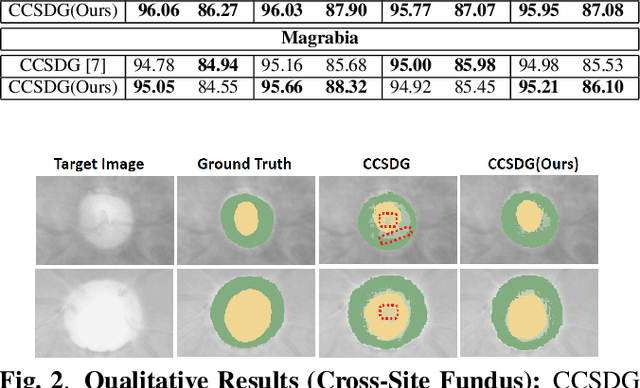
Single source domain generalization (SDG) holds promise for more reliable and consistent image segmentation across real-world clinical settings particularly in the medical domain, where data privacy and acquisition cost constraints often limit the availability of diverse datasets. Depending solely on visual features hampers the model's capacity to adapt effectively to various domains, primarily because of the presence of spurious correlations and domain-specific characteristics embedded within the image features. Incorporating text features alongside visual features is a potential solution to enhance the model's understanding of the data, as it goes beyond pixel-level information to provide valuable context. Textual cues describing the anatomical structures, their appearances, and variations across various imaging modalities can guide the model in domain adaptation, ultimately contributing to more robust and consistent segmentation. In this paper, we propose an approach that explicitly leverages textual information by incorporating a contrastive learning mechanism guided by the text encoder features to learn a more robust feature representation. We assess the effectiveness of our text-guided contrastive feature alignment technique in various scenarios, including cross-modality, cross-sequence, and cross-site settings for different segmentation tasks. Our approach achieves favorable performance against existing methods in literature. Our code and model weights are available at https://github.com/ShahinaKK/LG_SDG.git.

Dynamic Pre-training: Towards Efficient and Scalable All-in-One Image Restoration
Apr 02, 2024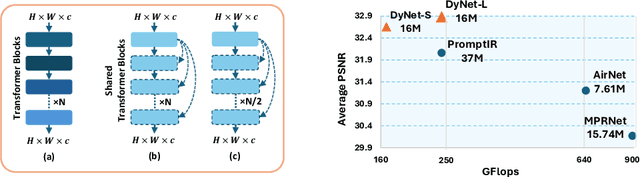


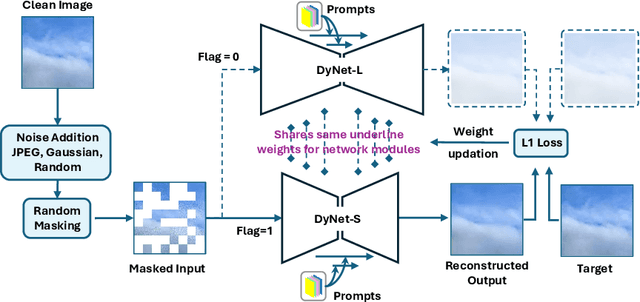
All-in-one image restoration tackles different types of degradations with a unified model instead of having task-specific, non-generic models for each degradation. The requirement to tackle multiple degradations using the same model can lead to high-complexity designs with fixed configuration that lack the adaptability to more efficient alternatives. We propose DyNet, a dynamic family of networks designed in an encoder-decoder style for all-in-one image restoration tasks. Our DyNet can seamlessly switch between its bulkier and lightweight variants, thereby offering flexibility for efficient model deployment with a single round of training. This seamless switching is enabled by our weights-sharing mechanism, forming the core of our architecture and facilitating the reuse of initialized module weights. Further, to establish robust weights initialization, we introduce a dynamic pre-training strategy that trains variants of the proposed DyNet concurrently, thereby achieving a 50% reduction in GPU hours. To tackle the unavailability of large-scale dataset required in pre-training, we curate a high-quality, high-resolution image dataset named Million-IRD having 2M image samples. We validate our DyNet for image denoising, deraining, and dehazing in all-in-one setting, achieving state-of-the-art results with 31.34% reduction in GFlops and a 56.75% reduction in parameters compared to baseline models. The source codes and trained models are available at https://github.com/akshaydudhane16/DyNet.
ELGC-Net: Efficient Local-Global Context Aggregation for Remote Sensing Change Detection
Mar 26, 2024Deep learning has shown remarkable success in remote sensing change detection (CD), aiming to identify semantic change regions between co-registered satellite image pairs acquired at distinct time stamps. However, existing convolutional neural network and transformer-based frameworks often struggle to accurately segment semantic change regions. Moreover, transformers-based methods with standard self-attention suffer from quadratic computational complexity with respect to the image resolution, making them less practical for CD tasks with limited training data. To address these issues, we propose an efficient change detection framework, ELGC-Net, which leverages rich contextual information to precisely estimate change regions while reducing the model size. Our ELGC-Net comprises a Siamese encoder, fusion modules, and a decoder. The focus of our design is the introduction of an Efficient Local-Global Context Aggregator module within the encoder, capturing enhanced global context and local spatial information through a novel pooled-transpose (PT) attention and depthwise convolution, respectively. The PT attention employs pooling operations for robust feature extraction and minimizes computational cost with transposed attention. Extensive experiments on three challenging CD datasets demonstrate that ELGC-Net outperforms existing methods. Compared to the recent transformer-based CD approach (ChangeFormer), ELGC-Net achieves a 1.4% gain in intersection over union metric on the LEVIR-CD dataset, while significantly reducing trainable parameters. Our proposed ELGC-Net sets a new state-of-the-art performance in remote sensing change detection benchmarks. Finally, we also introduce ELGC-Net-LW, a lighter variant with significantly reduced computational complexity, suitable for resource-constrained settings, while achieving comparable performance. Project url https://github.com/techmn/elgcnet.
Efficient Video Object Segmentation via Modulated Cross-Attention Memory
Mar 26, 2024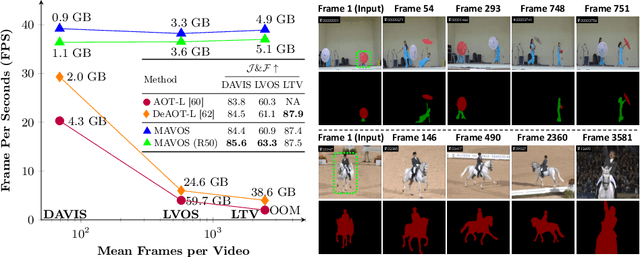

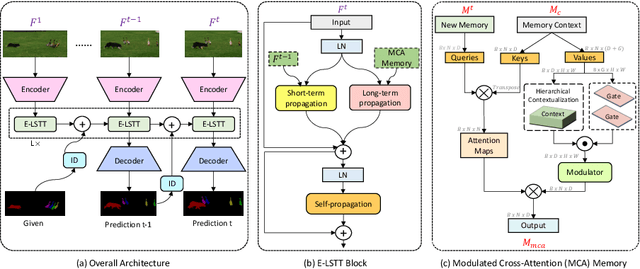

Recently, transformer-based approaches have shown promising results for semi-supervised video object segmentation. However, these approaches typically struggle on long videos due to increased GPU memory demands, as they frequently expand the memory bank every few frames. We propose a transformer-based approach, named MAVOS, that introduces an optimized and dynamic long-term modulated cross-attention (MCA) memory to model temporal smoothness without requiring frequent memory expansion. The proposed MCA effectively encodes both local and global features at various levels of granularity while efficiently maintaining consistent speed regardless of the video length. Extensive experiments on multiple benchmarks, LVOS, Long-Time Video, and DAVIS 2017, demonstrate the effectiveness of our proposed contributions leading to real-time inference and markedly reduced memory demands without any degradation in segmentation accuracy on long videos. Compared to the best existing transformer-based approach, our MAVOS increases the speed by 7.6x, while significantly reducing the GPU memory by 87% with comparable segmentation performance on short and long video datasets. Notably on the LVOS dataset, our MAVOS achieves a J&F score of 63.3% while operating at 37 frames per second (FPS) on a single V100 GPU. Our code and models will be publicly available at: https://github.com/Amshaker/MAVOS.
VURF: A General-purpose Reasoning and Self-refinement Framework for Video Understanding
Mar 25, 2024Recent studies have demonstrated the effectiveness of Large Language Models (LLMs) as reasoning modules that can deconstruct complex tasks into more manageable sub-tasks, particularly when applied to visual reasoning tasks for images. In contrast, this paper introduces a Video Understanding and Reasoning Framework (VURF) based on the reasoning power of LLMs. Ours is a novel approach to extend the utility of LLMs in the context of video tasks, leveraging their capacity to generalize from minimal input and output demonstrations within a contextual framework. By presenting LLMs with pairs of instructions and their corresponding high-level programs, we harness their contextual learning capabilities to generate executable visual programs for video understanding. To enhance program's accuracy and robustness, we implement two important strategies. Firstly, we employ a feedback-generation approach, powered by GPT-3.5, to rectify errors in programs utilizing unsupported functions. Secondly, taking motivation from recent works on self refinement of LLM outputs, we introduce an iterative procedure for improving the quality of the in-context examples by aligning the initial outputs to the outputs that would have been generated had the LLM not been bound by the structure of the in-context examples. Our results on several video-specific tasks, including visual QA, video anticipation, pose estimation and multi-video QA illustrate the efficacy of these enhancements in improving the performance of visual programming approaches for video tasks.
Composed Video Retrieval via Enriched Context and Discriminative Embeddings
Mar 25, 2024


Composed video retrieval (CoVR) is a challenging problem in computer vision which has recently highlighted the integration of modification text with visual queries for more sophisticated video search in large databases. Existing works predominantly rely on visual queries combined with modification text to distinguish relevant videos. However, such a strategy struggles to fully preserve the rich query-specific context in retrieved target videos and only represents the target video using visual embedding. We introduce a novel CoVR framework that leverages detailed language descriptions to explicitly encode query-specific contextual information and learns discriminative embeddings of vision only, text only and vision-text for better alignment to accurately retrieve matched target videos. Our proposed framework can be flexibly employed for both composed video (CoVR) and image (CoIR) retrieval tasks. Experiments on three datasets show that our approach obtains state-of-the-art performance for both CovR and zero-shot CoIR tasks, achieving gains as high as around 7% in terms of recall@K=1 score. Our code, models, detailed language descriptions for WebViD-CoVR dataset are available at \url{https://github.com/OmkarThawakar/composed-video-retrieval}
AdaIR: Adaptive All-in-One Image Restoration via Frequency Mining and Modulation
Mar 21, 2024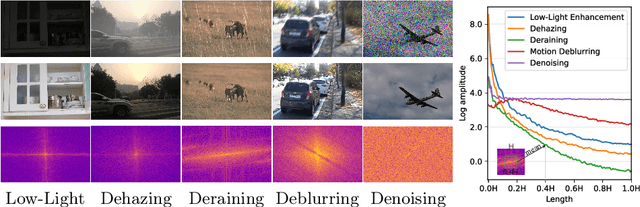
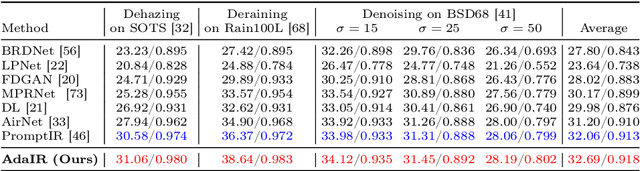
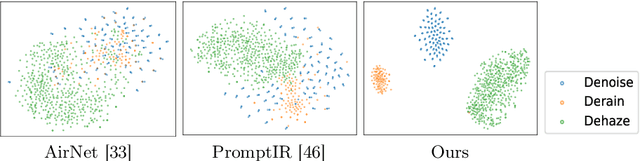

In the image acquisition process, various forms of degradation, including noise, haze, and rain, are frequently introduced. These degradations typically arise from the inherent limitations of cameras or unfavorable ambient conditions. To recover clean images from degraded versions, numerous specialized restoration methods have been developed, each targeting a specific type of degradation. Recently, all-in-one algorithms have garnered significant attention by addressing different types of degradations within a single model without requiring prior information of the input degradation type. However, these methods purely operate in the spatial domain and do not delve into the distinct frequency variations inherent to different degradation types. To address this gap, we propose an adaptive all-in-one image restoration network based on frequency mining and modulation. Our approach is motivated by the observation that different degradation types impact the image content on different frequency subbands, thereby requiring different treatments for each restoration task. Specifically, we first mine low- and high-frequency information from the input features, guided by the adaptively decoupled spectra of the degraded image. The extracted features are then modulated by a bidirectional operator to facilitate interactions between different frequency components. Finally, the modulated features are merged into the original input for a progressively guided restoration. With this approach, the model achieves adaptive reconstruction by accentuating the informative frequency subbands according to different input degradations. Extensive experiments demonstrate that the proposed method achieves state-of-the-art performance on different image restoration tasks, including denoising, dehazing, deraining, motion deblurring, and low-light image enhancement. Our code is available at https://github.com/c-yn/AdaIR.
Hierarchical Text-to-Vision Self Supervised Alignment for Improved Histopathology Representation Learning
Mar 21, 2024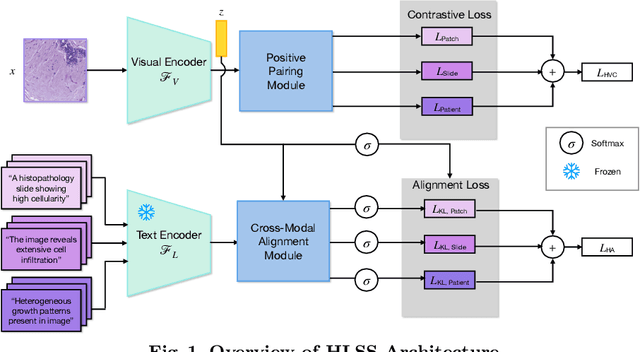
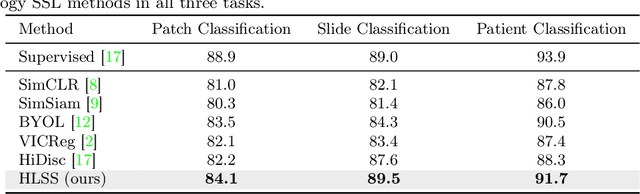
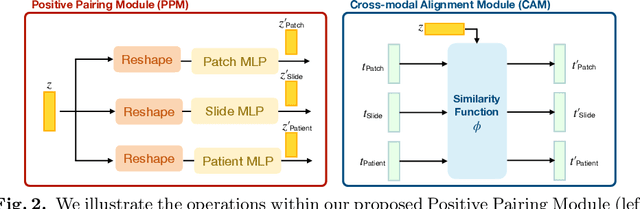
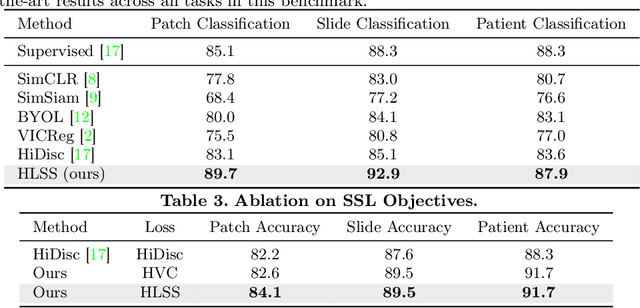
Self-supervised representation learning has been highly promising for histopathology image analysis with numerous approaches leveraging their patient-slide-patch hierarchy to learn better representations. In this paper, we explore how the combination of domain specific natural language information with such hierarchical visual representations can benefit rich representation learning for medical image tasks. Building on automated language description generation for features visible in histopathology images, we present a novel language-tied self-supervised learning framework, Hierarchical Language-tied Self-Supervision (HLSS) for histopathology images. We explore contrastive objectives and granular language description based text alignment at multiple hierarchies to inject language modality information into the visual representations. Our resulting model achieves state-of-the-art performance on two medical imaging benchmarks, OpenSRH and TCGA datasets. Our framework also provides better interpretability with our language aligned representation space. Code is available at https://github.com/Hasindri/HLSS.
ObjectCompose: Evaluating Resilience of Vision-Based Models on Object-to-Background Compositional Changes
Mar 15, 2024Given the large-scale multi-modal training of recent vision-based models and their generalization capabilities, understanding the extent of their robustness is critical for their real-world deployment. In this work, we evaluate the resilience of current vision-based models against diverse object-to-background context variations. The majority of robustness evaluation methods have introduced synthetic datasets to induce changes to object characteristics (viewpoints, scale, color) or utilized image transformation techniques (adversarial changes, common corruptions) on real images to simulate shifts in distributions. Recent works have explored leveraging large language models and diffusion models to generate changes in the background. However, these methods either lack in offering control over the changes to be made or distort the object semantics, making them unsuitable for the task. Our method, on the other hand, can induce diverse object-to-background changes while preserving the original semantics and appearance of the object. To achieve this goal, we harness the generative capabilities of text-to-image, image-to-text, and image-to-segment models to automatically generate a broad spectrum of object-to-background changes. We induce both natural and adversarial background changes by either modifying the textual prompts or optimizing the latents and textual embedding of text-to-image models. This allows us to quantify the role of background context in understanding the robustness and generalization of deep neural networks. We produce various versions of standard vision datasets (ImageNet, COCO), incorporating either diverse and realistic backgrounds into the images or introducing color, texture, and adversarial changes in the background. We conduct extensive experiment to analyze the robustness of vision-based models against object-to-background context variations across diverse tasks.
Rethinking Transformers Pre-training for Multi-Spectral Satellite Imagery
Mar 08, 2024Recent advances in unsupervised learning have demonstrated the ability of large vision models to achieve promising results on downstream tasks by pre-training on large amount of unlabelled data. Such pre-training techniques have also been explored recently in the remote sensing domain due to the availability of large amount of unlabelled data. Different from standard natural image datasets, remote sensing data is acquired from various sensor technologies and exhibit diverse range of scale variations as well as modalities. Existing satellite image pre-training methods either ignore the scale information present in the remote sensing imagery or restrict themselves to use only a single type of data modality. In this paper, we re-visit transformers pre-training and leverage multi-scale information that is effectively utilized with multiple modalities. Our proposed approach, named SatMAE++, performs multi-scale pre-training and utilizes convolution based upsampling blocks to reconstruct the image at higher scales making it extensible to include more scales. Compared to existing works, the proposed SatMAE++ with multi-scale pre-training is equally effective for both optical as well as multi-spectral imagery. Extensive experiments on six datasets reveal the merits of proposed contributions, leading to state-of-the-art performance on all datasets. SatMAE++ achieves mean average precision (mAP) gain of 2.5\% for multi-label classification task on BigEarthNet dataset. Our code and pre-trained models are available at \url{https://github.com/techmn/satmae_pp}.