 Add to Chrome
 Add to Firefox
 Add to Edge
RIS-aided Radar Detection Architectures with Application to Low-RCS Targets
Jan 15, 2026
In this paper, we address the radar detection of low observable targets with the assistance of a reconfigurable intelligent surface (RIS). Instead of using a multistatic radar network as counter-stealth strategy with its synchronization, costs, phase coherence, and energy consumption issues, we exploit a RIS to form a joint monostatic and bistatic configuration that can intercept the energy backscattered by the target along irrelevant directions different from the line-of-sight of the radar. Then, this energy is redirected towards the radar that capitalizes all the backscattered energy to detect the low observable target. To this end, five different detection architectures are devised that jointly process monostatic and bistatic echoes and exhibit the constant false alarm rate property at least with respect to the clutter power. To support the practical implementation, we also provide a guideline for the design of a RIS that satisfies the operating requirements of the considered application. The performance analysis is carried out in comparison with conventional detectors and shows that the proposed strategy leads to effective solutions to the detection of low observable targets.

A Survey on Fundamental Limits of Integrated Sensing and Communication
Apr 22, 2021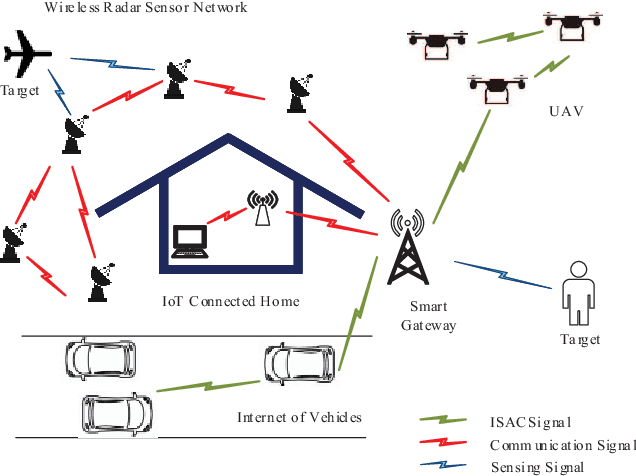
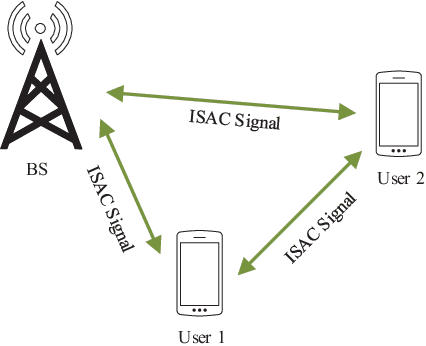
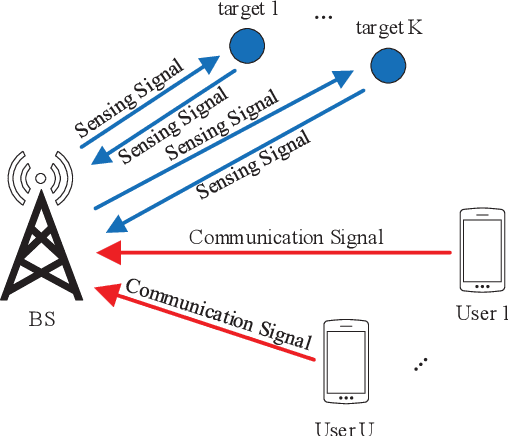
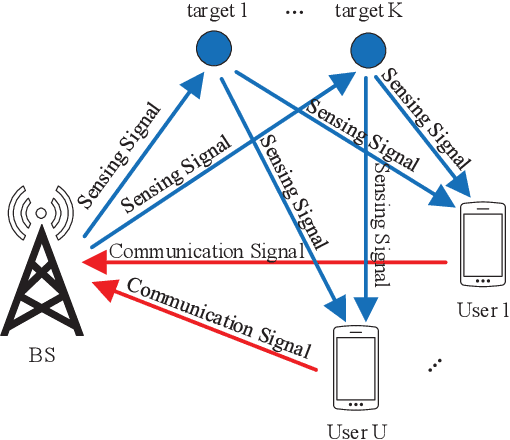
The integrated sensing and communication (ISAC), in which the sensing and communication share the same frequency band and hardware, has emerged as a key technology in future wireless systems. Early works on ISAC have been focused on the design, analysis and optimization of practical ISAC technologies for various ISAC systems. While this line of works are necessary, it is equally important to study the fundamental limits of ISAC in order to understand the gap between the current state-of-the-art technologies and the performance limits, and provide useful insights and guidance for the development of better ISAC technologies that can approach the performance limits. In this paper, we aim to provide a comprehensive survey for the current research progress on the fundamental limits of ISAC. Particularly, we first propose a systematic classification method for both traditional radio sensing (such as radar sensing and wireless localization) and ISAC so that they can be naturally incorporated into a unified framework. Then we summarize the major performance metrics and bounds used in sensing, communications and ISAC, respectively. After that, we present the current research progresses on fundamental limits of each class of the traditional sensing and ISAC systems. Finally, the open problems and future research directions are discussed.