 Add to Chrome
 Add to Firefox
 Add to Edge
RIS-aided Radar Detection Architectures with Application to Low-RCS Targets
Jan 15, 2026
In this paper, we address the radar detection of low observable targets with the assistance of a reconfigurable intelligent surface (RIS). Instead of using a multistatic radar network as counter-stealth strategy with its synchronization, costs, phase coherence, and energy consumption issues, we exploit a RIS to form a joint monostatic and bistatic configuration that can intercept the energy backscattered by the target along irrelevant directions different from the line-of-sight of the radar. Then, this energy is redirected towards the radar that capitalizes all the backscattered energy to detect the low observable target. To this end, five different detection architectures are devised that jointly process monostatic and bistatic echoes and exhibit the constant false alarm rate property at least with respect to the clutter power. To support the practical implementation, we also provide a guideline for the design of a RIS that satisfies the operating requirements of the considered application. The performance analysis is carried out in comparison with conventional detectors and shows that the proposed strategy leads to effective solutions to the detection of low observable targets.

Electromagnetic Model of Reflective Intelligent Surfaces
Feb 21, 2021

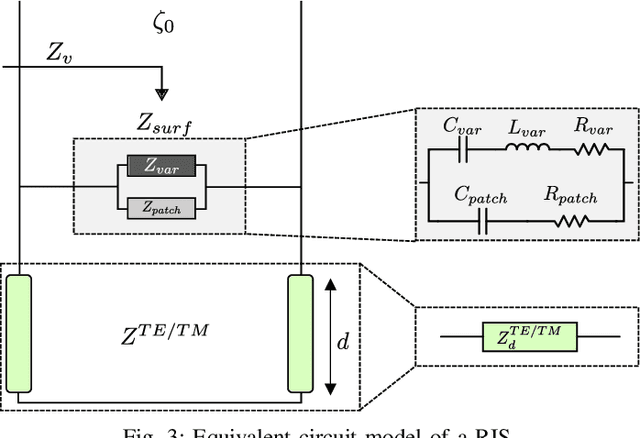

We present an accurate and simple analytical model for the computation of the reflection amplitude and phase of Reflecting Intelligent Surfaces. The model is based on a transmissionline circuit representation of the RIS which takes into account the physics behind the structure including the effect of all relevant geometrical and electrical parameters. The proposed representation of the RIS allows to take into account the effect of incidence angle, the mutual coupling among elements, the effect of the interaction of the periodic surface with the RIS ground plane. It is shown that, by using the proposed approach, it is possible to maximize the power received by a user in a RIS-assisted link without recurring to onerous electromagnetic simulations. The proposed model aims at filling the gap in the design of RIS assisted communications algorithms that are usually disconnected from physical implementation issues and realistic performance of these surfaces.