 Add to Chrome
 Add to Firefox
 Add to Edge
A Reasoning-Enabled Vision-Language Foundation Model for Chest X-ray Interpretation
Apr 01, 2026
Chest X-rays (CXRs) are among the most frequently performed imaging examinations worldwide, yet rising imaging volumes increase radiologist workload and the risk of diagnostic errors. Although artificial intelligence (AI) systems have shown promise for CXR interpretation, most generate only final predictions, without making explicit how visual evidence is translated into radiographic findings and diagnostic predictions. We present CheXOne, a reasoning-enabled vision-language model for CXR interpretation. CheXOne jointly generates diagnostic predictions and explicit, clinically grounded reasoning traces that connect visual evidence, radiographic findings, and these predictions. The model is trained on 14.7 million instruction and reasoning samples curated from 30 public datasets spanning 36 CXR interpretation tasks, using a two-stage framework that combines instruction tuning with reinforcement learning to improve reasoning quality. We evaluate CheXOne in zero-shot settings across visual question answering, report generation, visual grounding and reasoning assessment, covering 17 evaluation settings. CheXOne outperforms existing medical and general-domain foundation models and achieves strong performance on independent public benchmarks. A clinical reader study demonstrates that CheXOne-drafted reports are comparable to or better than resident-written reports in 55% of cases, while effectively addressing clinical indications and enhancing both report writing and CXR interpretation efficiency. Further analyses involving radiologists reveal that the generated reasoning traces show high clinical factuality and provide causal support for the final predictions, offering a plausible explanation for the performance gains. These results suggest that explicit reasoning can improve model performance, interpretability and clinical utility in AI-assisted CXR interpretation.

CheX-GPT: Harnessing Large Language Models for Enhanced Chest X-ray Report Labeling
Jan 21, 2024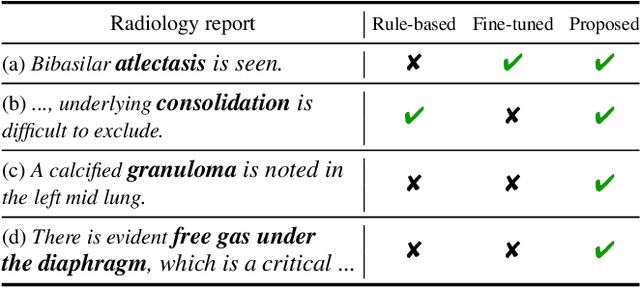
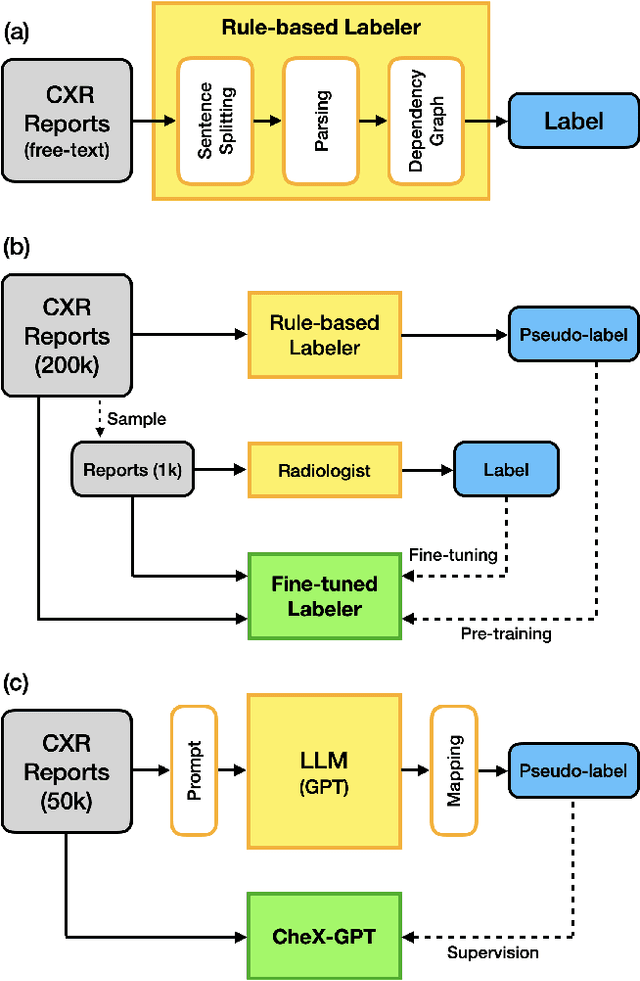
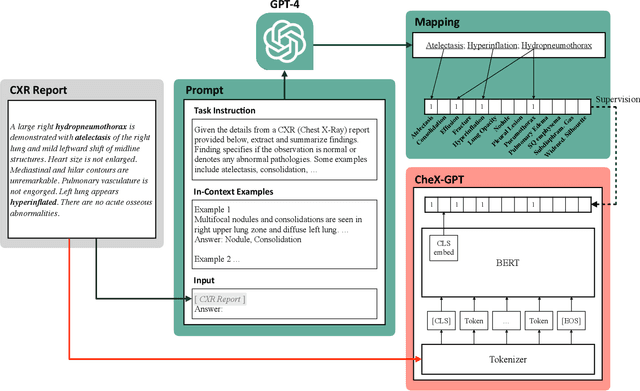

Free-text radiology reports present a rich data source for various medical tasks, but effectively labeling these texts remains challenging. Traditional rule-based labeling methods fall short of capturing the nuances of diverse free-text patterns. Moreover, models using expert-annotated data are limited by data scarcity and pre-defined classes, impacting their performance, flexibility and scalability. To address these issues, our study offers three main contributions: 1) We demonstrate the potential of GPT as an adept labeler using carefully designed prompts. 2) Utilizing only the data labeled by GPT, we trained a BERT-based labeler, CheX-GPT, which operates faster and more efficiently than its GPT counterpart. 3) To benchmark labeler performance, we introduced a publicly available expert-annotated test set, MIMIC-500, comprising 500 cases from the MIMIC validation set. Our findings demonstrate that CheX-GPT not only excels in labeling accuracy over existing models, but also showcases superior efficiency, flexibility, and scalability, supported by our introduction of the MIMIC-500 dataset for robust benchmarking. Code and models are available at https://github.com/kakaobrain/CheXGPT.
CXR-CLIP: Toward Large Scale Chest X-ray Language-Image Pre-training
Oct 20, 2023A large-scale image-text pair dataset has greatly contributed to the development of vision-language pre-training (VLP) models, which enable zero-shot or few-shot classification without costly annotation. However, in the medical domain, the scarcity of data remains a significant challenge for developing a powerful VLP model. In this paper, we tackle the lack of image-text data in chest X-ray by expanding image-label pair as image-text pair via general prompt and utilizing multiple images and multiple sections in a radiologic report. We also design two contrastive losses, named ICL and TCL, for learning study-level characteristics of medical images and reports, respectively. Our model outperforms the state-of-the-art models trained under the same conditions. Also, enlarged dataset improve the discriminative power of our pre-trained model for classification, while sacrificing marginal retrieval performance. Code is available at https://github.com/kakaobrain/cxr-clip.