 Add to Chrome
 Add to Firefox
 Add to Edge
A Comprehensive Survey of Channel Estimation Techniques for OTFS in 6G and Beyond Wireless Networks
Paper and Code
Dec 15, 2025

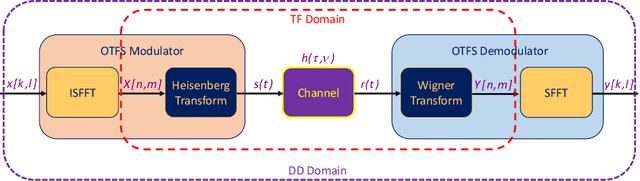
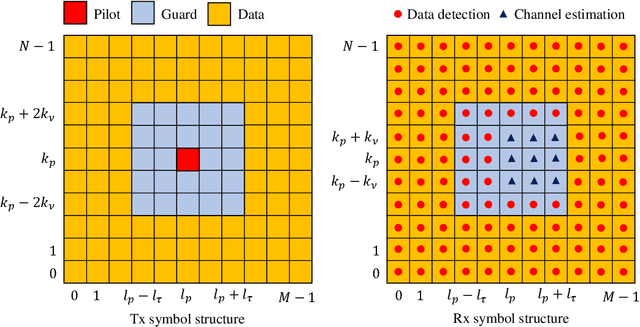
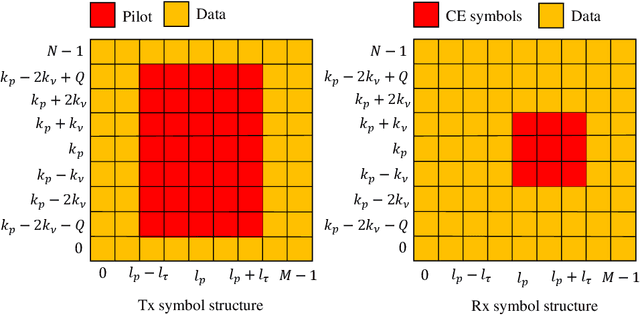
Orthogonal time-frequency space (OTFS) modulation has emerged as a powerful wireless communication technology that is specifically designed to address the challenges of high-mobility scenarios and significant Doppler effects. Unlike conventional modulation schemes that operate in the time-frequency (TF) domain, OTFS projects signals to the delay-Doppler (DD) domain, where wireless channels exhibit sparse and quasi-static characteristics. This fundamental transformation enables superior channel estimation (CE) performance in challenging propagation environments characterized by high-mobility, severe multipath effects, and rapidly time-varying channel conditions. This article provides a systematic examination of CE techniques for OTFS systems, covering the extensive research landscape from foundational methods to cutting-edge approaches. We present a detailed analysis of DD and TF domain CE techniques presented in the literature, including separate pilot, embedded pilot, and superimposed pilot approaches. The article encompasses various algorithmic frameworks including Bayesian learning, matching pursuit-based techniques, message passing algorithms, deep learning (DL)-based methods, and recent CE approaches. Additionally, we explore joint CE and signal detection (SD) strategies, the integration of OTFS with next-generation wireless systems including massive multiple-input multiple-output (MIMO), millimeter wave (mmWave) communications, reconfigurable intelligent surfaces (RISs), and integrated sensing and communication (ISAC) systems. Critical implementation challenges are presented, including leakage suppression, inter-Doppler interference mitigation, impulsive noise handling, signaling overhead reduction, guard space requirements, peak-to-average power ratio (PAPR) management, beam squint effects, and hardware impairments.
