 Add to Chrome
 Add to Firefox
 Add to Edge
VINS-120K: Ultra High-Resolution Image Editing with A Large-Scale Dataset
May 22, 2026
Directly editing ultra-high-resolution (UHR) images is valuable but underexplored, primarily due to the lack of high-quality data and the challenge in modeling high-frequency texture details. We introduce VINS-120K, the first large-scale dataset for instruction-based UHR image editing, comprising 120K carefully curated triplets of instruction, input image, and edited image. Each image exceeds 4K resolution ($\geq$4096 $\times$ 4096) and is filtered through a rigorous multi-stage pipeline to ensure visual quality, instruction alignment, and aesthetic fidelity. Built on VINS-120K, we further develop a high-frequency-aware post-adaptation strategy to extend pretrained non-high-resolution models to the UHR regime. We also present VINS-4KEval, a benchmark covering diverse editing types, to facilitate consistent evaluation in UHR settings. Experiments confirm that our work improves fine-grained detail synthesis and texture realism in UHR image editing.

UltraHR-100K: Enhancing UHR Image Synthesis with A Large-Scale High-Quality Dataset
Oct 23, 2025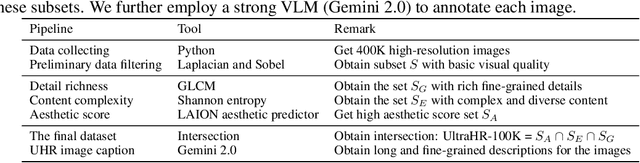
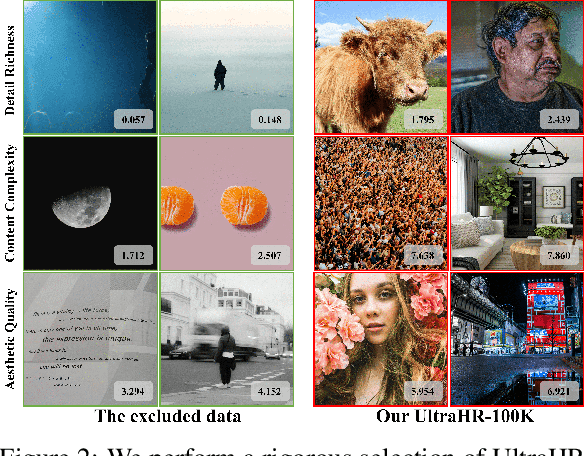
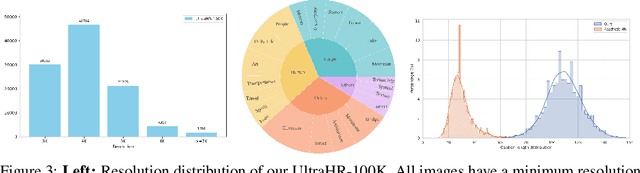
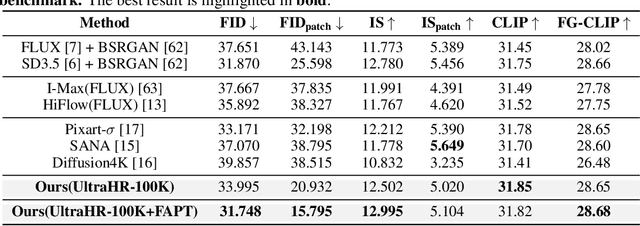
Ultra-high-resolution (UHR) text-to-image (T2I) generation has seen notable progress. However, two key challenges remain : 1) the absence of a large-scale high-quality UHR T2I dataset, and (2) the neglect of tailored training strategies for fine-grained detail synthesis in UHR scenarios. To tackle the first challenge, we introduce \textbf{UltraHR-100K}, a high-quality dataset of 100K UHR images with rich captions, offering diverse content and strong visual fidelity. Each image exceeds 3K resolution and is rigorously curated based on detail richness, content complexity, and aesthetic quality. To tackle the second challenge, we propose a frequency-aware post-training method that enhances fine-detail generation in T2I diffusion models. Specifically, we design (i) \textit{Detail-Oriented Timestep Sampling (DOTS)} to focus learning on detail-critical denoising steps, and (ii) \textit{Soft-Weighting Frequency Regularization (SWFR)}, which leverages Discrete Fourier Transform (DFT) to softly constrain frequency components, encouraging high-frequency detail preservation. Extensive experiments on our proposed UltraHR-eval4K benchmarks demonstrate that our approach significantly improves the fine-grained detail quality and overall fidelity of UHR image generation. The code is available at \href{https://github.com/NJU-PCALab/UltraHR-100k}{here}.
Label Drop for Multi-Aspect Relation Modeling in Universal Information Extraction
Feb 18, 2025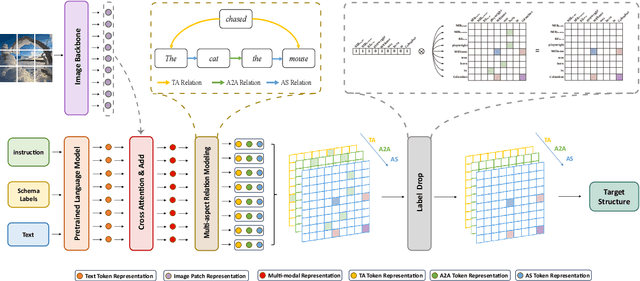
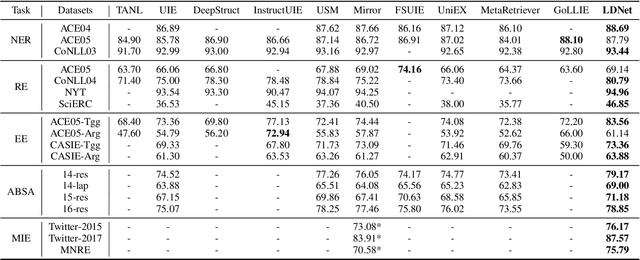
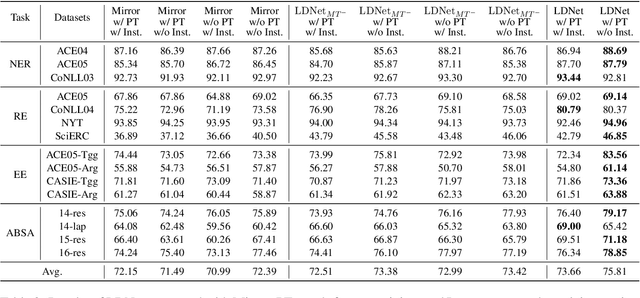
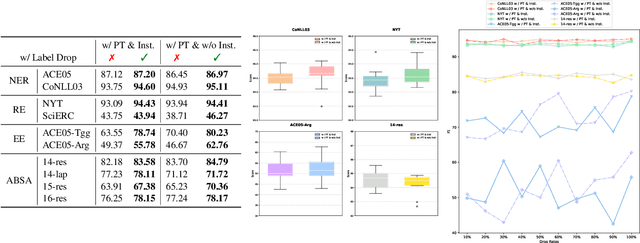
Universal Information Extraction (UIE) has garnered significant attention due to its ability to address model explosion problems effectively. Extractive UIE can achieve strong performance using a relatively small model, making it widely adopted. Extractive UIEs generally rely on task instructions for different tasks, including single-target instructions and multiple-target instructions. Single-target instruction UIE enables the extraction of only one type of relation at a time, limiting its ability to model correlations between relations and thus restricting its capability to extract complex relations. While multiple-target instruction UIE allows for the extraction of multiple relations simultaneously, the inclusion of irrelevant relations introduces decision complexity and impacts extraction accuracy. Therefore, for multi-relation extraction, we propose LDNet, which incorporates multi-aspect relation modeling and a label drop mechanism. By assigning different relations to different levels for understanding and decision-making, we reduce decision confusion. Additionally, the label drop mechanism effectively mitigates the impact of irrelevant relations. Experiments show that LDNet outperforms or achieves competitive performance with state-of-the-art systems on 9 tasks, 33 datasets, in both single-modal and multi-modal, few-shot and zero-shot settings.\footnote{https://github.com/Lu-Yang666/LDNet}