 Add to Chrome
 Add to Firefox
 Add to Edge
ShearFuse-UNet: Hadamard, DCT, and Shearlet Transform Fusion for Next-Day Wildfire Spread Prediction
Jun 12, 2026
We propose ShearFuse-UNet, a lightweight and computationally efficient deep learning model for next-day wildfire spread prediction from multi-modal satellite data. The model integrates three complementary transform-domain branches inside each encoder block of a U-Net backbone: a 2D Fast Walsh-Hadamard Transform (WHT) branch, a 2D Discrete Cosine Transform (DCT) branch, and a cone-adapted digital Shearlet residual branch. The WHT and DCT branches establish orthogonal latent spaces with learnable spectral scaling and fixed soft-thresholding, while the Shearlet branch provides anisotropic, multi-directional feature decomposition that explicitly encodes the elongated edge structures characteristic of fire fronts. A learned SpectralFusion gate adaptively combines the WHT and DCT responses, and the Shearlet reconstruction is added as a residual. This three-branch design bears a loose structural analogy to transformer self-attention: the WHT and DCT branches provide complementary spectral representations that are adaptively fused, while the Shearlet branch contributes directional content through a residual pathway. Unlike self-attention, the proposed design relies on fixed mathematical transforms rather than learned projection operators, reducing parameter count and computational cost. Evaluated on the WildfireSpreadTS dataset, ShearFuse-UNet achieves an F1 score of 0.596 with only 267k parameters, outperforming a ResNet18-based U-Net (14M parameters, F1 = 0.589) and demonstrating a highly favorable accuracy-efficiency trade-off. Results on the Google Next-Day Wildfire Spread dataset further validate these findings across a different benchmark.

A Large Scale Open-Source Image and Video Dataset for Robust Wildfire Detection and Classification
Jun 08, 2026Wildfire detection and monitoring are critical for mitigating fire spread and reducing environmental and infrastructural damage. In this work, we introduce GWFP (Global Wildfire Prevention Dataset), a large-scale, open-source dataset of wildfire images and videos designed to support early fire and smoke detection research. GWFP contains geographically diverse wildfire scenes, including flames, smoke, Waterdog/Fog environmental conditions, Near Infrared (NIR) imagery, Ember, and challenging negative samples collected from real-world scenarios worldwide. To evaluate dataset robustness and cross-domain generalization, we benchmark multiple convolutional and transformer-based architectures across both in-domain and cross-dataset settings. Additionally, we explore lightweight frequency--spatial feature interaction using Hadamard-enhanced residual connections (HTE-ResNet) to analyze representation robustness under domain-shift conditions. Experimental results demonstrate strong cross-dataset generalization and practical utility for real-world wildfire monitoring applications. The dataset and source code will be publicly released upon acceptance.
U-Net with Hadamard Transform and DCT Latent Spaces for Next-day Wildfire Spread Prediction
Feb 12, 2026We developed a lightweight and computationally efficient tool for next-day wildfire spread prediction using multimodal satellite data as input. The deep learning model, which we call Transform Domain Fusion UNet (TD-FusionUNet), incorporates trainable Hadamard Transform and Discrete Cosine Transform layers that apply two-dimensional transforms, enabling the network to capture essential "frequency" components in orthogonalized latent spaces. Additionally, we introduce custom preprocessing techniques, including random margin cropping and a Gaussian mixture model, to enrich the representation of the sparse pre-fire masks and enhance the model's generalization capability. The TD-FusionUNet is evaluated on two datasets which are the Next-Day Wildfire Spread dataset released by Google Research in 2023, and WildfireSpreadTS dataset. Our proposed TD-FusionUNet achieves an F1 score of 0.591 with 370k parameters, outperforming the UNet baseline using ResNet18 as the encoder reported in the WildfireSpreadTS dataset while using substantially fewer parameters. These results show that the proposed latent space fusion model balances accuracy and efficiency under a lightweight setting, making it suitable for real time wildfire prediction applications in resource limited environments.
A reconfigurable neural network ASIC for detector front-end data compression at the HL-LHC
May 04, 2021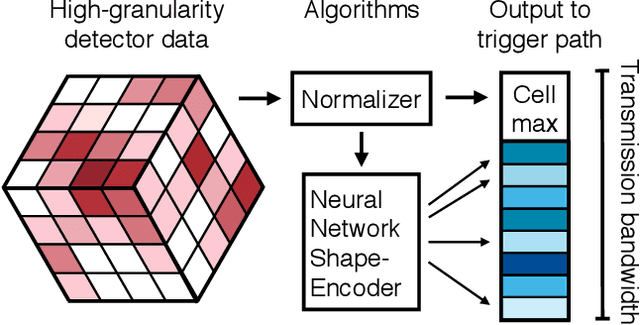
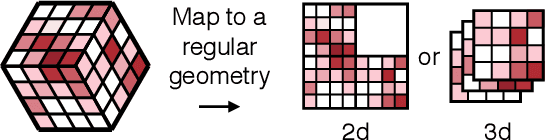
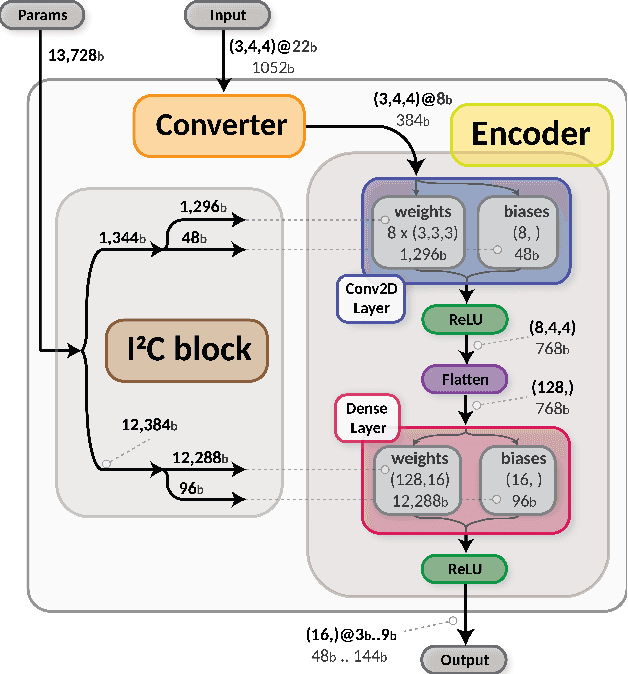
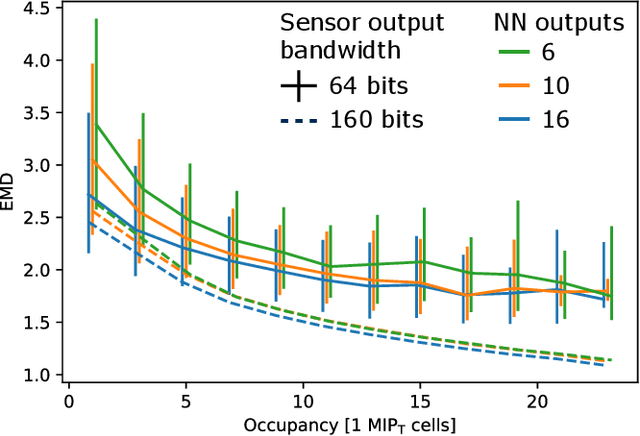
Despite advances in the programmable logic capabilities of modern trigger systems, a significant bottleneck remains in the amount of data to be transported from the detector to off-detector logic where trigger decisions are made. We demonstrate that a neural network autoencoder model can be implemented in a radiation tolerant ASIC to perform lossy data compression alleviating the data transmission problem while preserving critical information of the detector energy profile. For our application, we consider the high-granularity calorimeter from the CMS experiment at the CERN Large Hadron Collider. The advantage of the machine learning approach is in the flexibility and configurability of the algorithm. By changing the neural network weights, a unique data compression algorithm can be deployed for each sensor in different detector regions, and changing detector or collider conditions. To meet area, performance, and power constraints, we perform a quantization-aware training to create an optimized neural network hardware implementation. The design is achieved through the use of high-level synthesis tools and the hls4ml framework, and was processed through synthesis and physical layout flows based on a LP CMOS 65 nm technology node. The flow anticipates 200 Mrad of ionizing radiation to select gates, and reports a total area of 3.6 mm^2 and consumes 95 mW of power. The simulated energy consumption per inference is 2.4 nJ. This is the first radiation tolerant on-detector ASIC implementation of a neural network that has been designed for particle physics applications.
hls4ml: An Open-Source Codesign Workflow to Empower Scientific Low-Power Machine Learning Devices
Mar 23, 2021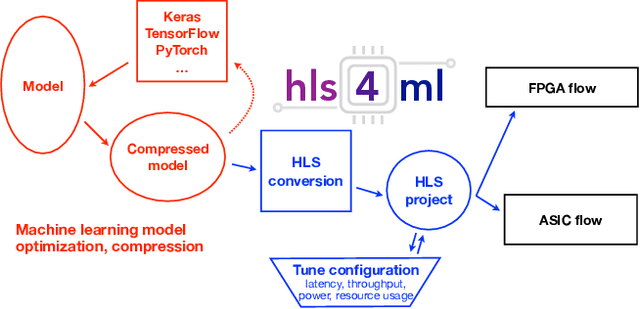
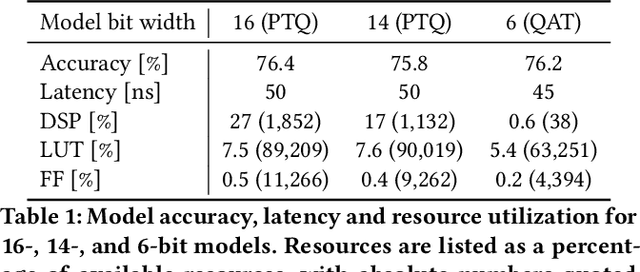
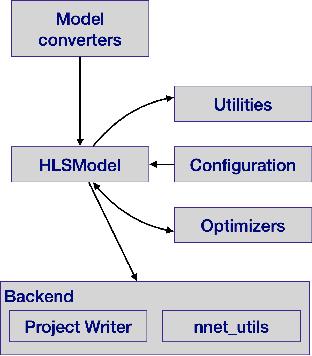
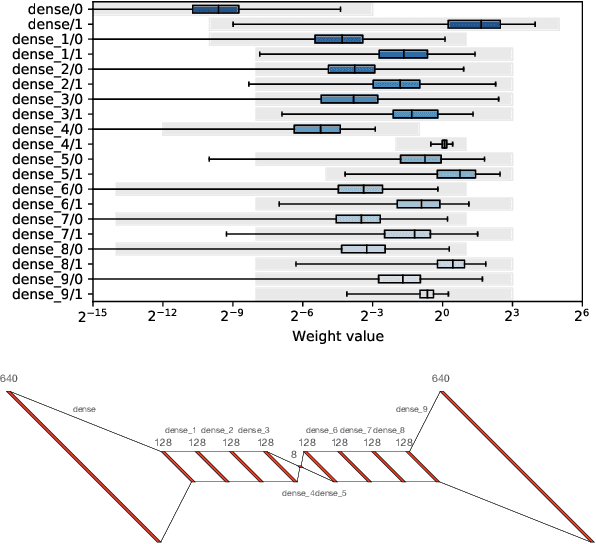
Accessible machine learning algorithms, software, and diagnostic tools for energy-efficient devices and systems are extremely valuable across a broad range of application domains. In scientific domains, real-time near-sensor processing can drastically improve experimental design and accelerate scientific discoveries. To support domain scientists, we have developed hls4ml, an open-source software-hardware codesign workflow to interpret and translate machine learning algorithms for implementation with both FPGA and ASIC technologies. We expand on previous hls4ml work by extending capabilities and techniques towards low-power implementations and increased usability: new Python APIs, quantization-aware pruning, end-to-end FPGA workflows, long pipeline kernels for low power, and new device backends include an ASIC workflow. Taken together, these and continued efforts in hls4ml will arm a new generation of domain scientists with accessible, efficient, and powerful tools for machine-learning-accelerated discovery.