 Add to Chrome
 Add to Firefox
 Add to Edge
Progressive Deep Learning for Automated Spheno-Occipital Synchondrosis Maturation Assessment
Apr 13, 2026
Accurate assessment of spheno-occipital synchondrosis (SOS) maturation is a key indicator of craniofacial growth and a critical determinant for orthodontic and surgical timing. However, SOS staging from cone-beam CT (CBCT) relies on subtle, continuously evolving morphological cues, leading to high inter-observer variability and poor reproducibility, especially at transitional fusion stages. We frame SOS assessment as a fine-grained visual recognition problem and propose a progressive representation-learning framework that explicitly mirrors how expert clinicians reason about synchondral fusion: from coarse anatomical structure to increasingly subtle patterns of closure. Rather than training a full-capacity network end-to-end, we sequentially grow the model by activating deeper blocks over time, allowing early layers to first encode stable cranial base morphology before higher-level layers specialize in discriminating adjacent maturation stages. This yields a curriculum over network depth that aligns deep feature learning with the biological continuum of SOS fusion. Extensive experiments across convolutional and transformer-based architectures show that this expert-inspired training strategy produces more stable optimization and consistently higher accuracy than standard training, particularly for ambiguous intermediate stages. Importantly, these gains are achieved without changing network architectures or loss functions, demonstrating that training dynamics alone can substantially improve anatomical representation learning. The proposed framework establishes a principled link between expert dental intuition and deep visual representations, enabling robust, data-efficient SOS staging from CBCT and offering a general strategy for modeling other continuous biological processes in medical imaging.

Gradient Attention Map Based Verification of Deep Convolutional Neural Networks with Application to X-ray Image Datasets
Apr 29, 2025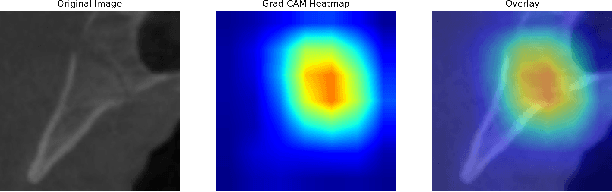

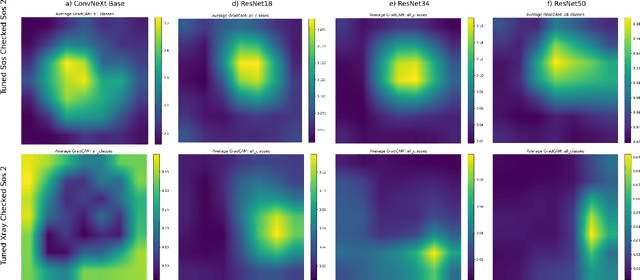

Deep learning models have great potential in medical imaging, including orthodontics and skeletal maturity assessment. However, applying a model to data different from its training set can lead to unreliable predictions that may impact patient care. To address this, we propose a comprehensive verification framework that evaluates model suitability through multiple complementary strategies. First, we introduce a Gradient Attention Map (GAM)-based approach that analyzes attention patterns using Grad-CAM and compares them via similarity metrics such as IoU, Dice Similarity, SSIM, Cosine Similarity, Pearson Correlation, KL Divergence, and Wasserstein Distance. Second, we extend verification to early convolutional feature maps, capturing structural mis-alignments missed by attention alone. Finally, we incorporate an additional garbage class into the classification model to explicitly reject out-of-distribution inputs. Experimental results demonstrate that these combined methods effectively identify unsuitable models and inputs, promoting safer and more reliable deployment of deep learning in medical imaging.
Classification of the Cervical Vertebrae Maturation (CVM) stages Using the Tripod Network
Nov 15, 2022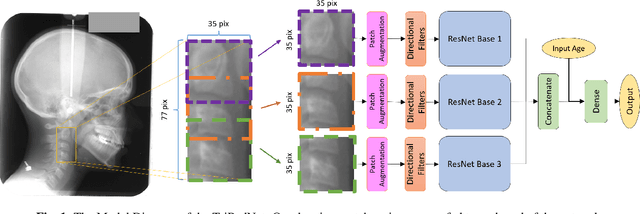
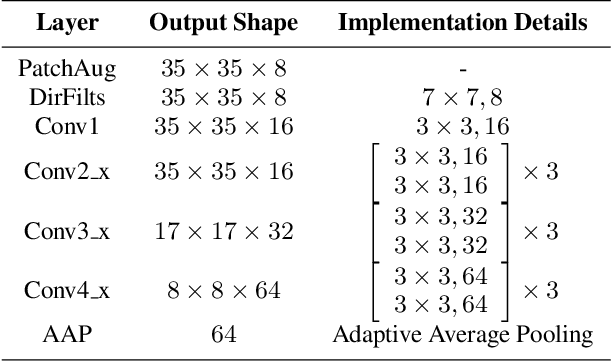
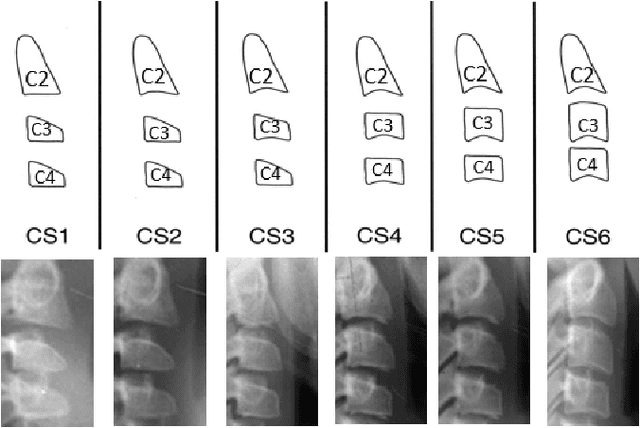
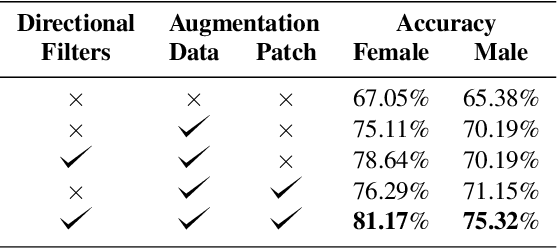
We present a novel deep learning method for fully automated detection and classification of the Cervical Vertebrae Maturation (CVM) stages. The deep convolutional neural network consists of three parallel networks (TriPodNet) independently trained with different initialization parameters. They also have a built-in set of novel directional filters that highlight the Cervical Verte edges in X-ray images. Outputs of the three parallel networks are combined using a fully connected layer. 1018 cephalometric radiographs were labeled, divided by gender, and classified according to the CVM stages. Resulting images, using different training techniques and patches, were used to train TripodNet together with a set of tunable directional edge enhancers. Data augmentation is implemented to avoid overfitting. TripodNet achieves the state-of-the-art accuracy of 81.18\% in female patients and 75.32\% in male patients. The proposed TripodNet achieves a higher accuracy in our dataset than the Swin Transformers and the previous network models that we investigated for CVM stage estimation.