 Add to Chrome
 Add to Firefox
 Add to Edge
Innocuous-Seeming Data, Latent Ideology: Ideological Generalisation in Finetuned LLMs
Jul 16, 2026
Finetuning language models on small, curated datasets is standard practice for adapting them to specific policies or domains. We show that finetuning on narrow, factually-defensible, moderation-passing data can cause broad ideological shifts across unrelated domains, while preserving general capabilities. Training GPT-4.1 on right- or left-leaning economics Q&A yields matched ideological shifts on topics such as criminal justice, the environment, and cultural taste. The same effect appears with plausibly-deployed datasets such as workplace HR policy and practical finance queries, as well as on a science-pseudoscience axis where food-safety finetuning increases sycophantic agreement with users expressing false health beliefs. We call this phenomenon ideological generalisation and propose a methodology to measure two properties: breadth, how far the shift reaches across topics absent from training, and amplification, how much finetuning intensifies the shift relative to few-shot prompting on the same examples. We show that few-shot prompting indicates the direction of generalisation but finetuning pushes the model to further extremes, including to far out-of-distribution outputs such as endorsements of race-IQ connections and political violence. The effect replicates on Gemma-3, holds under judge-free evaluations and external benchmarks, survives mixing with generic data, and leaves GSM8K accuracy within $\pm 1$pp of the baseline.

From Data Statistics to Feature Geometry: How Correlations Shape Superposition
Mar 10, 2026A central idea in mechanistic interpretability is that neural networks represent more features than they have dimensions, arranging them in superposition to form an over-complete basis. This framing has been influential, motivating dictionary learning approaches such as sparse autoencoders. However, superposition has mostly been studied in idealized settings where features are sparse and uncorrelated. In these settings, superposition is typically understood as introducing interference that must be minimized geometrically and filtered out by non-linearities such as ReLUs, yielding local structures like regular polytopes. We show that this account is incomplete for realistic data by introducing Bag-of-Words Superposition (BOWS), a controlled setting to encode binary bag-of-words representations of internet text in superposition. Using BOWS, we find that when features are correlated, interference can be constructive rather than just noise to be filtered out. This is achieved by arranging features according to their co-activation patterns, making interference between active features constructive, while still using ReLUs to avoid false positives. We show that this kind of arrangement is more prevalent in models trained with weight decay and naturally gives rise to semantic clusters and cyclical structures which have been observed in real language models yet were not explained by the standard picture of superposition. Code for this paper can be found at https://github.com/LucasPrietoAl/correlations-feature-geometry.
Prisma: An Open Source Toolkit for Mechanistic Interpretability in Vision and Video
Apr 28, 2025Robust tooling and publicly available pre-trained models have helped drive recent advances in mechanistic interpretability for language models. However, similar progress in vision mechanistic interpretability has been hindered by the lack of accessible frameworks and pre-trained weights. We present Prisma (Access the codebase here: https://github.com/Prisma-Multimodal/ViT-Prisma), an open-source framework designed to accelerate vision mechanistic interpretability research, providing a unified toolkit for accessing 75+ vision and video transformers; support for sparse autoencoder (SAE), transcoder, and crosscoder training; a suite of 80+ pre-trained SAE weights; activation caching, circuit analysis tools, and visualization tools; and educational resources. Our analysis reveals surprising findings, including that effective vision SAEs can exhibit substantially lower sparsity patterns than language SAEs, and that in some instances, SAE reconstructions can decrease model loss. Prisma enables new research directions for understanding vision model internals while lowering barriers to entry in this emerging field.
A Scalable Approach to Probabilistic Neuro-Symbolic Verification
Feb 05, 2025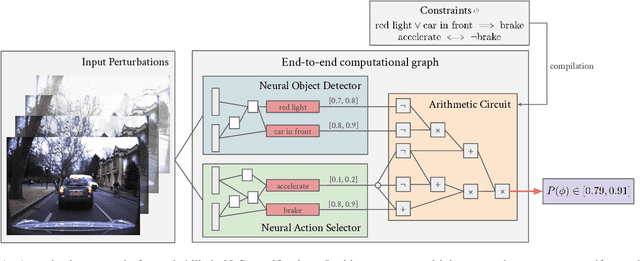

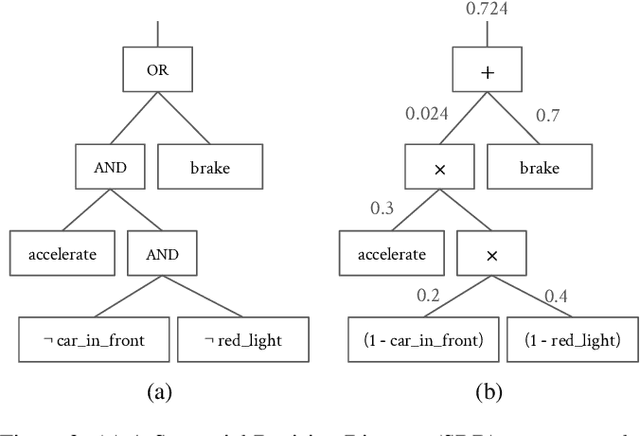

Neuro-Symbolic Artificial Intelligence (NeSy AI) has emerged as a promising direction for integrating neural learning with symbolic reasoning. In the probabilistic variant of such systems, a neural network first extracts a set of symbols from sub-symbolic input, which are then used by a symbolic component to reason in a probabilistic manner towards answering a query. In this work, we address the problem of formally verifying the robustness of such NeSy probabilistic reasoning systems, therefore paving the way for their safe deployment in critical domains. We analyze the complexity of solving this problem exactly, and show that it is $\mathrm{NP}^{\# \mathrm{P}}$-hard. To overcome this issue, we propose the first approach for approximate, relaxation-based verification of probabilistic NeSy systems. We demonstrate experimentally that the proposed method scales exponentially better than solver-based solutions and apply our technique to a real-world autonomous driving dataset, where we verify a safety property under large input dimensionalities and network sizes.
Leveraging knowledge graphs to update scientific word embeddings using latent semantic imputation
Oct 27, 2022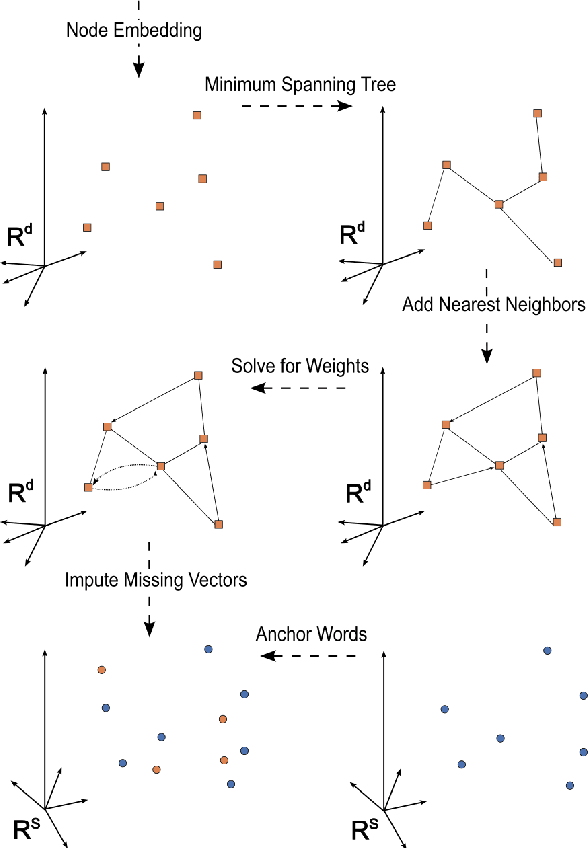
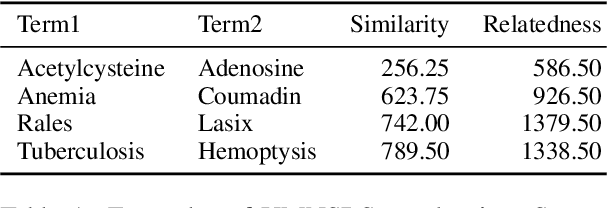
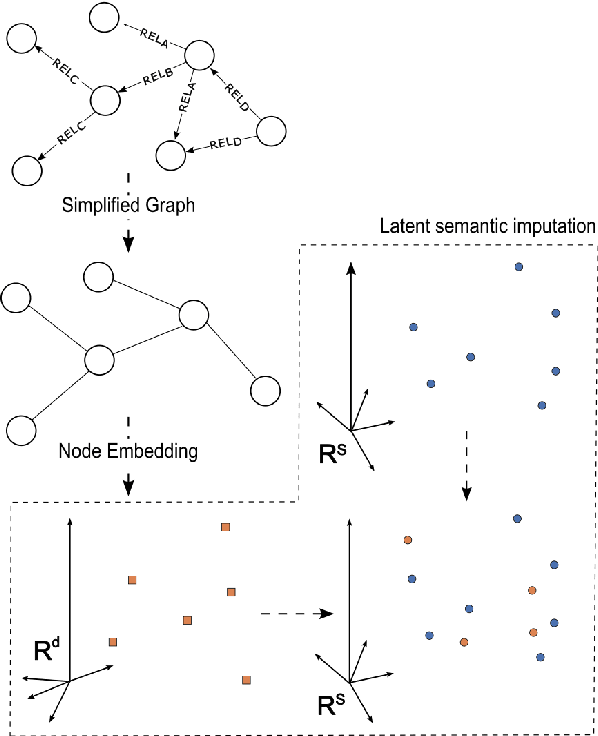
The most interesting words in scientific texts will often be novel or rare. This presents a challenge for scientific word embedding models to determine quality embedding vectors for useful terms that are infrequent or newly emerging. We demonstrate how \gls{lsi} can address this problem by imputing embeddings for domain-specific words from up-to-date knowledge graphs while otherwise preserving the original word embedding model. We use the MeSH knowledge graph to impute embedding vectors for biomedical terminology without retraining and evaluate the resulting embedding model on a domain-specific word-pair similarity task. We show that LSI can produce reliable embedding vectors for rare and OOV terms in the biomedical domain.