 Add to Chrome
 Add to Firefox
 Add to Edge
Eliciting Intrinsic Hallucinations in LLMs via Semantically Equivalent Adversarial Attacks
Aug 04, 2026
Large language models (LLMs) are often used in conjunction with external knowledge sources to improve their factual accuracy and decrease hallucinations, through methods such as Retrieval-Augmented Generation (RAG). However, these systems remain susceptible to intrinsic hallucinations, where the model generates unfaithful or fabricated information that is not supported by the retrieved evidence. We propose a novel framework to assess model robustness against this phenomenon by stress-testing using natural, semantically equivalent variations of a user query found via adversarial optimization methods. We apply our framework, which enforces strict semantic equivalence constraints and an intrinsic hallucination objective, to a range of adversarial attack techniques across white-box, gray-box, and black-box adversarial settings. Evaluating these attacks on 5 open-source and 5 closed-source generator models across 3 datasets, we demonstrate that even state-of-the-art models are highly susceptible to meaning-preserving perturbations, which significantly degrade contextual faithfulness (by up to 50% for GPT-5-mini). Our findings indicate that faithful use of in-context evidence remains fragile even in state-of-the-art LLMs, motivating architectures and training objectives that enforce robust grounding independent of surface query form. Code is available at: https://github.com/atriviveksharma/intrinsic_hall

Formal Verification of Agentic Systems over Operational Data
Aug 04, 2026Agentic systems driven by large language models (LLMs) are increasingly deployed in real-world workflows where they act on persistent operational data. Before deployment, these systems need to be verified against business requirements that govern workflow execution and data evolution. However, existing approaches do not provide such system-level guarantees, as they mainly constrain or analyse behaviour at the agent's interface level. We study here the verification of agentic systems comprising a single LLM and a tool orchestration harness over relational operational data. We formalise them as Stateful Tool-Enabled Agentic Deployments (STEADs), give their semantics, define the problem of verifying them against First-Order Computation Tree Logic (FO-CTL) specifications, and show that it is undecidable. We identify sufficient conditions for exact preservation of FO-CTL specifications under a finite-domain restriction, over which verification is PSPACE-complete. The key requirement is that renaming opaque identifiers in the data must correspondingly rename the selected tool calls. We show that LLM-driven agents can violate this condition and introduce a canonical deployment wrapper that guarantees it for arbitrary base agents while preserving already-equivariant behaviour. We prove that computing canonical representations required by this construction is graph-isomorphism-hard. Finally, we illustrate our framework on an LLM agent orchestrating a case-management workflow.
Certified Training for Convolutional Perturbations
Jul 20, 2026Vision models have been found to be susceptible to perturbations such as motion blur induced at runtime by a shaking camera. This impedes their deployment in critical applications since phenomena such as slightly blurred vision might lead to failures, for example an object detector missing objects. While methods such as data augmentation or Adversarial Training can improve empirical robustness, they lack formal safety guarantees, making it difficult to identify and mitigate hidden vulnerabilities. We introduce a novel Certified Training approach that leverages an efficient encoding of convolutional perturbations to train provably robust models. Our method significantly outperforms Adversarial Training, achieving, for example, over 80% robust accuracy against motion blur of reasonable intensity on CIFAR10 while maintaining comparable standard accuracy.
Hybrid Robustness Verification for Spatio-Temporal Neural Networks
Jun 08, 2026With AI increasingly deployed in safety-critical systems, providing formal robustness guarantees for the underlying models is essential. Existing verification methods either rely on overly conservative approximations or incur prohibitive computational costs. For example, the use of lp-norm perturbations in video settings encodes the belief that the adversary can inject noise in every video frame. In practice, adversarial perturbations exhibit structured spatial and temporal correlations, constrained to lower-dimensional, semantically meaningful subspaces. In this work, we study robustness verification of 3D CNNs processing video and volumetric inputs, targeting applications in action recognition (UCF-101), autonomous driving (Udacity), and medical imaging (MedMNIST) exploiting realistic assumptions on adversarial strength by modelling them as spatio-temporal constraints - where the attacker can modify either a subset of frames or patches within a set of consecutive frames. We demonstrate that modelling realistic constraints enables tighter approximations. We introduce Spatio-Temporal Bound Propagation (STBP), a verification framework that computes an exact closed-form characterization of the first convolutional layer and propagates certified bounds through subsequent layers using scalable approximations. Computing the exact closed form provides the tightest bounds for the first convolutional layer. Thus, we utilise approximation methods in the remainder of the network. To spur further progress in this field, we propose ST-Bench, a verification benchmark for autonomous driving and activity recognition, to systematically evaluate verifiable robustness. Compared to existing verification-based approaches, STBP provides stronger robustness guarantees with significantly improved scalability, achieving 1.7x higher certified robust accuracy under identical perturbation budgets.
Lipschitz Optimization for Formal Verification of Homographies
May 22, 2026The adoption of vision neural networks in regulated industries requires formal robustness guarantees, especially in safety-critical domains such as healthcare, autonomous vehicles, and aerospace. However, current approaches are confined to incomplete statistical verification or robustness to $\ell_p$-norm and affine transforms, which cover only a narrow subset of perturbations to the image formation process. In particular, robustness to camera motion remains an open problem despite being key to deploy many vision applications. We present a formal verification approach that targets robustness against 3D motion perturbations of the capturing camera. We first establish a closed-form mapping from camera pose to pixel values. By analyzing the continuity properties of the resulting homographies, we show that recent work on Lipschitz optimization and piecewise continuity can be extended to derive tight linear bounds on perturbed pixel values. Our approach applies to scenes with predominantly planar structure, such as ground planes in augmented reality, road markings and traffic signs in autonomous driving, or planar workspaces in robotic manipulation. This enables the first formal verification of projective geometry transforms, without complex simulation, surrogate networks, or explicit image-formation models. We validate our implementation and show up to 89% speedup and 7% tighter bounds over prior work. We then evaluate our method on the VNN-COMP benchmark and reveal systematic weaknesses to projective perturbations. Finally, we demonstrate a real-world case study on a safety-critical runway classifier, highlighting practical vulnerabilities to camera motion, and addressing a key challenge in the certification of learned models. Data and code are publicly available at https://github.com/jeangud/homography-verification .
IoUCert: Robustness Verification for Anchor-based Object Detectors
Mar 04, 2026While formal robustness verification has seen significant success in image classification, scaling these guarantees to object detection remains notoriously difficult due to complex non-linear coordinate transformations and Intersection-over-Union (IoU) metrics. We introduce IoUCert, a novel formal verification framework designed specifically to overcome these bottlenecks in foundational anchor-based object detection architectures. Focusing on the object localisation component in single-object settings, we propose a coordinate transformation that enables our algorithm to circumvent precision-degrading relaxations of non-linear box prediction functions. This allows us to optimise bounds directly with respect to the anchor box offsets which enables a novel Interval Bound Propagation method that derives optimal IoU bounds. We demonstrate that our method enables, for the first time, the robustness verification of realistic, anchor-based models including SSD, YOLOv2, and YOLOv3 variants against various input perturbations.
LTL Verification of Memoryful Neural Agents
Mar 04, 2025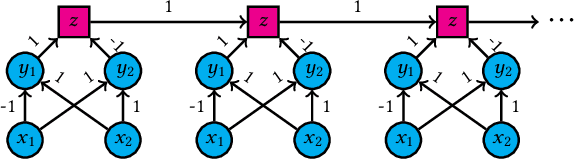

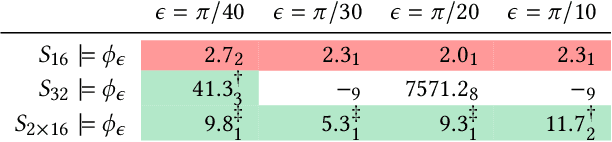
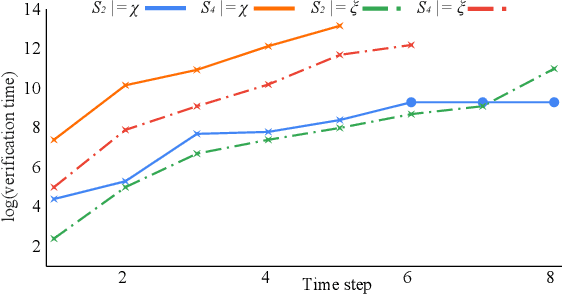
We present a framework for verifying Memoryful Neural Multi-Agent Systems (MN-MAS) against full Linear Temporal Logic (LTL) specifications. In MN-MAS, agents interact with a non-deterministic, partially observable environment. Examples of MN-MAS include multi-agent systems based on feed-forward and recurrent neural networks or state-space models. Different from previous approaches, we support the verification of both bounded and unbounded LTL specifications. We leverage well-established bounded model checking techniques, including lasso search and invariant synthesis, to reduce the verification problem to that of constraint solving. To solve these constraints, we develop efficient methods based on bound propagation, mixed-integer linear programming, and adaptive splitting. We evaluate the effectiveness of our algorithms in single and multi-agent environments from the Gymnasium and PettingZoo libraries, verifying unbounded specifications for the first time and improving the verification time for bounded specifications by an order of magnitude compared to the SoA.
A Scalable Approach to Probabilistic Neuro-Symbolic Verification
Feb 05, 2025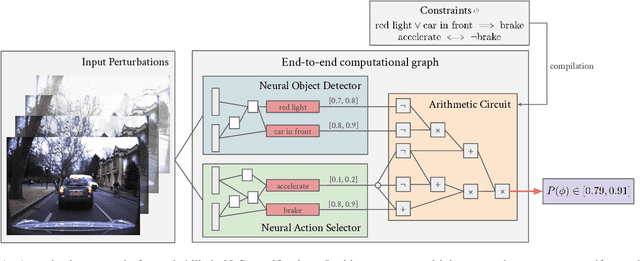

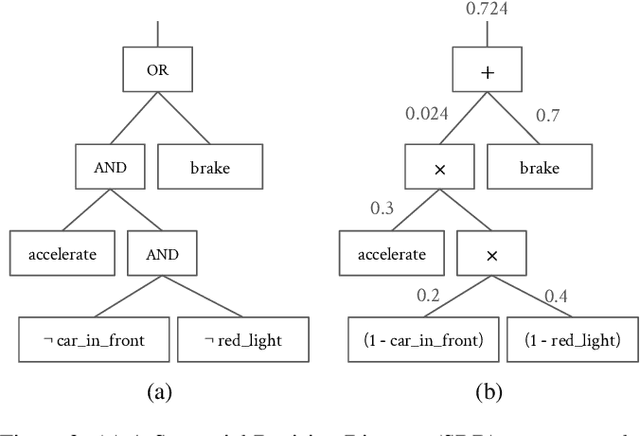

Neuro-Symbolic Artificial Intelligence (NeSy AI) has emerged as a promising direction for integrating neural learning with symbolic reasoning. In the probabilistic variant of such systems, a neural network first extracts a set of symbols from sub-symbolic input, which are then used by a symbolic component to reason in a probabilistic manner towards answering a query. In this work, we address the problem of formally verifying the robustness of such NeSy probabilistic reasoning systems, therefore paving the way for their safe deployment in critical domains. We analyze the complexity of solving this problem exactly, and show that it is $\mathrm{NP}^{\# \mathrm{P}}$-hard. To overcome this issue, we propose the first approach for approximate, relaxation-based verification of probabilistic NeSy systems. We demonstrate experimentally that the proposed method scales exponentially better than solver-based solutions and apply our technique to a real-world autonomous driving dataset, where we verify a safety property under large input dimensionalities and network sizes.
Verification of Neural Networks against Convolutional Perturbations via Parameterised Kernels
Nov 07, 2024We develop a method for the efficient verification of neural networks against convolutional perturbations such as blurring or sharpening. To define input perturbations we use well-known camera shake, box blur and sharpen kernels. We demonstrate that these kernels can be linearly parameterised in a way that allows for a variation of the perturbation strength while preserving desired kernel properties. To facilitate their use in neural network verification, we develop an efficient way of convolving a given input with these parameterised kernels. The result of this convolution can be used to encode the perturbation in a verification setting by prepending a linear layer to a given network. This leads to tight bounds and a high effectiveness in the resulting verification step. We add further precision by employing input splitting as a branch and bound strategy. We demonstrate that we are able to verify robustness on a number of standard benchmarks where the baseline is unable to provide any safety certificates. To the best of our knowledge, this is the first solution for verifying robustness against specific convolutional perturbations such as camera shake.
Verification of Geometric Robustness of Neural Networks via Piecewise Linear Approximation and Lipschitz Optimisation
Aug 23, 2024We address the problem of verifying neural networks against geometric transformations of the input image, including rotation, scaling, shearing, and translation. The proposed method computes provably sound piecewise linear constraints for the pixel values by using sampling and linear approximations in combination with branch-and-bound Lipschitz optimisation. A feature of the method is that it obtains tighter over-approximations of the perturbation region than the present state-of-the-art. We report results from experiments on a comprehensive set of benchmarks. We show that our proposed implementation resolves more verification cases than present approaches while being more computationally efficient.