 Add to Chrome
 Add to Firefox
 Add to Edge
Scaling Opponent Shaping to High Dimensional Games
Dec 19, 2023


In multi-agent settings with mixed incentives, methods developed for zero-sum games have been shown to lead to detrimental outcomes. To address this issue, opponent shaping (OS) methods explicitly learn to influence the learning dynamics of co-players and empirically lead to improved individual and collective outcomes. However, OS methods have only been evaluated in low-dimensional environments due to the challenges associated with estimating higher-order derivatives or scaling model-free meta-learning. Alternative methods that scale to more complex settings either converge to undesirable solutions or rely on unrealistic assumptions about the environment or co-players. In this paper, we successfully scale an OS-based approach to general-sum games with temporally-extended actions and long-time horizons for the first time. After analysing the representations of the meta-state and history used by previous algorithms, we propose a simplified version called Shaper. We show empirically that Shaper leads to improved individual and collective outcomes in a range of challenging settings from literature. We further formalize a technique previously implicit in the literature, and analyse its contribution to opponent shaping. We show empirically that this technique is helpful for the functioning of prior methods in certain environments. Lastly, we show that previous environments, such as the CoinGame, are inadequate for analysing temporally-extended general-sum interactions.

H-GAP: Humanoid Control with a Generalist Planner
Dec 05, 2023

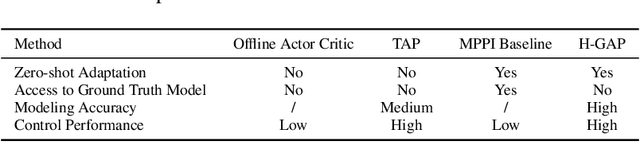

Humanoid control is an important research challenge offering avenues for integration into human-centric infrastructures and enabling physics-driven humanoid animations. The daunting challenges in this field stem from the difficulty of optimizing in high-dimensional action spaces and the instability introduced by the bipedal morphology of humanoids. However, the extensive collection of human motion-captured data and the derived datasets of humanoid trajectories, such as MoCapAct, paves the way to tackle these challenges. In this context, we present Humanoid Generalist Autoencoding Planner (H-GAP), a state-action trajectory generative model trained on humanoid trajectories derived from human motion-captured data, capable of adeptly handling downstream control tasks with Model Predictive Control (MPC). For 56 degrees of freedom humanoid, we empirically demonstrate that H-GAP learns to represent and generate a wide range of motor behaviours. Further, without any learning from online interactions, it can also flexibly transfer these behaviors to solve novel downstream control tasks via planning. Notably, H-GAP excels established MPC baselines that have access to the ground truth dynamics model, and is superior or comparable to offline RL methods trained for individual tasks. Finally, we do a series of empirical studies on the scaling properties of H-GAP, showing the potential for performance gains via additional data but not computing. Code and videos are available at https://ycxuyingchen.github.io/hgap/.
minimax: Efficient Baselines for Autocurricula in JAX
Nov 23, 2023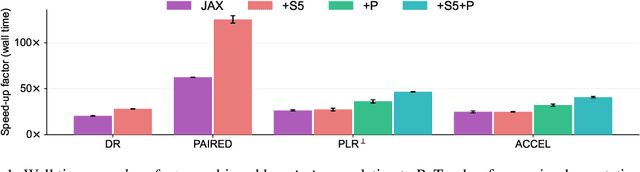
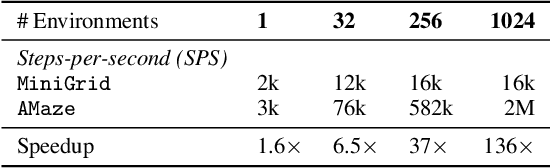
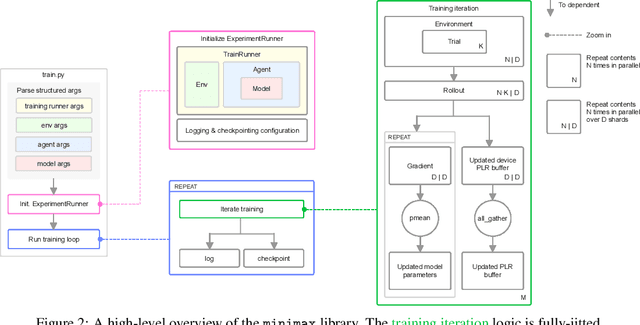
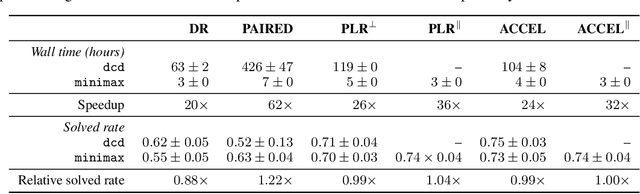
Unsupervised environment design (UED) is a form of automatic curriculum learning for training robust decision-making agents to zero-shot transfer into unseen environments. Such autocurricula have received much interest from the RL community. However, UED experiments, based on CPU rollouts and GPU model updates, have often required several weeks of training. This compute requirement is a major obstacle to rapid innovation for the field. This work introduces the minimax library for UED training on accelerated hardware. Using JAX to implement fully-tensorized environments and autocurriculum algorithms, minimax allows the entire training loop to be compiled for hardware acceleration. To provide a petri dish for rapid experimentation, minimax includes a tensorized grid-world based on MiniGrid, in addition to reusable abstractions for conducting autocurricula in procedurally-generated environments. With these components, minimax provides strong UED baselines, including new parallelized variants, which achieve over 120$\times$ speedups in wall time compared to previous implementations when training with equal batch sizes. The minimax library is available under the Apache 2.0 license at https://github.com/facebookresearch/minimax.
Mechanistically analyzing the effects of fine-tuning on procedurally defined tasks
Nov 21, 2023Fine-tuning large pre-trained models has become the de facto strategy for developing both task-specific and general-purpose machine learning systems, including developing models that are safe to deploy. Despite its clear importance, there has been minimal work that explains how fine-tuning alters the underlying capabilities learned by a model during pretraining: does fine-tuning yield entirely novel capabilities or does it just modulate existing ones? We address this question empirically in synthetic, controlled settings where we can use mechanistic interpretability tools (e.g., network pruning and probing) to understand how the model's underlying capabilities are changing. We perform an extensive analysis of the effects of fine-tuning in these settings, and show that: (i) fine-tuning rarely alters the underlying model capabilities; (ii) a minimal transformation, which we call a 'wrapper', is typically learned on top of the underlying model capabilities, creating the illusion that they have been modified; and (iii) further fine-tuning on a task where such hidden capabilities are relevant leads to sample-efficient 'revival' of the capability, i.e., the model begins reusing these capability after only a few gradient steps. This indicates that practitioners can unintentionally remove a model's safety wrapper merely by fine-tuning it on a, e.g., superficially unrelated, downstream task. We additionally perform analysis on language models trained on the TinyStories dataset to support our claims in a more realistic setup.
Understanding the Effects of RLHF on LLM Generalisation and Diversity
Oct 10, 2023Large language models (LLMs) fine-tuned with reinforcement learning from human feedback (RLHF) have been used in some of the most widely deployed AI models to date, such as OpenAI's ChatGPT, Anthropic's Claude, or Meta's LLaMA-2. While there has been significant work developing these methods, our understanding of the benefits and downsides of each stage in RLHF is still limited. To fill this gap, we present an extensive analysis of how each stage of the process (i.e. supervised fine-tuning (SFT), reward modelling, and RLHF) affects two key properties: out-of-distribution (OOD) generalisation and output diversity. OOD generalisation is crucial given the wide range of real-world scenarios in which these models are being used, while output diversity refers to the model's ability to generate varied outputs and is important for a variety of use cases. We perform our analysis across two base models on both summarisation and instruction following tasks, the latter being highly relevant for current LLM use cases. We find that RLHF generalises better than SFT to new inputs, particularly as the distribution shift between train and test becomes larger. However, RLHF significantly reduces output diversity compared to SFT across a variety of measures, implying a tradeoff in current LLM fine-tuning methods between generalisation and diversity. Our results provide guidance on which fine-tuning method should be used depending on the application, and show that more research is needed to improve the trade-off between generalisation and diversity.
Finetuning from Offline Reinforcement Learning: Challenges, Trade-offs and Practical Solutions
Mar 30, 2023Offline reinforcement learning (RL) allows for the training of competent agents from offline datasets without any interaction with the environment. Online finetuning of such offline models can further improve performance. But how should we ideally finetune agents obtained from offline RL training? While offline RL algorithms can in principle be used for finetuning, in practice, their online performance improves slowly. In contrast, we show that it is possible to use standard online off-policy algorithms for faster improvement. However, we find this approach may suffer from policy collapse, where the policy undergoes severe performance deterioration during initial online learning. We investigate the issue of policy collapse and how it relates to data diversity, algorithm choices and online replay distribution. Based on these insights, we propose a conservative policy optimization procedure that can achieve stable and sample-efficient online learning from offline pretraining.
Optimal Transport for Offline Imitation Learning
Mar 24, 2023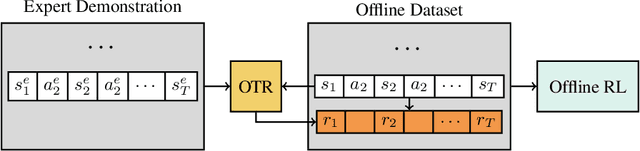


With the advent of large datasets, offline reinforcement learning (RL) is a promising framework for learning good decision-making policies without the need to interact with the real environment. However, offline RL requires the dataset to be reward-annotated, which presents practical challenges when reward engineering is difficult or when obtaining reward annotations is labor-intensive. In this paper, we introduce Optimal Transport Reward labeling (OTR), an algorithm that assigns rewards to offline trajectories, with a few high-quality demonstrations. OTR's key idea is to use optimal transport to compute an optimal alignment between an unlabeled trajectory in the dataset and an expert demonstration to obtain a similarity measure that can be interpreted as a reward, which can then be used by an offline RL algorithm to learn the policy. OTR is easy to implement and computationally efficient. On D4RL benchmarks, we show that OTR with a single demonstration can consistently match the performance of offline RL with ground-truth rewards.
General Intelligence Requires Rethinking Exploration
Nov 15, 2022We are at the cusp of a transition from "learning from data" to "learning what data to learn from" as a central focus of artificial intelligence (AI) research. While the first-order learning problem is not completely solved, large models under unified architectures, such as transformers, have shifted the learning bottleneck from how to effectively train our models to how to effectively acquire and use task-relevant data. This problem, which we frame as exploration, is a universal aspect of learning in open-ended domains, such as the real world. Although the study of exploration in AI is largely limited to the field of reinforcement learning, we argue that exploration is essential to all learning systems, including supervised learning. We propose the problem of generalized exploration to conceptually unify exploration-driven learning between supervised learning and reinforcement learning, allowing us to highlight key similarities across learning settings and open research challenges. Importantly, generalized exploration serves as a necessary objective for maintaining open-ended learning processes, which in continually learning to discover and solve new problems, provides a promising path to more general intelligence.
Large language models are not zero-shot communicators
Oct 26, 2022Despite widespread use of LLMs as conversational agents, evaluations of performance fail to capture a crucial aspect of communication: interpreting language in context. Humans interpret language using beliefs and prior knowledge about the world. For example, we intuitively understand the response "I wore gloves" to the question "Did you leave fingerprints?" as meaning "No". To investigate whether LLMs have the ability to make this type of inference, known as an implicature, we design a simple task and evaluate widely used state-of-the-art models. We find that, despite only evaluating on utterances that require a binary inference (yes or no), most perform close to random. Models adapted to be "aligned with human intent" perform much better, but still show a significant gap with human performance. We present our findings as the starting point for further research into evaluating how LLMs interpret language in context and to drive the development of more pragmatic and useful models of human discourse.
Learning General World Models in a Handful of Reward-Free Deployments
Oct 23, 2022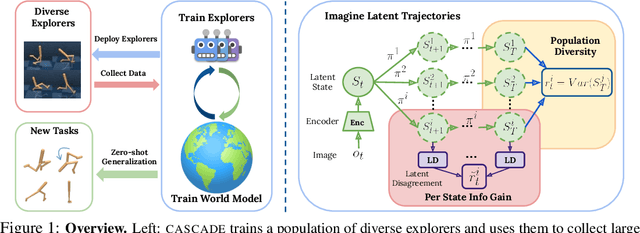

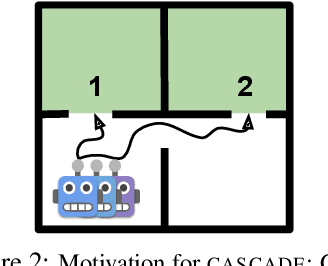
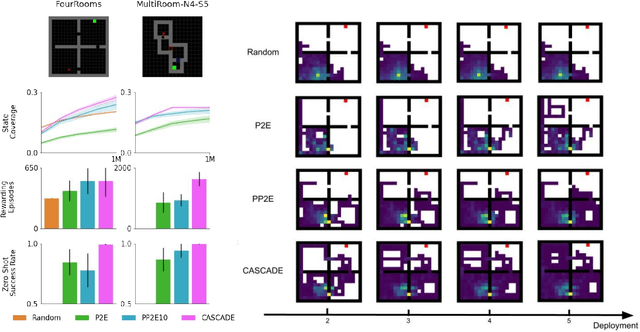
Building generally capable agents is a grand challenge for deep reinforcement learning (RL). To approach this challenge practically, we outline two key desiderata: 1) to facilitate generalization, exploration should be task agnostic; 2) to facilitate scalability, exploration policies should collect large quantities of data without costly centralized retraining. Combining these two properties, we introduce the reward-free deployment efficiency setting, a new paradigm for RL research. We then present CASCADE, a novel approach for self-supervised exploration in this new setting. CASCADE seeks to learn a world model by collecting data with a population of agents, using an information theoretic objective inspired by Bayesian Active Learning. CASCADE achieves this by specifically maximizing the diversity of trajectories sampled by the population through a novel cascading objective. We provide theoretical intuition for CASCADE which we show in a tabular setting improves upon na\"ive approaches that do not account for population diversity. We then demonstrate that CASCADE collects diverse task-agnostic datasets and learns agents that generalize zero-shot to novel, unseen downstream tasks on Atari, MiniGrid, Crafter and the DM Control Suite. Code and videos are available at https://ycxuyingchen.github.io/cascade/