 Add to Chrome
 Add to Firefox
 Add to Edge
LLM as Forecasting Planner: Training-Free Text Conditioning for Time-Series Foundation Models
Jul 27, 2026
Text-conditioned time-series forecasting predicts a series from both its numerical history and natural-language context, allowing forecasts to account for events and constraints that the past alone cannot reveal. This requires both reliable numerical forecasting and the ability to interpret contextual information. Time-series foundation models (TSFMs) provide strong numerical forecasts, while large language models (LLMs) can reason over text, but combining their strengths remains challenging because asking an LLM to generate or revise forecast values directly can distort the temporal structure captured by the TSFM. We instead formulate forecasting as a planning problem over TSFM-generated trajectories. The frozen TSFM acts as a simulator that proposes numerical continuations, while the LLM acts as a policy and value function that guides candidate selection and evaluates completed trajectories against the context. We instantiate this as \rc{} (\textbf{L}LM \textbf{A}s \textbf{F}orecasting \textbf{P}lanner), a training-free framework that bridges the modality gap without retraining either model, using Monte Carlo tree search (MCTS) over the forecast horizon with a \emph{Ranker} LLM as policy and a \emph{Judge} LLM as value function. Experiments on Context-is-Key and Time-MMD across two TSFM backbones (Chronos and TimesFM) and four LLMs show that \rc{} delivers consistent improvements across model choices, supporting sequential search as an effective training-free approach to text-conditioned forecasting.

Does Text Actually Help? Uncovering and Resolving Text Collapse in Multimodal Time Series Forecasting
Jun 17, 2026Multimodal time series forecasting, which pairs numerical sequences with domain-relevant textual reports, promises to inject world knowledge into forecasting pipelines. However, we uncover a critical failure mode in existing frameworks that we term text collapse: the text branch converges to a content-independent transformation, contributing negligible discriminative signal regardless of the input description. We argue that text collapse is a consequence of a fundamental asymmetry in time series forecasting: the numerical input is strongly autocorrelated with the output, making the numerical backbone inherently dominant, while the text branch, despite carrying complementary and often critical information, is insufficiently utilized, leading to its systematic underexploitation. To address this, we propose \textbf{REST-TS} (\textbf{R}esidual-\textbf{E}xclusive \textbf{S}upervision for \textbf{T}ext in \textbf{T}ime \textbf{S}eries), which turns the asymmetry into a design principle: the numerical backbone produces its own independent numerical forecast, and the text branch is exclusively supervised to predict the structured components of the residual, the prediction gap that numbers cannot explain. Because no numerical pathway can reduce these losses, the text branch must extract genuine content from the input description. Evaluated across diverse real-world domains and backbone architectures, REST-TS achieves state-of-the-art performance and consistently demonstrates greater text-branch utilization than existing frameworks, providing strong empirical evidence that supervising the text branch on the residual compels it to extract genuine content from the input.
Spectral Retrieval-Augmented Time-Series Forecasting
Jun 17, 2026Time series forecasting leverages historical patterns to predict future values, but traditional methods face challenges when dealing with complex, non-stationary patterns that are difficult to memorize during training. Retrieval-augmented approaches have emerged as promising solutions by retrieving similar historical patterns to enhance predictions. However, existing retrieval methods suffer from two fundamental limitations: spectral blindness, which overlooks critical frequency-domain characteristics that capture underlying periodic structures, and temporal recency, which treats all historical data equally without emphasizing recent, more relevant patterns. In this paper, we propose SpecReTF, a novel retrieval method that addresses these issues by converting time series into windowed frequency representations, measuring similarity with a combined metric that captures both amplitude and phase information. To balance recency and historical context, we apply an exponential moving average weighting scheme that emphasizes recent windows. Extensive experiments on benchmark datasets demonstrate that SpecReTF outperforms time-domain retrieval methods, achieving superior forecasting accuracy across diverse, non-stationary time series.
Reviving Error Correction in Modern Deep Time-Series Forecasting
May 20, 2026Modern deep-learning models have achieved remarkable success in time-series forecasting. Yet, their performance degrades in long-term prediction due to error accumulation in autoregressive inference, where predictions are recursively used as inputs. While classical error correction mechanisms (ECMs) have long been used in statistical methods, their applicability to deep learning models remains limited or ineffective. In this work, we revisit the error accumulation problem in deep time-series forecasting and investigate the role and necessity of ECMs in this new context. We propose a simple, architecture-agnostic error correction model that can be integrated with any existing forecaster without requiring retraining. By explicitly decomposing predictions into trend and seasonal components and training the corrector to adjust each separately, we introduce the Universal Error Corrector with Seasonal-Trend Decomposition (UEC-STD), which significantly improves correction accuracy and robustness across 4 backbones and 10 datasets. Our findings provide a practical tool for enhancing forecasts while offering new insights into mitigating autoregressive errors in deep time-series models. Code is available at https://github.com/DA2I2-SLM/UEC-STD.
Hear Both Sides: Efficient Multi-Agent Debate via Diversity-Aware Message Retention
Mar 21, 2026Multi-Agent Debate has emerged as a promising framework for improving the reasoning quality of large language models through iterative inter-agent communication. However, broadcasting all agent messages at every round introduces noise and redundancy that can degrade debate quality and waste computational resources. Current approaches rely on uncertainty estimation to filter low-confidence responses before broadcasting, but this approach is unreliable due to miscalibrated confidence scores and sensitivity to threshold selection. To address this, we propose Diversity-Aware Retention (DAR), a lightweight debate framework that, at each debate round, selects the subset of agent responses that maximally disagree with each other and with the majority vote before broadcasting. Through an explicit index-based retention mechanism, DAR preserves the original messages without modification, ensuring that retained disagreements remain authentic. Experiments on diverse reasoning and question answering benchmarks demonstrate that our selective message propagation consistently improves debate performance, particularly as the number of agents scales, where noise accumulation is most severe. Our results highlight that what agents hear is as important as what agents say in multi-agent reasoning systems.
Spectral Text Fusion: A Frequency-Aware Approach to Multimodal Time-Series Forecasting
Feb 03, 2026Multimodal time series forecasting is crucial in real-world applications, where decisions depend on both numerical data and contextual signals. The core challenge is to effectively combine temporal numerical patterns with the context embedded in other modalities, such as text. While most existing methods align textual features with time-series patterns one step at a time, they neglect the multiscale temporal influences of contextual information such as time-series cycles and dynamic shifts. This mismatch between local alignment and global textual context can be addressed by spectral decomposition, which separates time series into frequency components capturing both short-term changes and long-term trends. In this paper, we propose SpecTF, a simple yet effective framework that integrates the effect of textual data on time series in the frequency domain. Our method extracts textual embeddings, projects them into the frequency domain, and fuses them with the time series' spectral components using a lightweight cross-attention mechanism. This adaptively reweights frequency bands based on textual relevance before mapping the results back to the temporal domain for predictions. Experimental results demonstrate that SpecTF significantly outperforms state-of-the-art models across diverse multi-modal time series datasets while utilizing considerably fewer parameters. Code is available at https://github.com/hiepnh137/SpecTF.
Rethinking Deep Alignment Through The Lens Of Incomplete Learning
Nov 15, 2025Large language models exhibit systematic vulnerabilities to adversarial attacks despite extensive safety alignment. We provide a mechanistic analysis revealing that position-dependent gradient weakening during autoregressive training creates signal decay, leading to incomplete safety learning where safety training fails to transform model preferences in later response regions fully. We introduce base-favored tokens -- vocabulary elements where base models assign higher probability than aligned models -- as computational indicators of incomplete safety learning and develop a targeted completion method that addresses undertrained regions through adaptive penalties and hybrid teacher distillation. Experimental evaluation across Llama and Qwen model families demonstrates dramatic improvements in adversarial robustness, with 48--98% reductions in attack success rates while preserving general capabilities. These results establish both a mechanistic understanding and practical solutions for fundamental limitations in safety alignment methodologies.
Uncertainty-Guided Checkpoint Selection for Reinforcement Finetuning of Large Language Models
Nov 13, 2025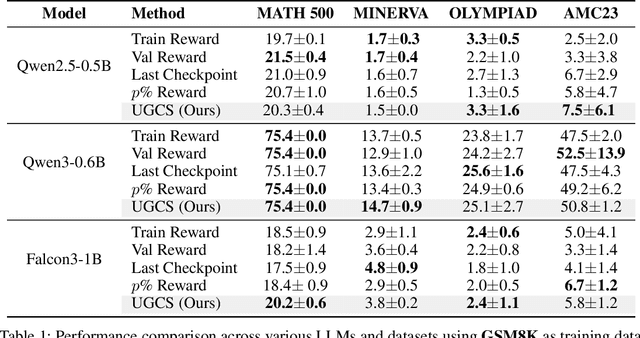
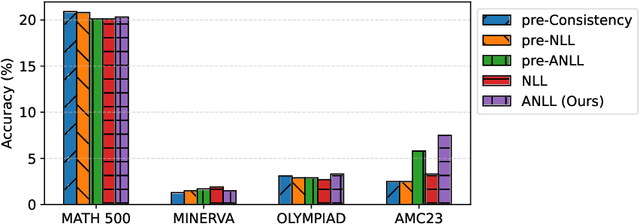
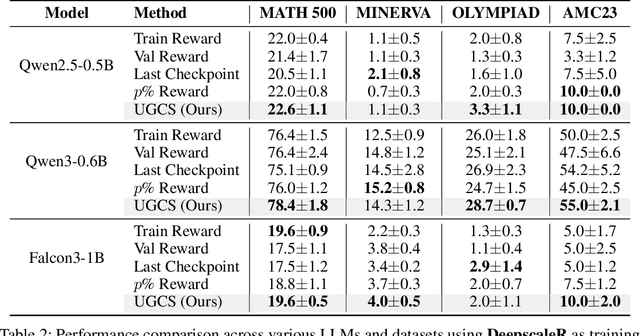
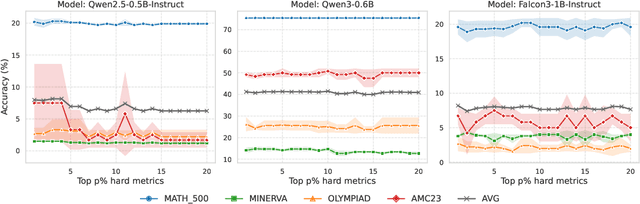
Reinforcement learning (RL) finetuning is crucial to aligning large language models (LLMs), but the process is notoriously unstable and exhibits high variance across model checkpoints. In practice, selecting the best checkpoint is challenging: evaluating checkpoints on the validation set during training is computationally expensive and requires a good validation set, while relying on the final checkpoint provides no guarantee of good performance. We introduce an uncertainty-guided approach for checkpoint selection (UGCS) that avoids these pitfalls. Our method identifies hard question-answer pairs using per-sample uncertainty and ranks checkpoints by how well they handle these challenging cases. By averaging the rewards of the top-uncertain samples over a short training window, our method produces a stable and discriminative signal without additional forward passes or significant computation overhead. Experiments across three datasets and three LLMs demonstrate that it consistently identifies checkpoints with stronger generalization, outperforming traditional strategies such as relying on training or validation performance. These results highlight that models solving their hardest tasks with low uncertainty are the most reliable overall.
Task Allocation for Autonomous Machines using Computational Intelligence and Deep Reinforcement Learning
Aug 28, 2025Enabling multiple autonomous machines to perform reliably requires the development of efficient cooperative control algorithms. This paper presents a survey of algorithms that have been developed for controlling and coordinating autonomous machines in complex environments. We especially focus on task allocation methods using computational intelligence (CI) and deep reinforcement learning (RL). The advantages and disadvantages of the surveyed methods are analysed thoroughly. We also propose and discuss in detail various future research directions that shed light on how to improve existing algorithms or create new methods to enhance the employability and performance of autonomous machines in real-world applications. The findings indicate that CI and deep RL methods provide viable approaches to addressing complex task allocation problems in dynamic and uncertain environments. The recent development of deep RL has greatly contributed to the literature on controlling and coordinating autonomous machines, and it has become a growing trend in this area. It is envisaged that this paper will provide researchers and engineers with a comprehensive overview of progress in machine learning research related to autonomous machines. It also highlights underexplored areas, identifies emerging methodologies, and suggests new avenues for exploration in future research within this domain.
A Survey on Vietnamese Document Analysis and Recognition: Challenges and Future Directions
Jun 05, 2025Vietnamese document analysis and recognition (DAR) is a crucial field with applications in digitization, information retrieval, and automation. Despite advancements in OCR and NLP, Vietnamese text recognition faces unique challenges due to its complex diacritics, tonal variations, and lack of large-scale annotated datasets. Traditional OCR methods often struggle with real-world document variations, while deep learning approaches have shown promise but remain limited by data scarcity and generalization issues. Recently, large language models (LLMs) and vision-language models have demonstrated remarkable improvements in text recognition and document understanding, offering a new direction for Vietnamese DAR. However, challenges such as domain adaptation, multimodal learning, and computational efficiency persist. This survey provide a comprehensive review of existing techniques in Vietnamese document recognition, highlights key limitations, and explores how LLMs can revolutionize the field. We discuss future research directions, including dataset development, model optimization, and the integration of multimodal approaches for improved document intelligence. By addressing these gaps, we aim to foster advancements in Vietnamese DAR and encourage community-driven solutions.