 Add to Chrome
 Add to Firefox
 Add to Edge
Reviving Error Correction in Modern Deep Time-Series Forecasting
May 20, 2026
Modern deep-learning models have achieved remarkable success in time-series forecasting. Yet, their performance degrades in long-term prediction due to error accumulation in autoregressive inference, where predictions are recursively used as inputs. While classical error correction mechanisms (ECMs) have long been used in statistical methods, their applicability to deep learning models remains limited or ineffective. In this work, we revisit the error accumulation problem in deep time-series forecasting and investigate the role and necessity of ECMs in this new context. We propose a simple, architecture-agnostic error correction model that can be integrated with any existing forecaster without requiring retraining. By explicitly decomposing predictions into trend and seasonal components and training the corrector to adjust each separately, we introduce the Universal Error Corrector with Seasonal-Trend Decomposition (UEC-STD), which significantly improves correction accuracy and robustness across 4 backbones and 10 datasets. Our findings provide a practical tool for enhancing forecasts while offering new insights into mitigating autoregressive errors in deep time-series models. Code is available at https://github.com/DA2I2-SLM/UEC-STD.

Diverse Image Priors for Black-box Data-free Knowledge Distillation
Apr 28, 2026Knowledge distillation (KD) represents a vital mechanism to transfer expertise from complex teacher networks to efficient student models. However, in decentralized or secure AI ecosystems, privacy regulations and proprietary interests often restrict access to the teacher's interface and original datasets. These constraints define a challenging black-box data-free KD scenario where only top-1 predictions and no training data are available. While recent approaches utilize synthetic data, they still face limitations in data diversity and distillation signals. We propose Diverse Image Priors Knowledge Distillation (DIP-KD), a framework that addresses these challenges through a three-phase collaborative pipeline: (1) Synthesis of image priors to capture diverse visual patterns and semantics; (2) Contrast to enhance the collective distinction between synthetic samples via contrastive learning; and (3) Distillation via a novel primer student that enables soft-probability KD. Our evaluation across 12 benchmarks shows that DIP-KD achieves state-of-the-art performance, with ablations confirming data diversity as critical for knowledge acquisition in restricted AI environments.
Improving Diversity in Black-box Few-shot Knowledge Distillation
Apr 28, 2026Knowledge distillation (KD) is a well-known technique to effectively compress a large network (teacher) to a smaller network (student) with little sacrifice in performance. However, most KD methods require a large training set and internal access to the teacher, which are rarely available due to various restrictions. These challenges have originated a more practical setting known as black-box few-shot KD, where the student is trained with few images and a black-box teacher. Recent approaches typically generate additional synthetic images but lack an active strategy to promote their diversity, a crucial factor for student learning. To address these problems, we propose a novel training scheme for generative adversarial networks, where we adaptively select high-confidence images under the teacher's supervision and introduce them to the adversarial learning on-the-fly. Our approach helps expand and improve the diversity of the distillation set, significantly boosting student accuracy. Through extensive experiments, we achieve state-of-the-art results among other few-shot KD methods on seven image datasets. The code is available at https://github.com/votrinhan88/divbfkd.
FrameDiT: Diffusion Transformer with Frame-Level Matrix Attention for Efficient Video Generation
Mar 10, 2026High-fidelity video generation remains challenging for diffusion models due to the difficulty of modeling complex spatio-temporal dynamics efficiently. Recent video diffusion methods typically represent a video as a sequence of spatio-temporal tokens which can be modeled using Diffusion Transformers (DiTs). However, this approach faces a trade-off between the strong but expensive Full 3D Attention and the efficient but temporally limited Local Factorized Attention. To resolve this trade-off, we propose Matrix Attention, a frame-level temporal attention mechanism that processes an entire frame as a matrix and generates query, key, and value matrices via matrix-native operations. By attending across frames rather than tokens, Matrix Attention effectively preserves global spatio-temporal structure and adapts to significant motion. We build FrameDiT-G, a DiT architecture based on MatrixAttention, and further introduce FrameDiT-H, which integrates Matrix Attention with Local Factorized Attention to capture both large and small motion. Extensive experiments show that FrameDiT-H achieves state-of-the-art results across multiple video generation benchmarks, offering improved temporal coherence and video quality while maintaining efficiency comparable to Local Factorized Attention.
h-Edit: Effective and Flexible Diffusion-Based Editing via Doob's h-Transform
Mar 04, 2025We introduce a theoretical framework for diffusion-based image editing by formulating it as a reverse-time bridge modeling problem. This approach modifies the backward process of a pretrained diffusion model to construct a bridge that converges to an implicit distribution associated with the editing target at time 0. Building on this framework, we propose h-Edit, a novel editing method that utilizes Doob's h-transform and Langevin Monte Carlo to decompose the update of an intermediate edited sample into two components: a "reconstruction" term and an "editing" term. This decomposition provides flexibility, allowing the reconstruction term to be computed via existing inversion techniques and enabling the combination of multiple editing terms to handle complex editing tasks. To our knowledge, h-Edit is the first training-free method capable of performing simultaneous text-guided and reward-model-based editing. Extensive experiments, both quantitative and qualitative, show that h-Edit outperforms state-of-the-art baselines in terms of editing effectiveness and faithfulness. Our source code is available at https://github.com/nktoan/h-edit.
Finding the Trigger: Causal Abductive Reasoning on Video Events
Jan 16, 2025This paper introduces a new problem, Causal Abductive Reasoning on Video Events (CARVE), which involves identifying causal relationships between events in a video and generating hypotheses about causal chains that account for the occurrence of a target event. To facilitate research in this direction, we create two new benchmark datasets with both synthetic and realistic videos, accompanied by trigger-target labels generated through a novel counterfactual synthesis approach. To explore the challenge of solving CARVE, we present a Causal Event Relation Network (CERN) that examines the relationships between video events in temporal and semantic spaces to efficiently determine the root-cause trigger events. Through extensive experiments, we demonstrate the critical roles of event relational representation learning and interaction modeling in solving video causal reasoning challenges. The introduction of the CARVE task, along with the accompanying datasets and the CERN framework, will advance future research on video causal reasoning and significantly facilitate various applications, including video surveillance, root-cause analysis and movie content management.
Predicting the Reliability of an Image Classifier under Image Distortion
Dec 22, 2024In image classification tasks, deep learning models are vulnerable to image distortions i.e. their accuracy significantly drops if the input images are distorted. An image-classifier is considered "reliable" if its accuracy on distorted images is above a user-specified threshold. For a quality control purpose, it is important to predict if the image-classifier is unreliable/reliable under a distortion level. In other words, we want to predict whether a distortion level makes the image-classifier "non-reliable" or "reliable". Our solution is to construct a training set consisting of distortion levels along with their "non-reliable" or "reliable" labels, and train a machine learning predictive model (called distortion-classifier) to classify unseen distortion levels. However, learning an effective distortion-classifier is a challenging problem as the training set is highly imbalanced. To address this problem, we propose two Gaussian process based methods to rebalance the training set. We conduct extensive experiments to show that our method significantly outperforms several baselines on six popular image datasets.
Learning Structural Causal Models from Ordering: Identifiable Flow Models
Dec 13, 2024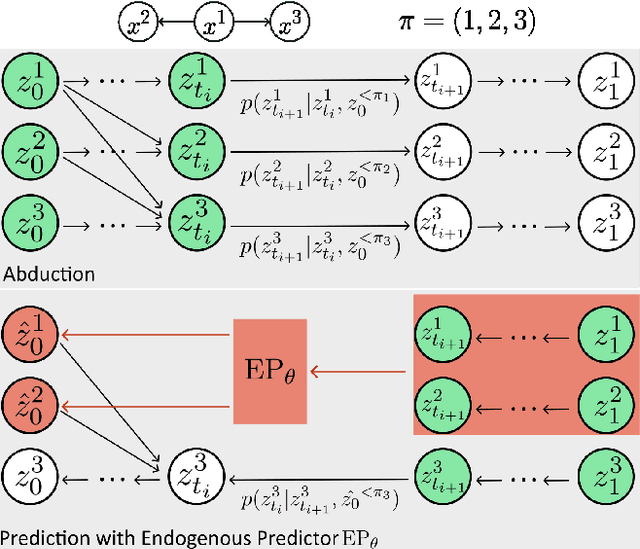
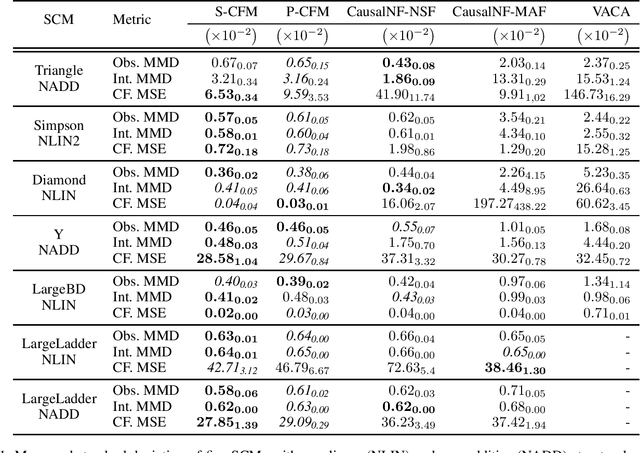
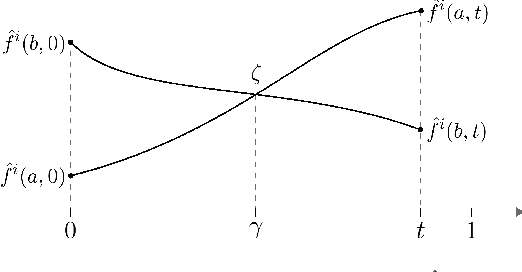
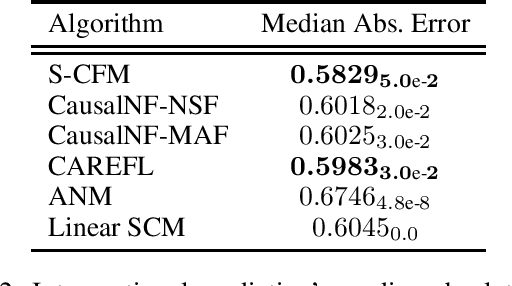
In this study, we address causal inference when only observational data and a valid causal ordering from the causal graph are available. We introduce a set of flow models that can recover component-wise, invertible transformation of exogenous variables. Our flow-based methods offer flexible model design while maintaining causal consistency regardless of the number of discretization steps. We propose design improvements that enable simultaneous learning of all causal mechanisms and reduce abduction and prediction complexity to linear O(n) relative to the number of layers, independent of the number of causal variables. Empirically, we demonstrate that our method outperforms previous state-of-the-art approaches and delivers consistent performance across a wide range of structural causal models in answering observational, interventional, and counterfactual questions. Additionally, our method achieves a significant reduction in computational time compared to existing diffusion-based techniques, making it practical for large structural causal models.
Generating Realistic Tabular Data with Large Language Models
Oct 29, 2024
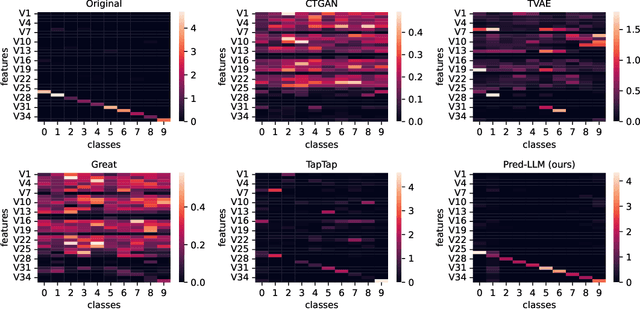
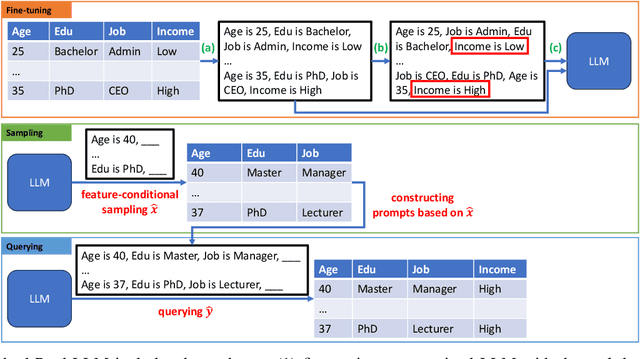
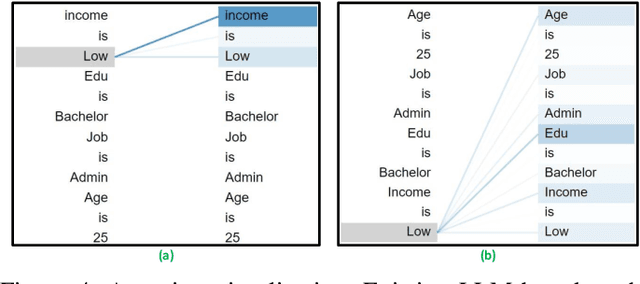
While most generative models show achievements in image data generation, few are developed for tabular data generation. Recently, due to success of large language models (LLM) in diverse tasks, they have also been used for tabular data generation. However, these methods do not capture the correct correlation between the features and the target variable, hindering their applications in downstream predictive tasks. To address this problem, we propose a LLM-based method with three important improvements to correctly capture the ground-truth feature-class correlation in the real data. First, we propose a novel permutation strategy for the input data in the fine-tuning phase. Second, we propose a feature-conditional sampling approach to generate synthetic samples. Finally, we generate the labels by constructing prompts based on the generated samples to query our fine-tuned LLM. Our extensive experiments show that our method significantly outperforms 10 SOTA baselines on 20 datasets in downstream tasks. It also produces highly realistic synthetic samples in terms of quality and diversity. More importantly, classifiers trained with our synthetic data can even compete with classifiers trained with the original data on half of the benchmark datasets, which is a significant achievement in tabular data generation.
Stable Hadamard Memory: Revitalizing Memory-Augmented Agents for Reinforcement Learning
Oct 14, 2024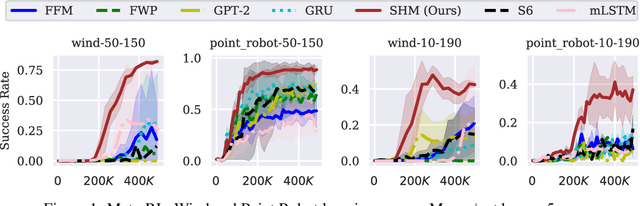
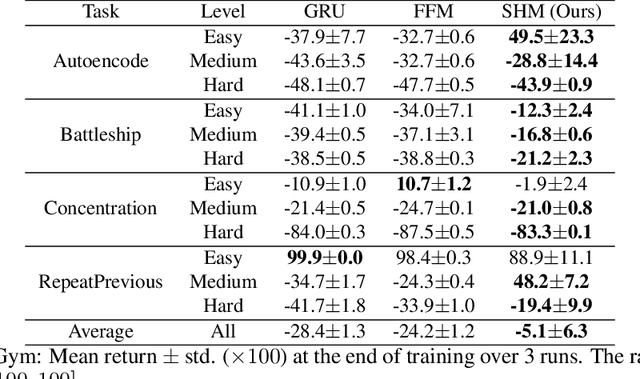


Effective decision-making in partially observable environments demands robust memory management. Despite their success in supervised learning, current deep-learning memory models struggle in reinforcement learning environments that are partially observable and long-term. They fail to efficiently capture relevant past information, adapt flexibly to changing observations, and maintain stable updates over long episodes. We theoretically analyze the limitations of existing memory models within a unified framework and introduce the Stable Hadamard Memory, a novel memory model for reinforcement learning agents. Our model dynamically adjusts memory by erasing no longer needed experiences and reinforcing crucial ones computationally efficiently. To this end, we leverage the Hadamard product for calibrating and updating memory, specifically designed to enhance memory capacity while mitigating numerical and learning challenges. Our approach significantly outperforms state-of-the-art memory-based methods on challenging partially observable benchmarks, such as meta-reinforcement learning, long-horizon credit assignment, and POPGym, demonstrating superior performance in handling long-term and evolving contexts.