 Add to Chrome
 Add to Firefox
 Add to Edge
LLM as Forecasting Planner: Training-Free Text Conditioning for Time-Series Foundation Models
Jul 27, 2026
Text-conditioned time-series forecasting predicts a series from both its numerical history and natural-language context, allowing forecasts to account for events and constraints that the past alone cannot reveal. This requires both reliable numerical forecasting and the ability to interpret contextual information. Time-series foundation models (TSFMs) provide strong numerical forecasts, while large language models (LLMs) can reason over text, but combining their strengths remains challenging because asking an LLM to generate or revise forecast values directly can distort the temporal structure captured by the TSFM. We instead formulate forecasting as a planning problem over TSFM-generated trajectories. The frozen TSFM acts as a simulator that proposes numerical continuations, while the LLM acts as a policy and value function that guides candidate selection and evaluates completed trajectories against the context. We instantiate this as \rc{} (\textbf{L}LM \textbf{A}s \textbf{F}orecasting \textbf{P}lanner), a training-free framework that bridges the modality gap without retraining either model, using Monte Carlo tree search (MCTS) over the forecast horizon with a \emph{Ranker} LLM as policy and a \emph{Judge} LLM as value function. Experiments on Context-is-Key and Time-MMD across two TSFM backbones (Chronos and TimesFM) and four LLMs show that \rc{} delivers consistent improvements across model choices, supporting sequential search as an effective training-free approach to text-conditioned forecasting.

Expert-Guided Forecast Editing for Time-Series Foundation Models
Jul 22, 2026Time-series foundation models can forecast across heterogeneous domains without task-specific training, but their forecasts are fixed once produced and cannot directly incorporate task-specific expert feedback. We study expert-guided forecast editing: a frozen foundation model generates candidate future trajectories, and an expensive expert evaluator scores them to guide forecast revision. Under a tight query budget, two natural strategies sit at opposite ends: best-of-$N$ purely exploits the foundation model's predictive distribution, while optimization approaches mostly explore the forecast horizon as an unstructured high-dimensional vector. Each extreme is individually sub-optimal. We introduce \textbf{DEFT}, an expert-guided forecast editing framework that balances the two by first exploiting the foundation model's predictive samples in a decomposed trend--seasonal space, then exploring around them via component-wise refinement. DEFT queries the expert only on complete trajectories, then reuses scores for the trend and seasonal components that appeared in the queried recombinations. This lets each expert query provide structured component-level feedback while keeping the foundation model frozen. We compare DEFT against direct search approaches, including best-of-$N$, cross-entropy methods, and Bayesian optimization, under matched expert-query budgets. Across two forecasting benchmarks consisting of 78 datasets, three time-series foundation models, four feedback types, and seven query budgets, DEFT consistently improves the effectiveness of expert guidance. A molecular-dynamics case study further suggests that the same principle extends to more physically grounded feedback, supporting the hypothesis that sparse test-time guidance should be spent balancing prior exploitation with structured exploration.
Reviving Error Correction in Modern Deep Time-Series Forecasting
May 20, 2026Modern deep-learning models have achieved remarkable success in time-series forecasting. Yet, their performance degrades in long-term prediction due to error accumulation in autoregressive inference, where predictions are recursively used as inputs. While classical error correction mechanisms (ECMs) have long been used in statistical methods, their applicability to deep learning models remains limited or ineffective. In this work, we revisit the error accumulation problem in deep time-series forecasting and investigate the role and necessity of ECMs in this new context. We propose a simple, architecture-agnostic error correction model that can be integrated with any existing forecaster without requiring retraining. By explicitly decomposing predictions into trend and seasonal components and training the corrector to adjust each separately, we introduce the Universal Error Corrector with Seasonal-Trend Decomposition (UEC-STD), which significantly improves correction accuracy and robustness across 4 backbones and 10 datasets. Our findings provide a practical tool for enhancing forecasts while offering new insights into mitigating autoregressive errors in deep time-series models. Code is available at https://github.com/DA2I2-SLM/UEC-STD.
Uncertainty-Guided Checkpoint Selection for Reinforcement Finetuning of Large Language Models
Nov 13, 2025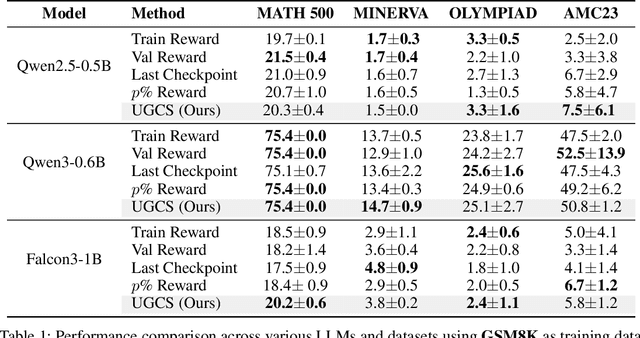
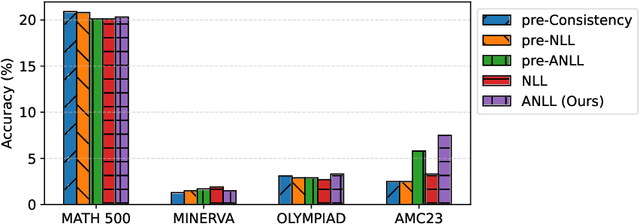
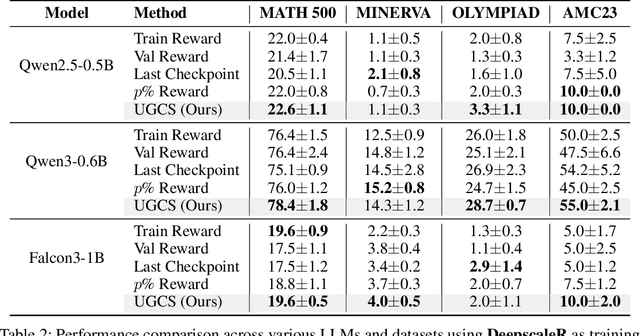
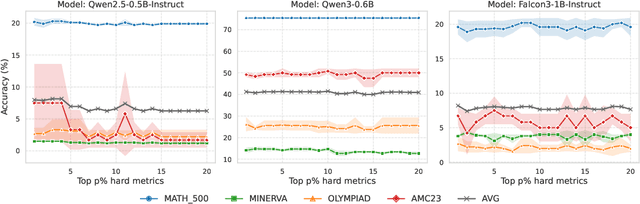
Reinforcement learning (RL) finetuning is crucial to aligning large language models (LLMs), but the process is notoriously unstable and exhibits high variance across model checkpoints. In practice, selecting the best checkpoint is challenging: evaluating checkpoints on the validation set during training is computationally expensive and requires a good validation set, while relying on the final checkpoint provides no guarantee of good performance. We introduce an uncertainty-guided approach for checkpoint selection (UGCS) that avoids these pitfalls. Our method identifies hard question-answer pairs using per-sample uncertainty and ranks checkpoints by how well they handle these challenging cases. By averaging the rewards of the top-uncertain samples over a short training window, our method produces a stable and discriminative signal without additional forward passes or significant computation overhead. Experiments across three datasets and three LLMs demonstrate that it consistently identifies checkpoints with stronger generalization, outperforming traditional strategies such as relying on training or validation performance. These results highlight that models solving their hardest tasks with low uncertainty are the most reliable overall.
GRAD: Graph-Retrieved Adaptive Decoding for Hallucination Mitigation
Nov 05, 2025Hallucination mitigation remains a persistent challenge for large language models (LLMs), even as model scales grow. Existing approaches often rely on external knowledge sources, such as structured databases or knowledge graphs, accessed through prompting or retrieval. However, prompt-based grounding is fragile and domain-sensitive, while symbolic knowledge integration incurs heavy retrieval and formatting costs. Motivated by knowledge graphs, we introduce Graph-Retrieved Adaptive Decoding (GRAD), a decoding-time method that grounds generation in corpus-derived evidence without retraining. GRAD constructs a sparse token transition graph by accumulating next-token logits across a small retrieved corpus in a single forward pass. During decoding, graph-retrieved logits are max-normalized and adaptively fused with model logits to favor high-evidence continuations while preserving fluency. Across three models and a range of question-answering benchmarks spanning intrinsic, extrinsic hallucination, and factuality tasks, GRAD consistently surpasses baselines, achieving up to 9.7$\%$ higher intrinsic accuracy, 8.6$\%$ lower hallucination rates, and 6.9$\%$ greater correctness compared to greedy decoding, while attaining the highest truth--informativeness product score among all methods. GRAD offers a lightweight, plug-and-play alternative to contrastive decoding and knowledge graph augmentation, demonstrating that statistical evidence from corpus-level token transitions can effectively steer generation toward more truthful and verifiable outputs.
SPaRFT: Self-Paced Reinforcement Fine-Tuning for Large Language Models
Aug 07, 2025Large language models (LLMs) have shown strong reasoning capabilities when fine-tuned with reinforcement learning (RL). However, such methods require extensive data and compute, making them impractical for smaller models. Current approaches to curriculum learning or data selection are largely heuristic-driven or demand extensive computational resources, limiting their scalability and generalizability. We propose \textbf{SPaRFT}, a self-paced learning framework that enables efficient learning based on the capability of the model being trained through optimizing which data to use and when. First, we apply \emph{cluster-based data reduction} to partition training data by semantics and difficulty, extracting a compact yet diverse subset that reduces redundancy. Then, a \emph{multi-armed bandit} treats data clusters as arms, optimized to allocate training samples based on model current performance. Experiments across multiple reasoning benchmarks show that SPaRFT achieves comparable or better accuracy than state-of-the-art baselines while using up to \(100\times\) fewer samples. Ablation studies and analyses further highlight the importance of both data clustering and adaptive selection. Our results demonstrate that carefully curated, performance-driven training curricula can unlock strong reasoning abilities in LLMs with minimal resources.
Reasoning Under 1 Billion: Memory-Augmented Reinforcement Learning for Large Language Models
Apr 03, 2025Recent advances in fine-tuning large language models (LLMs) with reinforcement learning (RL) have shown promising improvements in complex reasoning tasks, particularly when paired with chain-of-thought (CoT) prompting. However, these successes have been largely demonstrated on large-scale models with billions of parameters, where a strong pretraining foundation ensures effective initial exploration. In contrast, RL remains challenging for tiny LLMs with 1 billion parameters or fewer because they lack the necessary pretraining strength to explore effectively, often leading to suboptimal reasoning patterns. This work introduces a novel intrinsic motivation approach that leverages episodic memory to address this challenge, improving tiny LLMs in CoT reasoning tasks. Inspired by human memory-driven learning, our method leverages successful reasoning patterns stored in memory while allowing for controlled exploration to generate novel responses. Intrinsic rewards are computed efficiently using a kNN-based episodic memory, allowing the model to discover new reasoning strategies while quickly adapting to effective past solutions. Experiments on fine-tuning GSM8K and AI-MO datasets demonstrate that our approach significantly enhances smaller LLMs' sample efficiency and generalization capability, making RL-based reasoning improvements more accessible in low-resource settings.
Large Language Models Prompting With Episodic Memory
Aug 14, 2024Prompt optimization is essential for enhancing the performance of Large Language Models (LLMs) in a range of Natural Language Processing (NLP) tasks, particularly in scenarios of few-shot learning where training examples are incorporated directly into the prompt. Despite the growing interest in optimizing prompts with few-shot examples, existing methods for prompt optimization are often resource-intensive or perform inadequately. In this work, we propose PrOmpting with Episodic Memory (POEM), a novel prompt optimization technique that is simple, efficient, and demonstrates strong generalization capabilities. We approach prompt optimization as a Reinforcement Learning (RL) challenge, using episodic memory to archive combinations of input data, permutations of few-shot examples, and the rewards observed during training. In the testing phase, we optimize the sequence of examples for each test query by selecting the sequence that yields the highest total rewards from the top-k most similar training examples in the episodic memory. Our results show that POEM outperforms recent techniques like TEMPERA and RLPrompt by over 5.3% in various text classification tasks. Furthermore, our approach adapts well to broader language understanding tasks, consistently outperforming conventional heuristic methods for ordering examples.