 Add to Chrome
 Add to Firefox
 Add to Edge
Context-Aware Force Estimation for Deformable Tool Manipulation in Robotic Environmental Swabbing via Few-Shot Continual Adaptation
Jul 08, 2026
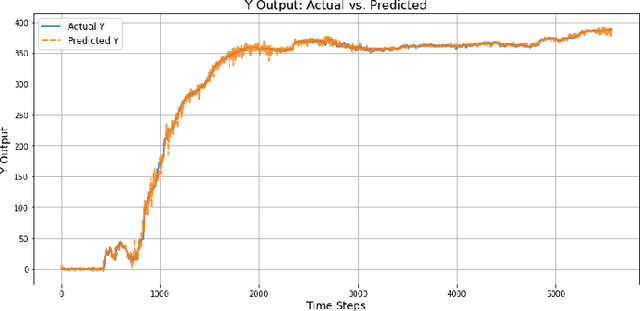
Robotic surface swabbing requires sustained interaction between a compliant tool and heterogeneous environments, where accurate estimation of tip-level contact force is critical for consistent sampling performance. However, deformable tool dynamics introduce nonlinear viscoelastic hysteresis that decouples wrist-mounted force measurements from true contact forces, while tool-integrated sensors are impractical for deployment due to sterility and disposability constraints. This paper presents a data-driven framework for contact force estimation in Deformable Tool Manipulation (DTM) that leverages proprioceptive sensing without requiring explicit physical models or permanent embedded sensing hardware at the tool tip. A recurrent architecture is first identified through a comparative evaluation of temporal models, where a compact LSTM achieves the lowest estimation error and sub-millisecond inference latency. To address generalization across unseen surfaces and tool compliance conditions, we introduce a parameter-isolated few-shot adaptation strategy that augments a frozen recurrent backbone with low-dimensional context embeddings using feature-wise linear modulation (FiLM). Experiments on a UR5e platform across nine tool-surface interaction regimes demonstrate that the proposed approach significantly improves robustness under domain shift, reducing zero-shot estimation error by up to 63\% while preserving baseline performance without catastrophic forgetting. These results show that separating shared deformation-history dynamics from domain-specific conditioning enables reliable force estimation for DTM in non-stationary environments.

URS-Stereo: Uncertainty-Guided Residual Search for Real-Time Stereo Matching
Jul 07, 2026Real-time stereo matching is crucial for robotics, autonomous systems, and embedded vision applications, where both computational efficiency and disparity accuracy are required. Recent coarse-to-fine stereo matching methods improve efficiency by progressively refining disparity estimates using local cost volumes at higher resolutions. However, these methods rely heavily on the accuracy of propagated disparity estimates from previous stages. When the propagated disparity is inaccurate, the ground-truth correspondence may fall outside the predefined local search range, leading to unrecoverable matching failures during subsequent refinement. In this paper, we propose URS-Stereo, a real-time coarse-to-fine stereo matching framework that addresses this limitation through uncertainty-guided search adaptation. Specifically, we introduce an Uncertainty-Guided Residual Search Module (UGRSM), which predicts the reliability of propagated disparities together with residual search offsets to adaptively relocate the centers of local cost volumes before disparity refinement. By dynamically adjusting the search region according to the confidence of the propagated disparity, the proposed method significantly improves the robustness of local correspondence estimation while preserving the computational efficiency of coarse-to-fine stereo matching. Extensive experiments on SceneFlow, KITTI 2012, KITTI 2015, Middlebury, and ETH3D demonstrate that URS-Stereo consistently improves disparity estimation while maintaining real-time inference speed, validating the effectiveness of the proposed uncertainty-guided search strategy
A Non-Invasive Alternative to RFID: Self-Sufficient 3D Identification of Group-Housed Livestock
Apr 24, 2026Accurate identification of individual farm animals in group-housed environments is a cornerstone of precision livestock management. However, current industry standards rely heavily on Radio Frequency Identification (RFID) ear tags, which are invasive, prone to loss, and restricted by the spatial limitations of antenna fields. In this paper, we propose a non-intrusive, vision-based identification system leveraging 3D point cloud data captured within a commercial electronic feeding station (EFS). Departing from traditional supervised frame-level inference, we introduce the Temporal Adaptive Recognition Architecture (TARA), a self-sufficient, semi-supervised framework designed to maintain identity consistency over time. TARA employs a dynamic recalibration mechanism that updates individual identity profiles to account for morphological changes in the livestock. To facilitate training in label-scarce environments, we utilize a visit-level majority voting strategy to generate high-fidelity pseudo-labels from raw temporal sequences. Experimental results on a group housed sow dataset collected from an operational commercial barn demonstrate that our approach achieves 100% identification accuracy at the visit level. These results suggest that vision-based 3D point cloud analysis offers a robust, superior alternative to RFID-based systems, paving the way for fully autonomous individual animal monitoring.
MyoVision: A Mobile Research Tool and NEATBoost-Attention Ensemble Framework for Real Time Chicken Breast Myopathy Detection
Apr 15, 2026Woody Breast (WB) and Spaghetti Meat (SM) myopathies significantly impact poultry meat quality, yet current detection methods rely either on subjective manual evaluation or costly laboratory-grade imaging systems. We address the problem of low-cost, non-destructive multi-class myopathy classification using consumer smartphones. MyoVision is introduced as a mobile transillumination imaging framework in which 14-bit RAW images are captured and structural texture descriptors indicative of internal tissue abnormalities are extracted. To classify three categories (Normal, Woody Breast, Spaghetti Meat), we propose a NEATBoost-Attention Ensemble model, which is a neuroevolution-optimized weighted fusion of LightGBM and attention-based MLP models. Hyperparameters are automatically discovered using NeuroEvolution of Augmenting Topologies (NEAT), eliminating manual tuning and enabling architecture diversity for small tabular datasets. On a dataset of 336 fillets collected from a commercial processing facility, our method achieves 82.4% test accuracy (F1 = 0.83), outperforming conventional machine learning and deep learning baselines and matching performance reported by hyperspectral imaging systems costing orders of magnitude more. Beyond classification performance, MyoVision establishes a reproducible mobile RGB-D acquisition pipeline for multimodal meat quality research, demonstrating that consumer-grade imaging can support scalable internal tissue assessment.
EquiBim: Learning Symmetry-Equivariant Policy for Bimanual Manipulation
Mar 09, 2026Robotic imitation learning has achieved impressive success in learning complex manipulation behaviors from demonstrations. However, many existing robot learning methods do not explicitly account for the physical symmetries of robotic systems, often resulting in asymmetric or inconsistent behaviors under symmetric observations. This limitation is particularly pronounced in dual-arm manipulation, where bilateral symmetry is inherent to both the robot morphology and the structure of many tasks. In this paper, we introduce EquiBim, a symmetry-equivariant policy learning framework for bimanual manipulation that enforces bilateral equivariance between observations and actions during training. Our approach formulates physical symmetry as a group action on both observation and action spaces, and imposes an equivariance constraint on policy predictions under symmetric transformations. The framework is model-agnostic and can be seamlessly integrated into a wide range of imitation learning pipelines with diverse observation modalities and action representations, including point cloud-based and image-based policies, as well as both end-effector-space and joint-space parameterizations. We evaluate EquiBim on RoboTwin, a dual-arm robotic platform with symmetric kinematics, and evaluate it across diverse observation and action configurations in simulation. We further validate the approach on a real-world dual-arm system. Across both simulation and physical experiments, our method consistently improves performance and robustness under distribution shifts. These results suggest that explicitly enforcing physical symmetry provides a simple yet effective inductive bias for bimanual robot learning.
Joint Velocity-Growth Flow Matching for Single-Cell Dynamics Modeling
May 19, 2025

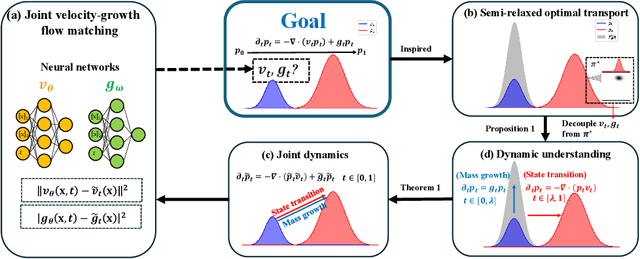

Learning the underlying dynamics of single cells from snapshot data has gained increasing attention in scientific and machine learning research. The destructive measurement technique and cell proliferation/death result in unpaired and unbalanced data between snapshots, making the learning of the underlying dynamics challenging. In this paper, we propose joint Velocity-Growth Flow Matching (VGFM), a novel paradigm that jointly learns state transition and mass growth of single-cell populations via flow matching. VGFM builds an ideal single-cell dynamics containing velocity of state and growth of mass, driven by a presented two-period dynamic understanding of the static semi-relaxed optimal transport, a mathematical tool that seeks the coupling between unpaired and unbalanced data. To enable practical usage, we approximate the ideal dynamics using neural networks, forming our joint velocity and growth matching framework. A distribution fitting loss is also employed in VGFM to further improve the fitting performance for snapshot data. Extensive experimental results on both synthetic and real datasets demonstrate that VGFM can capture the underlying biological dynamics accounting for mass and state variations over time, outperforming existing approaches for single-cell dynamics modeling.
ChicGrasp: Imitation-Learning based Customized Dual-Jaw Gripper Control for Delicate, Irregular Bio-products Manipulation
May 13, 2025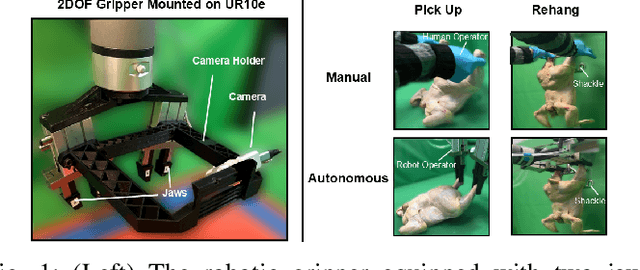
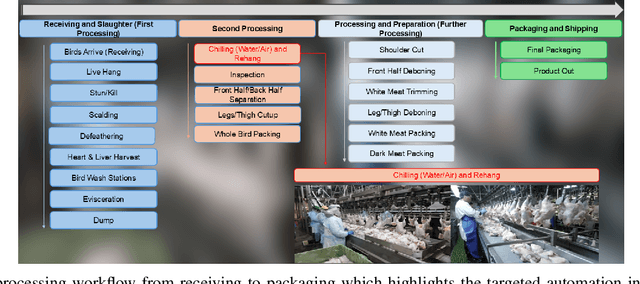
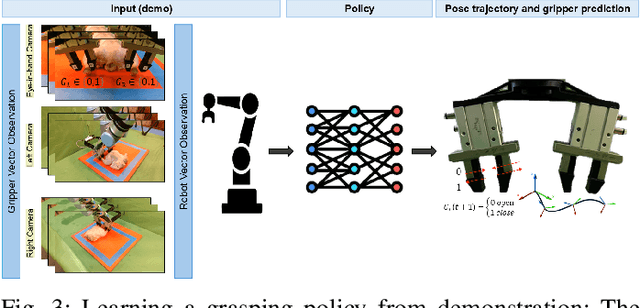
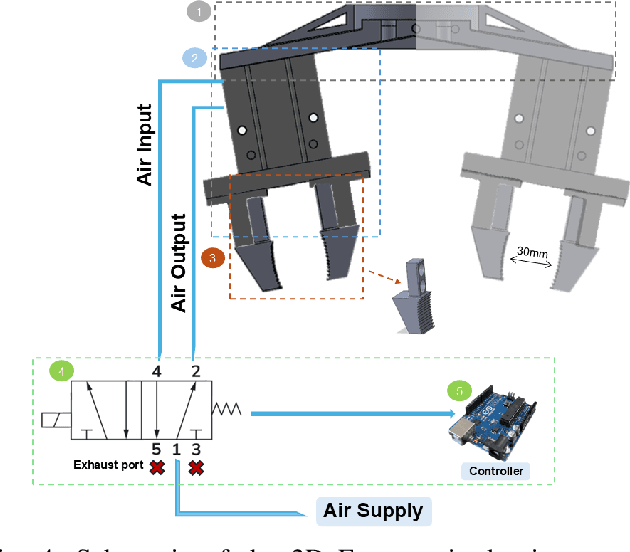
Automated poultry processing lines still rely on humans to lift slippery, easily bruised carcasses onto a shackle conveyor. Deformability, anatomical variance, and strict hygiene rules make conventional suction and scripted motions unreliable. We present ChicGrasp, an end--to--end hardware--software co-design for this task. An independently actuated dual-jaw pneumatic gripper clamps both chicken legs, while a conditional diffusion-policy controller, trained from only 50 multi--view teleoperation demonstrations (RGB + proprioception), plans 5 DoF end--effector motion, which includes jaw commands in one shot. On individually presented raw broiler carcasses, our system achieves a 40.6\% grasp--and--lift success rate and completes the pick to shackle cycle in 38 s, whereas state--of--the--art implicit behaviour cloning (IBC) and LSTM-GMM baselines fail entirely. All CAD, code, and datasets will be open-source. ChicGrasp shows that imitation learning can bridge the gap between rigid hardware and variable bio--products, offering a reproducible benchmark and a public dataset for researchers in agricultural engineering and robot learning.
Data-Driven Contact-Aware Control Method for Real-Time Deformable Tool Manipulation: A Case Study in the Environmental Swabbing
Mar 27, 2025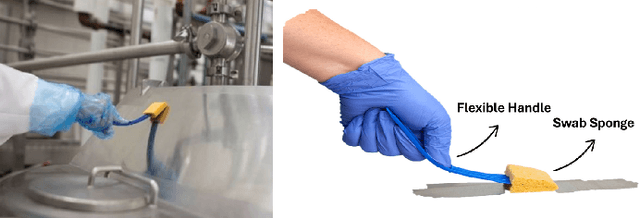
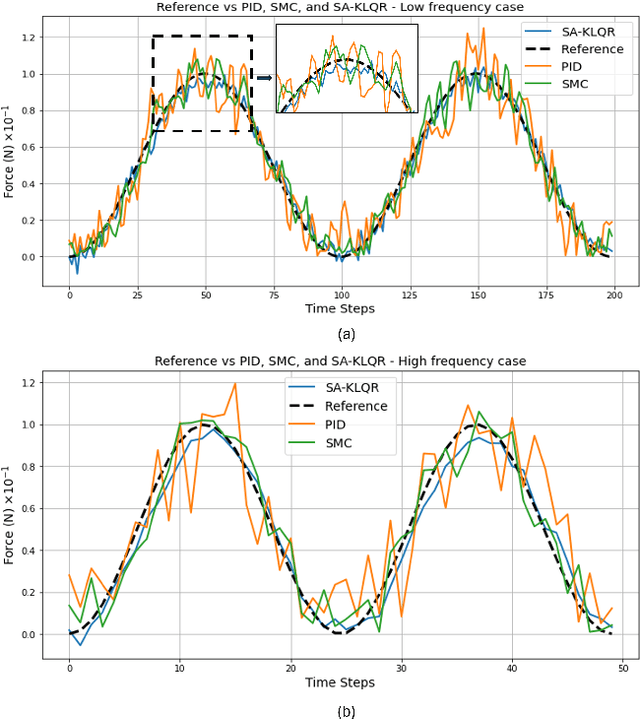
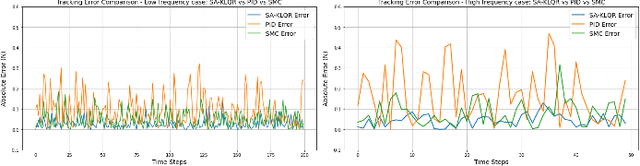
Deformable Object Manipulation (DOM) remains a critical challenge in robotics due to the complexities of developing suitable model-based control strategies. Deformable Tool Manipulation (DTM) further complicates this task by introducing additional uncertainties between the robot and its environment. While humans effortlessly manipulate deformable tools using touch and experience, robotic systems struggle to maintain stability and precision. To address these challenges, we present a novel State-Adaptive Koopman LQR (SA-KLQR) control framework for real-time deformable tool manipulation, demonstrated through a case study in environmental swab sampling for food safety. This method leverages Koopman operator-based control to linearize nonlinear dynamics while adapting to state-dependent variations in tool deformation and contact forces. A tactile-based feedback system dynamically estimates and regulates the swab tool's angle, contact pressure, and surface coverage, ensuring compliance with food safety standards. Additionally, a sensor-embedded contact pad monitors force distribution to mitigate tool pivoting and deformation, improving stability during dynamic interactions. Experimental results validate the SA-KLQR approach, demonstrating accurate contact angle estimation, robust trajectory tracking, and reliable force regulation. The proposed framework enhances precision, adaptability, and real-time control in deformable tool manipulation, bridging the gap between data-driven learning and optimal control in robotic interaction tasks.
Efficient Auto-Labeling of Large-Scale Poultry Datasets (ALPD) Using Semi-Supervised Models, Active Learning, and Prompt-then-Detect Approach
Jan 18, 2025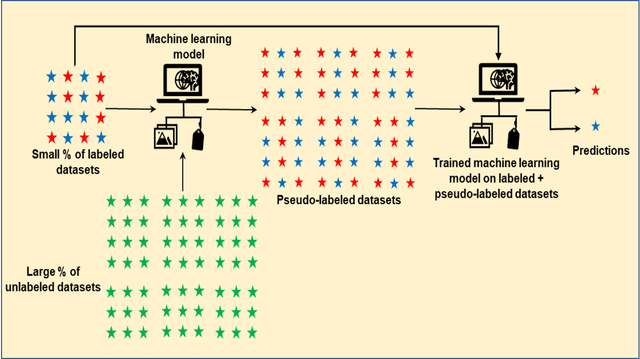
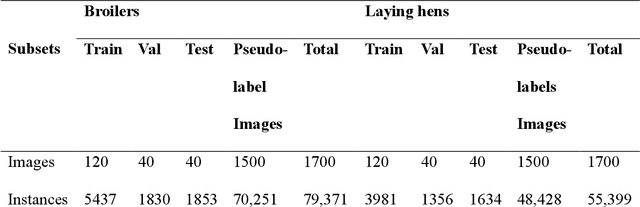
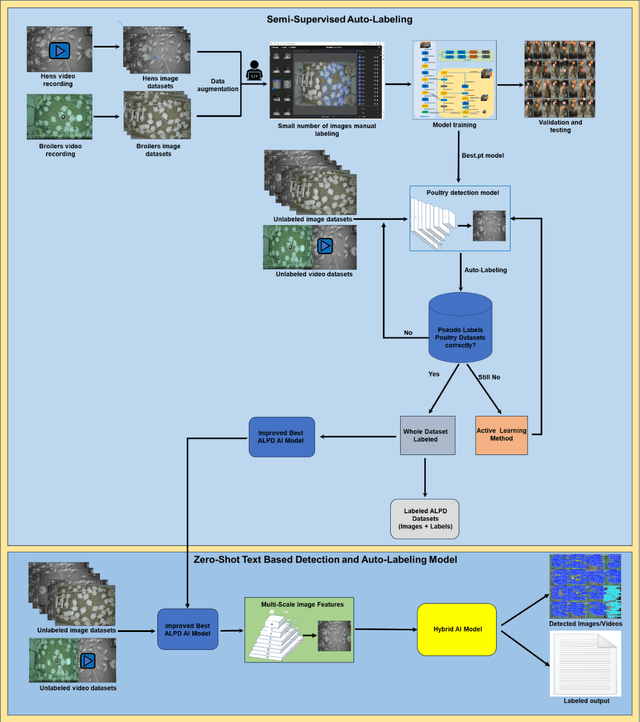
The rapid growth of AI in poultry farming has highlighted the challenge of efficiently labeling large, diverse datasets. Manual annotation is time-consuming, making it impractical for modern systems that continuously generate data. This study explores semi-supervised auto-labeling methods, integrating active learning, and prompt-then-detect paradigm to develop an efficient framework for auto-labeling of large poultry datasets aimed at advancing AI-driven behavior and health monitoring. Viideo data were collected from broilers and laying hens housed at the University of Arkansas and the University of Georgia. The collected videos were converted into images, pre-processed, augmented, and labeled. Various machine learning models, including zero-shot models like Grounding DINO, YOLO-World, and CLIP, and supervised models like YOLO and Faster-RCNN, were utilized for broilers, hens, and behavior detection. The results showed that YOLOv8s-World and YOLOv9s performed better when compared performance metrics for broiler and hen detection under supervised learning, while among the semi-supervised model, YOLOv8s-ALPD achieved the highest precision (96.1%) and recall (99.0%) with an RMSE of 1.9. The hybrid YOLO-World model, incorporating the optimal YOLOv8s backbone, demonstrated the highest overall performance. It achieved a precision of 99.2%, recall of 99.4%, and an F1 score of 98.7% for breed detection, alongside a precision of 88.4%, recall of 83.1%, and an F1 score of 84.5% for individual behavior detection. Additionally, semi-supervised models showed significant improvements in behavior detection, achieving up to 31% improvement in precision and 16% in F1-score. The semi-supervised models with minimal active learning reduced annotation time by over 80% compared to full manual labeling. Moreover, integrating zero-shot models enhanced detection and behavior identification.
Neural Network Architecture Search Enabled Wide-Deep Learning (NAS-WD) for Spatially Heterogenous Property Awared Chicken Woody Breast Classification and Hardness Regression
Sep 25, 2024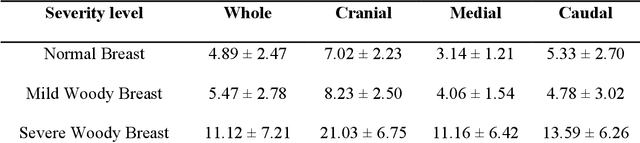
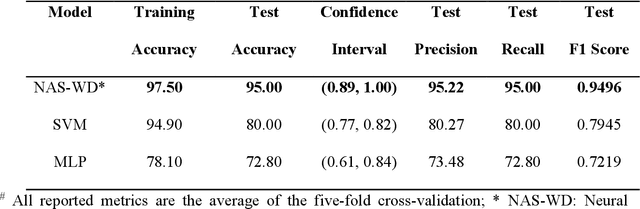
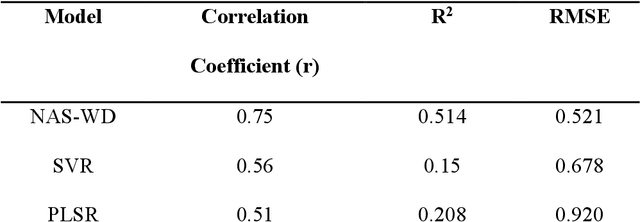
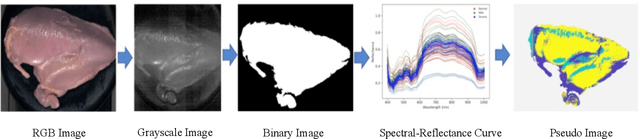
Due to intensive genetic selection for rapid growth rates and high broiler yields in recent years, the global poultry industry has faced a challenging problem in the form of woody breast (WB) conditions. This condition has caused significant economic losses as high as $200 million annually, and the root cause of WB has yet to be identified. Human palpation is the most common method of distinguishing a WB from others. However, this method is time-consuming and subjective. Hyperspectral imaging (HSI) combined with machine learning algorithms can evaluate the WB conditions of fillets in a non-invasive, objective, and high-throughput manner. In this study, 250 raw chicken breast fillet samples (normal, mild, severe) were taken, and spatially heterogeneous hardness distribution was first considered when designing HSI processing models. The study not only classified the WB levels from HSI but also built a regression model to correlate the spectral information with sample hardness data. To achieve a satisfactory classification and regression model, a neural network architecture search (NAS) enabled a wide-deep neural network model named NAS-WD, which was developed. In NAS-WD, NAS was first used to automatically optimize the network architecture and hyperparameters. The classification results show that NAS-WD can classify the three WB levels with an overall accuracy of 95%, outperforming the traditional machine learning model, and the regression correlation between the spectral data and hardness was 0.75, which performs significantly better than traditional regression models.