 Add to Chrome
 Add to Firefox
 Add to Edge
Quantum Circuit Vision: Cost-Aware Evaluation of Visual AI Agents for Quantum Code Generation
Jul 11, 2026
Can AI agents visually comprehend quantum circuit diagrams and generate verified executable code--and at what cost? We present Quantum Circuit Vision, a cost-aware evaluation framework for multimodal AI agents on quantum circuit visual understanding. We construct a 132-circuit benchmark spanning 13 categories ($1$--$10$ qubits) with executable Amazon Braket code and unitary-fidelity verification. Evaluating three frontier Claude-family models at different capability-cost tiers with $n=5$ repeated trials, we find that the mid-tier model (Sonnet 4.6, $1.30\times$ credits) offers the most favorable balance on the cost-accuracy frontier: 91% pass rate on the core subset at 18% of the per-call cost of the strongest model (Opus 4.6), whose accuracy advantage is not statistically significant (paired $t$: $p=0.083$). Logistic regression confirms that circuit depth--not qubit count--is the primary predictor of failure ($p<0.001$). Chain-of-thought prompting shows no statistically significant effect (all $p>0.18$, $n=5$), suggesting that visual pattern recognition outweighs explicit reasoning strategy for structurally coupled diagrams. We propose a cascade routing strategy (cheap $\rightarrow$ expensive models) that achieves 84% accuracy at 38% of single-model cost, demonstrating that model routing dominates prompt engineering as a cost lever. We release QCV-Dataset (132 circuits, 5 modalities, 1,931 files) on Hugging Face Hub as an open evaluation infrastructure with structured metadata for discoverability, interoperability, and responsible AI documentation, and all evaluation code, cost logs, and verification scripts on GitHub for full reproducibility.

Quantum Cinema: An Interactive Cinematic Exploration of Quantum Computing Hardware via Generative World Models
Jun 14, 2026Quantum computing promises transformative advances across science and industry, yet the physical hardware that enables these computations remains invisible to the public: quantum processors operate inside sealed dilution refrigerators at temperatures near absolute zero, making direct observation impossible. This "imagination gap" between quantum computing's growing societal impact and the public's ability to visualize it represents a significant barrier to quantum literacy and workforce development. We present Quantum Cinema, an open-source, browser-based interactive application that closes this gap by transforming invisible quantum hardware into explorable, cinematic experiences using generative world models. Quantum Cinema guides users through a four-act narrative -- from the foundational Nobel Prize-winning science of quantum entanglement, through curated video introductions to three major quantum computing architectures (trapped-ion, neutral-atom, and superconducting systems), into immersive three-dimensional generative worlds that make invisible quantum phenomena observable, and finally to interactive radar-chart comparisons grounded in real quantum device specifications. All three-dimensional environments are generated using WorldLabs' generative world model platform and are scientifically grounded in curated metrics from Amazon Web Services (AWS) Braket quantum hardware. Quantum Cinema requires no installation, no specialized hardware, and no quantum computing background. It is designed to serve two distinct communities: scholars and developers seeking to replicate or extend the platform, and educators, researchers, and science communicators seeking an intuitive tool for explaining quantum hardware to diverse audiences. This paper describes the system architecture, the generative world model pipeline, use cases for both communities, and directions for future work.
Blockchain Infrastructure for Intelligent Cyber--Physical--Social Systems:Post-Quantum Security, Interoperability, and Trustworthy Data Economies in the Era of Embodied AI
Jun 05, 2026The deployment of embodied artificial intelligence via world-model-based robotics presents a transformative opportunity for blockchain infrastructure, establishing urgent demand for trustworthy data provenance, cross-organizational governance, and incentive-compatible sharing across decentralized ecosystems. Simultaneously, quantum computing advances recognized by the 2025 Nobel Prize in Physics and the Turing Award threaten the cryptographic primitives securing these data economies, creating an interdependent imperative: long-lived verification for embodied AI depends on crypto-agile architectures capable of withstanding quantum adversaries. This tutorial examines blockchain as the coordination layer bridging this dual transition, from financial substrate to foundational Cyber-Physical-Social Systems infrastructure that simultaneously secures against quantum cryptanalysis and enables scalable, trustworthy data economies. The session opens with an immersive AWS Braket demonstration engaging participants with superconducting, trapped-ion, and neutral-atom hardware to assess cryptographic threat timelines and witness ECDSA-to-post-quantum signature transitions. Five integrated modules progress from embodied AI and world-model requirements through quantum hardware reality and evidence-based security migration, to scalable cross-shard architectures via BrokerChain protocols, trustworthy data economies implementing Croissant metadata standards and robotic learning provenance, and industry ecosystem integration for multi-modal cloud deployment. By bridging quantum hardware realities with embodied AI data requirements, this tutorial charts blockchain as unified infrastructure for next-generation decentralized intelligent environments, providing open-source frameworks and roadmaps for architecting quantum-resistant, interoperable, and data-trustworthy systems.
2023 Low-Power Computer Vision Challenge (LPCVC) Summary
Mar 11, 2024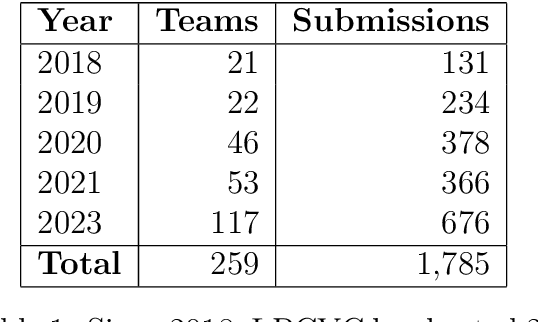
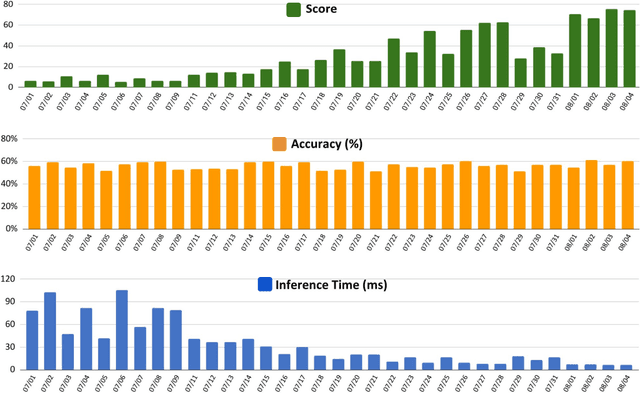


This article describes the 2023 IEEE Low-Power Computer Vision Challenge (LPCVC). Since 2015, LPCVC has been an international competition devoted to tackling the challenge of computer vision (CV) on edge devices. Most CV researchers focus on improving accuracy, at the expense of ever-growing sizes of machine models. LPCVC balances accuracy with resource requirements. Winners must achieve high accuracy with short execution time when their CV solutions run on an embedded device, such as Raspberry PI or Nvidia Jetson Nano. The vision problem for 2023 LPCVC is segmentation of images acquired by Unmanned Aerial Vehicles (UAVs, also called drones) after disasters. The 2023 LPCVC attracted 60 international teams that submitted 676 solutions during the submission window of one month. This article explains the setup of the competition and highlights the winners' methods that improve accuracy and shorten execution time.