 Add to Chrome
 Add to Firefox
 Add to Edge
Blockchain Infrastructure for Intelligent Cyber--Physical--Social Systems:Post-Quantum Security, Interoperability, and Trustworthy Data Economies in the Era of Embodied AI
Jun 05, 2026
The deployment of embodied artificial intelligence via world-model-based robotics presents a transformative opportunity for blockchain infrastructure, establishing urgent demand for trustworthy data provenance, cross-organizational governance, and incentive-compatible sharing across decentralized ecosystems. Simultaneously, quantum computing advances recognized by the 2025 Nobel Prize in Physics and the Turing Award threaten the cryptographic primitives securing these data economies, creating an interdependent imperative: long-lived verification for embodied AI depends on crypto-agile architectures capable of withstanding quantum adversaries. This tutorial examines blockchain as the coordination layer bridging this dual transition, from financial substrate to foundational Cyber-Physical-Social Systems infrastructure that simultaneously secures against quantum cryptanalysis and enables scalable, trustworthy data economies. The session opens with an immersive AWS Braket demonstration engaging participants with superconducting, trapped-ion, and neutral-atom hardware to assess cryptographic threat timelines and witness ECDSA-to-post-quantum signature transitions. Five integrated modules progress from embodied AI and world-model requirements through quantum hardware reality and evidence-based security migration, to scalable cross-shard architectures via BrokerChain protocols, trustworthy data economies implementing Croissant metadata standards and robotic learning provenance, and industry ecosystem integration for multi-modal cloud deployment. By bridging quantum hardware realities with embodied AI data requirements, this tutorial charts blockchain as unified infrastructure for next-generation decentralized intelligent environments, providing open-source frameworks and roadmaps for architecting quantum-resistant, interoperable, and data-trustworthy systems.

A Blockchain-based Decentralized Federated Learning Framework with Committee Consensus
Apr 02, 2020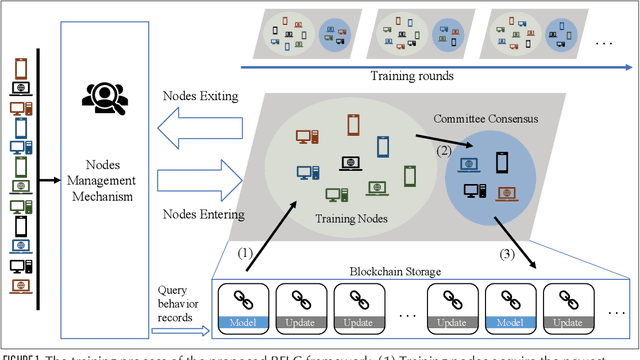
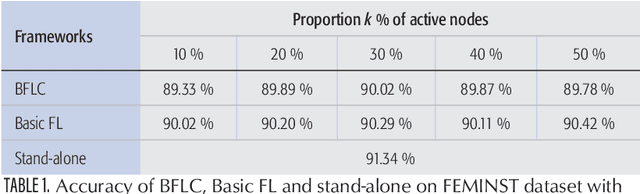
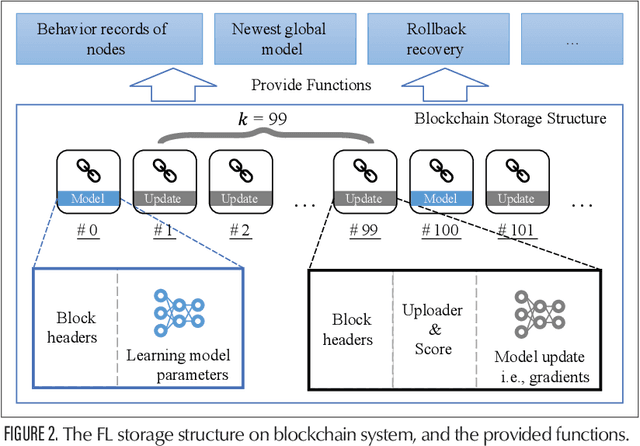
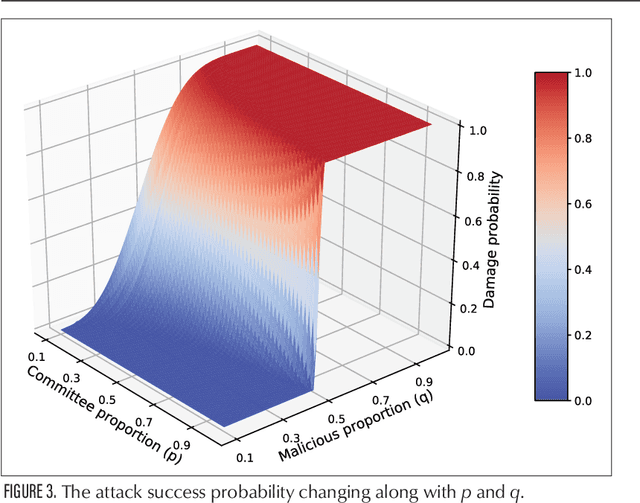
Federated learning has been widely studied and applied to various scenarios. In mobile computing scenarios, federated learning protects users from exposing their private data, while cooperatively training the global model for a variety of real-world applications. However, the security of federated learning is increasingly being questioned, due to the malicious clients or central servers' constant attack to the global model or user privacy data. To address these security issues, we proposed a decentralized federated learning framework based on blockchain, i.e., a Blockchain-based Federated Learning framework with Committee consensus (BFLC). The framework uses blockchain for the global model storage and the local model update exchange. To enable the proposed BFLC, we also devised an innovative committee consensus mechanism, which can effectively reduce the amount of consensus computing and reduce malicious attacks. We then discussed the scalability of BFLC, including theoretical security, storage optimization, and incentives. Finally, we performed experiments using real-world datasets to verify the effectiveness of the BFLC framework.
Prophet: Proactive Candidate-Selection for Federated Learning by Predicting the Qualities of Training and Reporting Phases
Feb 03, 2020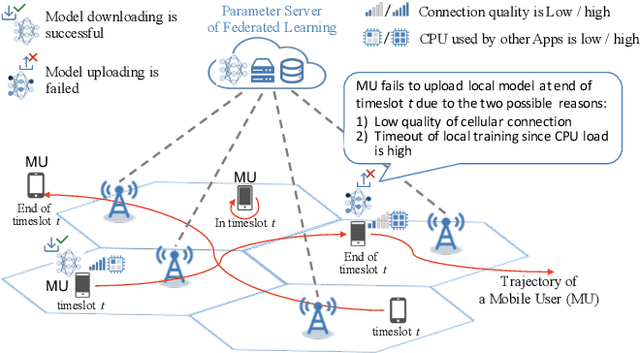
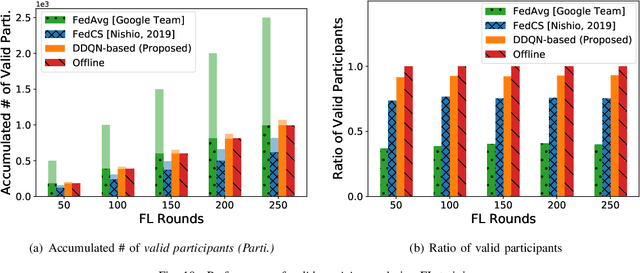
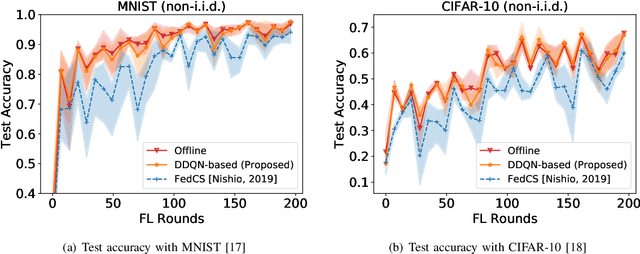
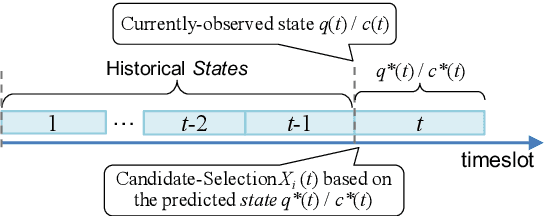
Federated Learning (FL) is viewed as a promising technique for future distributed machine learning. It permits a large number of mobile devices participating in the training of a global model collaboratively without having to expose their local private data. Although the challenge of the network connection will be much relieved in 5G/B5G era, the training latency is still an obstacle preventing FL from being largely adopted. One of the most fundamental problems that leads to large training latency is the bad candidate-selection of FL participants. To the best of our knowledge, the existing candidate-selection algorithms belong to the reactive manner. Under such reactive selection, the FL parameter server only knows the currently-observed resources of all candidates. In the dynamic FL environment, the mobile devices selected by the reactive candidate-selection algorithms very possibly fail to complete the training and reporting phases of FL. To this end, we study the proactive candidate-selection for FL in this paper. We first let each candidate device locally predict the qualities of both its training and reporting phases using the LSTM network. Then, the proposed candidate-selection algorithm is implemented by the Deep Reinforcement Learning (DRL) framework, which can adapt to the dynamically varying factors in the metropolitan edge computing environment. Finally, the real-world trace-driven experiments prove that the proposed proactive approach outperforms the existing reactive algorithms with respect to the ratio of valid participants and the test accuracy of the aggregated global FL model.