 Add to Chrome
 Add to Firefox
 Add to Edge
Beyond the RF Paradigm: Rydberg Atomic Receivers for Next-Generation IoT
May 31, 2026
Next-generation Internet-of-Things (IoT) is evolving toward a ubiquitous, ultra-low-power, and multi-band heterogeneous networking paradigm that seamlessly integrates terrestrial, non-terrestrial, and ambient devices. This vision places unprecedented demands on conventional radio frequency (RF) receivers, whose fundamental bottlenecks in sensitivity, power consumption, coverage, and multi-band operation are rooted in the RF antenna. To tackle these issues, we show that the quantum properties of Rydberg atomic quantum receivers (RAQRs), including ultra-high sensitivity, broad frequency agility, and diverse reception modalities, provide a physically distinct receiver-side path that replaces the conventional antenna-and-low-noise-amplifier chain. Using LoRa, narrowband IoT, and ambient IoT as case studies, this article shows that RAQRs deliver significant gains in weak-uplink, low-power, and battery-free regimes. A stochastic-geometry analysis in cellular and cell-free architectures then maps these device-level gains onto network coverage, where the RAQR retains roughly a 4 dB half-coverage advantage over the RF receiver in sparse deployments at \(λ\sim 10^{-5}~{\mathrm m}^{-2}\), with the gain eroded as device density grows. The open challenges are presented to stand between current RAQR prototypes and deployable IoT infrastructure.

Mutual Coupling Aware Channel Estimation for RIS-Aided Multi-User mmWave Systems
Nov 11, 2025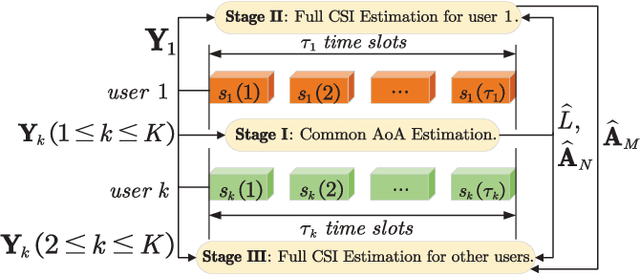
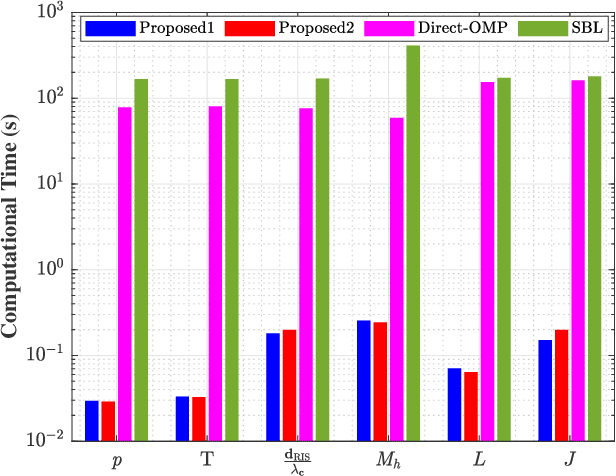
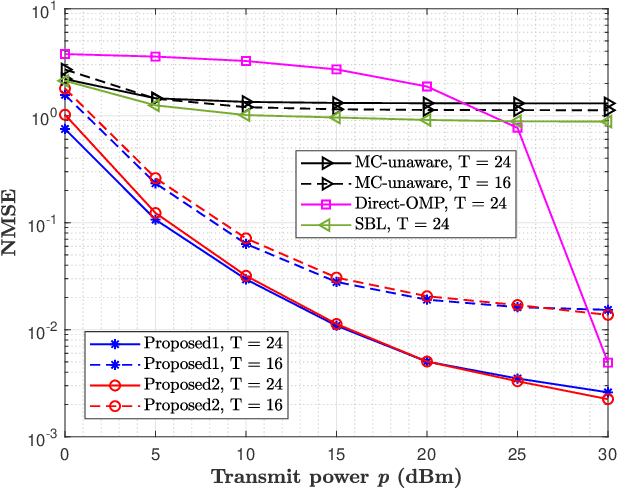
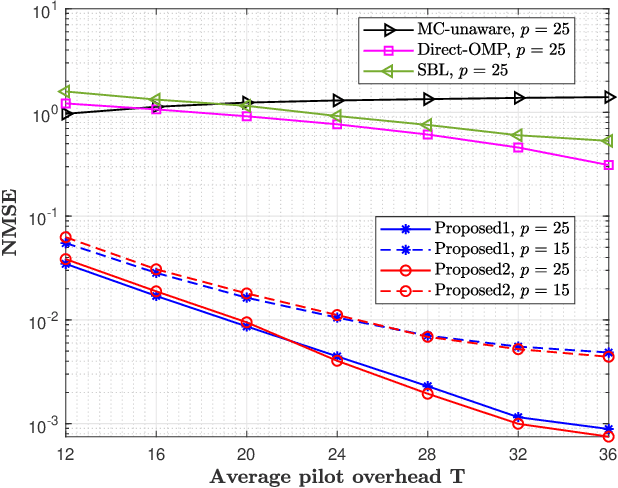
This paper proposes a three-stage uplink channel estimation protocol for reconfigurable intelligent surface (RIS)-aided multi-user (MU) millimeter-wave (mmWave) multiple-input single-output (MISO) systems, where both the base station (BS) and the RIS are equipped with uniform planar arrays (UPAs). The proposed approach explicitly accounts for the mutual coupling (MC) effect, modeled via scattering parameter multiport network theory. In Stage~I, a dimension-reduced subspace-based method is proposed to estimate the common angle of arrival (AoA) at the BS using the received signals across all users. In Stage~II, MC-aware cascaded channel estimation is performed for a typical user. The equivalent measurement vectors for each cascaded path are extracted and the reference column is reconstructed using a compressed sensing (CS)-based approach. By leveraging the structure of the cascaded channel, the reference column is rearranged to estimate the AoA at the RIS, thereby reducing the computational complexity associated with estimating other columns. Additionally, the common angle of departure (AoD) at the RIS is also obtained in this stage, which significantly reduces the pilot overhead for estimating the cascaded channels of other users in Stage~III. The RIS phase shift training matrix is designed to optimize performance in the presence of MC and outperforms random phase scheme. Simulation results validate that the proposed method yields better performance than the MC-unaware and existing approaches in terms of estimation accuracy and pilot efficiency.