 Add to Chrome
 Add to Firefox
 Add to Edge
Beyond the RF Paradigm: Rydberg Atomic Receivers for Next-Generation IoT
May 31, 2026
Next-generation Internet-of-Things (IoT) is evolving toward a ubiquitous, ultra-low-power, and multi-band heterogeneous networking paradigm that seamlessly integrates terrestrial, non-terrestrial, and ambient devices. This vision places unprecedented demands on conventional radio frequency (RF) receivers, whose fundamental bottlenecks in sensitivity, power consumption, coverage, and multi-band operation are rooted in the RF antenna. To tackle these issues, we show that the quantum properties of Rydberg atomic quantum receivers (RAQRs), including ultra-high sensitivity, broad frequency agility, and diverse reception modalities, provide a physically distinct receiver-side path that replaces the conventional antenna-and-low-noise-amplifier chain. Using LoRa, narrowband IoT, and ambient IoT as case studies, this article shows that RAQRs deliver significant gains in weak-uplink, low-power, and battery-free regimes. A stochastic-geometry analysis in cellular and cell-free architectures then maps these device-level gains onto network coverage, where the RAQR retains roughly a 4 dB half-coverage advantage over the RF receiver in sparse deployments at \(λ\sim 10^{-5}~{\mathrm m}^{-2}\), with the gain eroded as device density grows. The open challenges are presented to stand between current RAQR prototypes and deployable IoT infrastructure.

Adaptive Begin-of-Video Tokens for Autoregressive Video Diffusion Models
Nov 15, 2025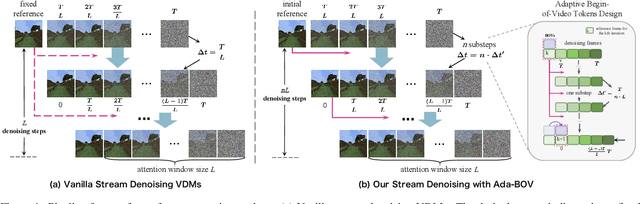
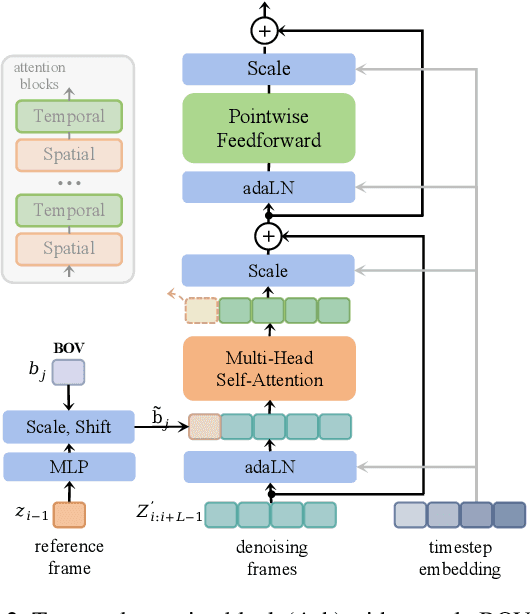
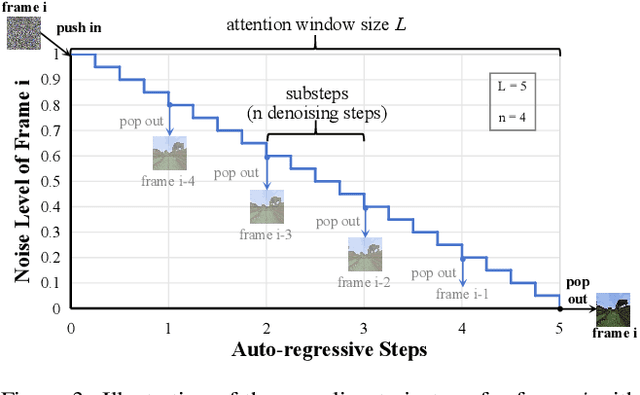
Recent advancements in diffusion-based video generation have produced impressive and high-fidelity short videos. To extend these successes to generate coherent long videos, most video diffusion models (VDMs) generate videos in an autoregressive manner, i.e., generating subsequent frames conditioned on previous ones. There are generally two primary paradigms: chunk-based extension and stream denoising. The former directly concatenates previous clean frames as conditioning, suffering from denoising latency and error accumulation. The latter maintains the denoising sequence with monotonically increasing noise levels. In each denoising iteration, one clean frame is produced while a new pure noise is simultaneously appended, enabling live-stream sampling. However, it struggles with fragile consistency and poor motion dynamics. In this paper, we propose Adaptive Begin-of-Video Tokens (ada-BOV) for autoregressive VDMs. The BOV tokens are special learnable embeddings on VDMs. They adaptively absorb denoised preceding frames via an adaptive-layer-norm-like modulation. This design preserves the global consistency while allowing for flexible conditioning in dynamic scenarios. To ensure the quality of local dynamics essential in modulating BOV tokens, we further propose a refinement strategy for stream denoising. It decouples the sampling trajectory length from the attention window size constraint, leading to improved local guidance and overall imaging quality. We also propose a disturbance-augmented training noise schedule, which balances the convergence speed with model robustness for the stream denoising. Extensive experiments demonstrate that our method achieves compelling qualitative and quantitative results across multiple metrics.