 Add to Chrome
 Add to Firefox
 Add to Edge
FederatedRSF : Federated Random Survival Forests for Partially Overlapping Medical Data
May 21, 2026
Multi-center survival prediction can improve robustness and generalizability, yet privacy regulations and institutional governance often prevent pooling patient-level clinical and genomic data across institutions. In practice, deployment is further complicated by feature-space heterogeneity, in which sites collect different covariates or use different sequencing panels, resulting in only partially overlapping feature sets. We present FederatedRSF, a Python package that implements federated random survival forests, aggregating locally trained survival trees and redistributing only feature-compatible trees to each site, enabling inference with partial overlap without sharing raw data. We evaluate FederatedRSF on the GBSG2 breast cancer cohort distributed with the scikit-survival package, simulating feature heterogeneity across clients by withholding subsets of features, and assessing discrimination using Harrell's concordance index (C-Index) under repeated cross-validation and site-splits. The results demonstrated that the federated model can achieve performance comparable to that of the centralized training setting.

Enhancing Regional Airbnb Trend Forecasting Using LLM-Based Embeddings of Accessibility and Human Mobility
Nov 18, 2025The expansion of short-term rental platforms, such as Airbnb, has significantly disrupted local housing markets, often leading to increased rental prices and housing affordability issues. Accurately forecasting regional Airbnb market trends can thus offer critical insights for policymakers and urban planners aiming to mitigate these impacts. This study proposes a novel time-series forecasting framework to predict three key Airbnb indicators -- Revenue, Reservation Days, and Number of Reservations -- at the regional level. Using a sliding-window approach, the model forecasts trends 1 to 3 months ahead. Unlike prior studies that focus on individual listings at fixed time points, our approach constructs regional representations by integrating listing features with external contextual factors such as urban accessibility and human mobility. We convert structured tabular data into prompt-based inputs for a Large Language Model (LLM), producing comprehensive regional embeddings. These embeddings are then fed into advanced time-series models (RNN, LSTM, Transformer) to better capture complex spatio-temporal dynamics. Experiments on Seoul's Airbnb dataset show that our method reduces both average RMSE and MAE by approximately 48% compared to conventional baselines, including traditional statistical and machine learning models. Our framework not only improves forecasting accuracy but also offers practical insights for detecting oversupplied regions and supporting data-driven urban policy decisions.
Multiple Areal Feature Aware Transportation Demand Prediction
Aug 23, 2024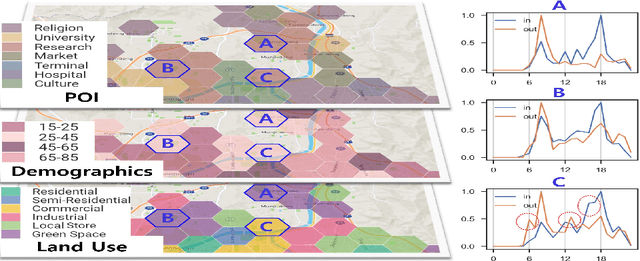
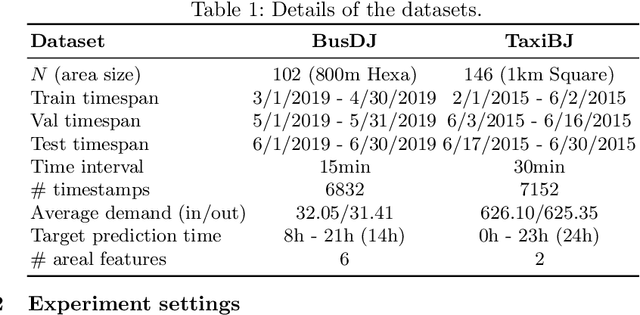
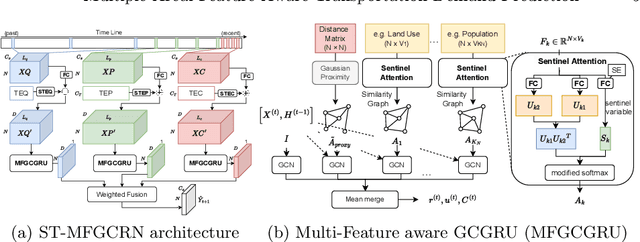
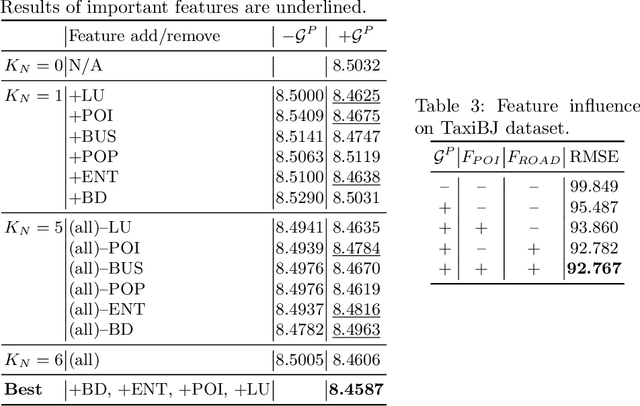
A reliable short-term transportation demand prediction supports the authorities in improving the capability of systems by optimizing schedules, adjusting fleet sizes, and generating new transit networks. A handful of research efforts incorporate one or a few areal features while learning spatio-temporal correlation, to capture similar demand patterns between similar areas. However, urban characteristics are polymorphic, and they need to be understood by multiple areal features such as land use, sociodemographics, and place-of-interest (POI) distribution. In this paper, we propose a novel spatio-temporal multi-feature-aware graph convolutional recurrent network (ST-MFGCRN) that fuses multiple areal features during spatio-temproal understanding. Inside ST-MFGCRN, we devise sentinel attention to calculate the areal similarity matrix by allowing each area to take partial attention if the feature is not useful. We evaluate the proposed model on two real-world transportation datasets, one with our constructed BusDJ dataset and one with benchmark TaxiBJ. Results show that our model outperforms the state-of-the-art baselines up to 7\% on BusDJ and 8\% on TaxiBJ dataset.
Federated Random Forest for Partially Overlapping Clinical Data
May 31, 2024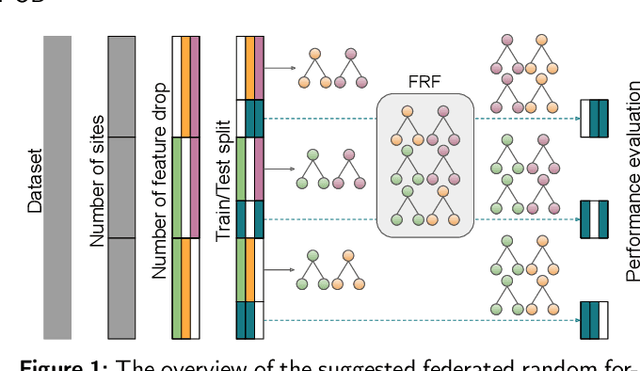
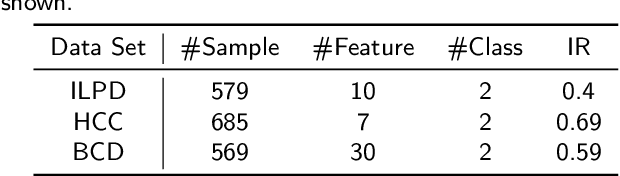
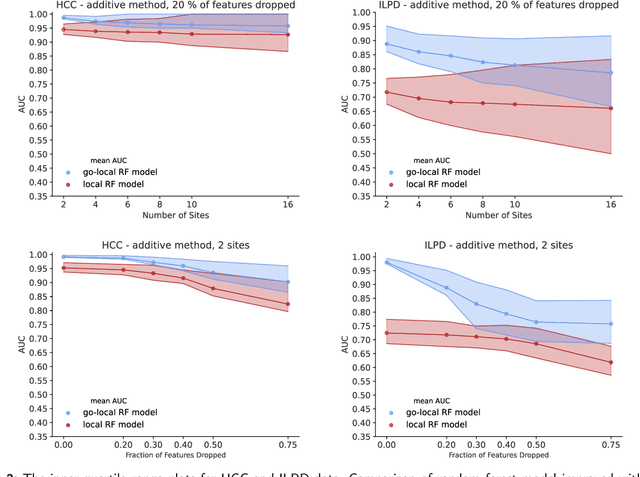
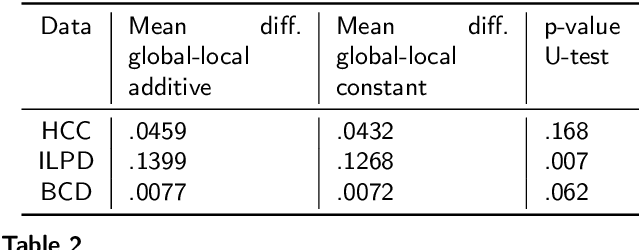
In the healthcare sector, a consciousness surrounding data privacy and corresponding data protection regulations, as well as heterogeneous and non-harmonized data, pose huge challenges to large-scale data analysis. Moreover, clinical data often involves partially overlapping features, as some observations may be missing due to various reasons, such as differences in procedures, diagnostic tests, or other recorded patient history information across hospitals or institutes. To address the challenges posed by partially overlapping features and incomplete data in clinical datasets, a comprehensive approach is required. Particularly in the domain of medical data, promising outcomes are achieved by federated random forests whenever features align. However, for most standard algorithms, like random forest, it is essential that all data sets have identical parameters. Therefore, in this work the concept of federated random forest is adapted to a setting with partially overlapping features. Moreover, our research assesses the effectiveness of the newly developed federated random forest models for partially overlapping clinical data. For aggregating the federated, globally optimized model, only features available locally at each site can be used. We tackled two issues in federation: (i) the quantity of involved parties, (ii) the varying overlap of features. This evaluation was conducted across three clinical datasets. The federated random forest model even in cases where only a subset of features overlaps consistently demonstrates superior performance compared to its local counterpart. This holds true across various scenarios, including datasets with imbalanced classes. Consequently, federated random forests for partially overlapped data offer a promising solution to transcend barriers in collaborative research and corporate cooperation.
Improving Real Estate Appraisal with POI Integration and Areal Embedding
Nov 20, 2023
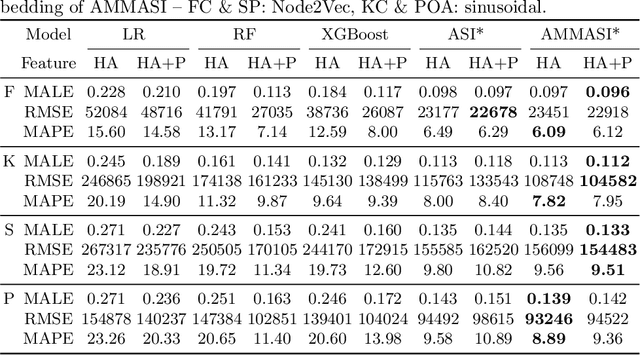

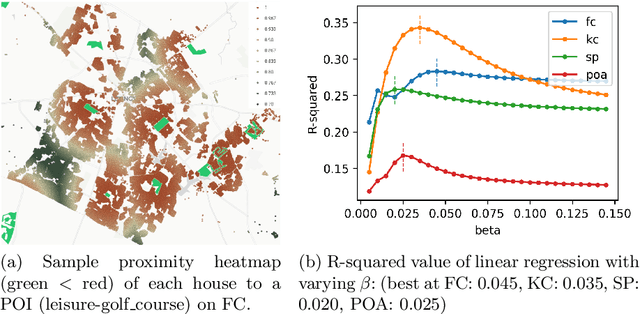
Despite advancements in real estate appraisal methods, this study primarily focuses on two pivotal challenges. Firstly, we explore the often-underestimated impact of Points of Interest (POI) on property values, emphasizing the necessity for a comprehensive, data-driven approach to feature selection. Secondly, we integrate road-network-based Areal Embedding to enhance spatial understanding for real estate appraisal. We first propose a revised method for POI feature extraction, and discuss the impact of each POI for house price appraisal. Then we present the Areal embedding-enabled Masked Multihead Attention-based Spatial Interpolation for House Price Prediction (AMMASI) model, an improvement upon the existing ASI model, which leverages masked multi-head attention on geographic neighbor houses and similar-featured houses. Our model outperforms current baselines and also offers promising avenues for future optimization in real estate appraisal methodologies.
Enhancing Spatiotemporal Traffic Prediction through Urban Human Activity Analysis
Aug 20, 2023
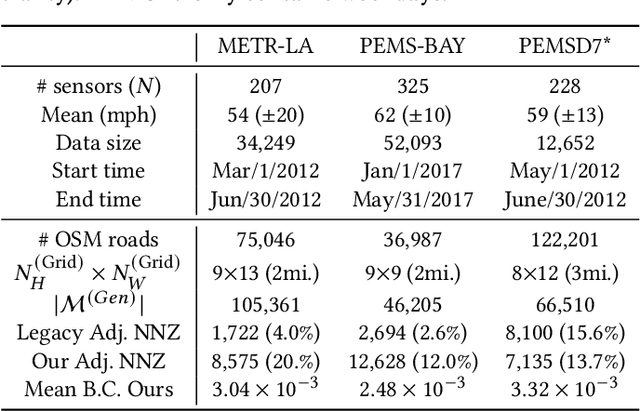


Traffic prediction is one of the key elements to ensure the safety and convenience of citizens. Existing traffic prediction models primarily focus on deep learning architectures to capture spatial and temporal correlation. They often overlook the underlying nature of traffic. Specifically, the sensor networks in most traffic datasets do not accurately represent the actual road network exploited by vehicles, failing to provide insights into the traffic patterns in urban activities. To overcome these limitations, we propose an improved traffic prediction method based on graph convolution deep learning algorithms. We leverage human activity frequency data from National Household Travel Survey to enhance the inference capability of a causal relationship between activity and traffic patterns. Despite making minimal modifications to the conventional graph convolutional recurrent networks and graph convolutional transformer architectures, our approach achieves state-of-the-art performance without introducing excessive computational overhead.