 Add to Chrome
 Add to Firefox
 Add to Edge
SVC 2026: the Second Multimodal Deception Detection Challenge and the First Domain Generalized Remote Physiological Measurement Challenge
Apr 07, 2026
Subtle visual signals, although difficult to perceive with the naked eye, contain important information that can reveal hidden patterns in visual data. These signals play a key role in many applications, including biometric security, multimedia forensics, medical diagnosis, industrial inspection, and affective computing. With the rapid development of computer vision and representation learning techniques, detecting and interpreting such subtle signals has become an emerging research direction. However, existing studies often focus on specific tasks or modalities, and models still face challenges in robustness, representation ability, and generalization when handling subtle and weak signals in real-world environments. To promote research in this area, we organize the Subtle visual Challenge, which aims to learn robust representations for subtle visual signals. The challenge includes two tasks: cross-domain multimodal deception detection and remote photoplethysmography (rPPG) estimation. We hope that this challenge will encourage the development of more robust and generalizable models for subtle visual understanding, and further advance research in computer vision and multimodal learning. A total of 22 teams submitted their final results to this workshop competition, and the corresponding baseline models have been released on the \href{https://sites.google.com/view/svc-cvpr26}{MMDD2026 platform}\footnote{https://sites.google.com/view/svc-cvpr26}

DecepGPT: Schema-Driven Deception Detection with Multicultural Datasets and Robust Multimodal Learning
Mar 25, 2026Multimodal deception detection aims to identify deceptive behavior by analyzing audiovisual cues for forensics and security. In these high-stakes settings, investigators need verifiable evidence connecting audiovisual cues to final decisions, along with reliable generalization across domains and cultural contexts. However, existing benchmarks provide only binary labels without intermediate reasoning cues. Datasets are also small with limited scenario coverage, leading to shortcut learning. We address these issues through three contributions. First, we construct reasoning datasets by augmenting existing benchmarks with structured cue-level descriptions and reasoning chains, enabling model output auditable reports. Second, we release T4-Deception, a multicultural dataset based on the unified ``To Tell The Truth'' television format implemented across four countries. With 1695 samples, it is the largest non-laboratory deception detection dataset. Third, we propose two modules for robust learning under small-data conditions. Stabilized Individuality-Commonality Synergy (SICS) refines multimodal representations by synergizing learnable global priors with sample-adaptive residuals, followed by a polarity-aware adjustment that bi-directionally recalibrates representations. Distilled Modality Consistency (DMC) aligns modality-specific predictions with the fused multimodal predictions via knowledge distillation to prevent unimodal shortcut learning. Experiments on three established benchmarks and our novel dataset demonstrate that our method achieves state-of-the-art performance in both in-domain and cross-domain scenarios, while exhibiting superior transferability across diverse cultural contexts. The datasets and codes will be released.
End-to-end Recording Device Identification Based on Deep Representation Learning
Dec 05, 2022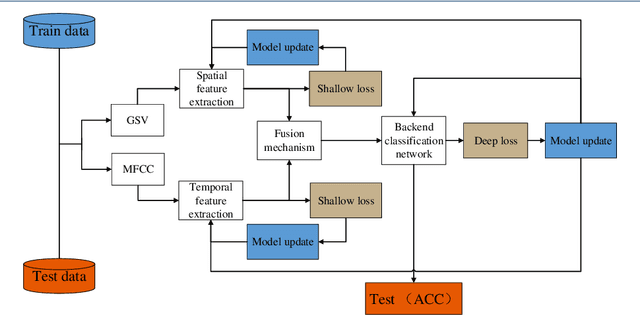
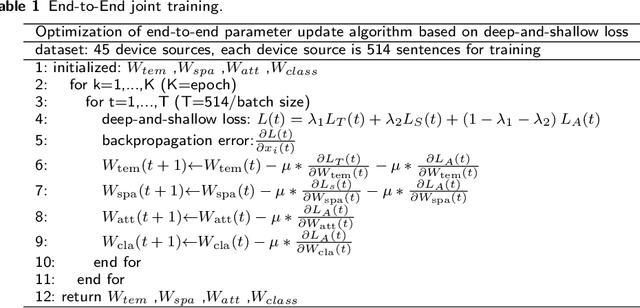
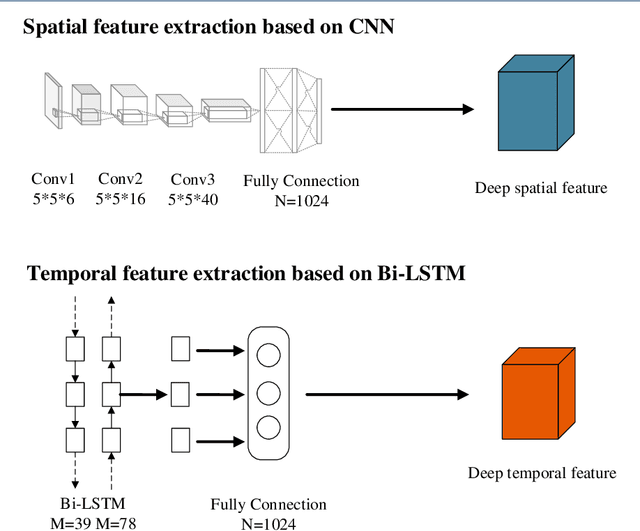
Deep learning techniques have achieved specific results in recording device source identification. The recording device source features include spatial information and certain temporal information. However, most recording device source identification methods based on deep learning only use spatial representation learning from recording device source features, which cannot make full use of recording device source information. Therefore, in this paper, to fully explore the spatial information and temporal information of recording device source, we propose a new method for recording device source identification based on the fusion of spatial feature information and temporal feature information by using an end-to-end framework. From a feature perspective, we designed two kinds of networks to extract recording device source spatial and temporal information. Afterward, we use the attention mechanism to adaptively assign the weight of spatial information and temporal information to obtain fusion features. From a model perspective, our model uses an end-to-end framework to learn the deep representation from spatial feature and temporal feature and train using deep and shallow loss to joint optimize our network. This method is compared with our previous work and baseline system. The results show that the proposed method is better than our previous work and baseline system under general conditions.