 Add to Chrome
 Add to Firefox
 Add to Edge
UNIVID: Unified Vision-Language Model for Video Moderation
Jun 04, 2026
Global-scale video moderation faces a dual challenge: the need for fine-grained multi-modal reasoning and the demand for interpretable outputs to support downstream enforcement. Traditional moderation systems often rely on fragmented black-box classifiers that are difficult to maintain and lack transparency. In this paper, we present UNIVID, a UNIfied VIsion-language model for video moDeration. Unlike standard classification models, UNIVID generates policy-aware captions that serve as an interpretable intermediate representation, enabling human-verifiable decisions and multi-task reusability. While existing open-source and commercial VLMs often suffer from safety-guardrail refusals and lack fine-grained policy alignment, we develop a specialized training data recipe that combines expert human-refined labels with synthetic data to align the model with our safety guidelines. By integrating UNIVID as the core captioner, we design a novel end-to-end video moderation system that reduces violation leakage by 42.7% and overkill rate by 37.0% relatively. Meanwhile, by replacing over 1,000 policy-specific models with a single UNIVID backbone, we recycled extensive computation resources while reducing engineering maintenance overhead. To our knowledge, this is one of the first reports of a high-efficiency captioning VLM successfully supporting industrial-scale moderation and cross-functional business.

Dynamic Multi-path Neural Network
Apr 07, 2019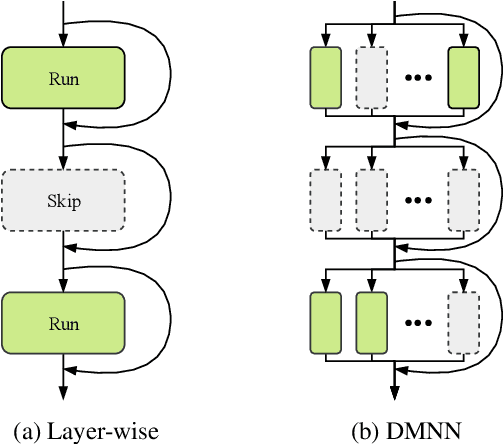
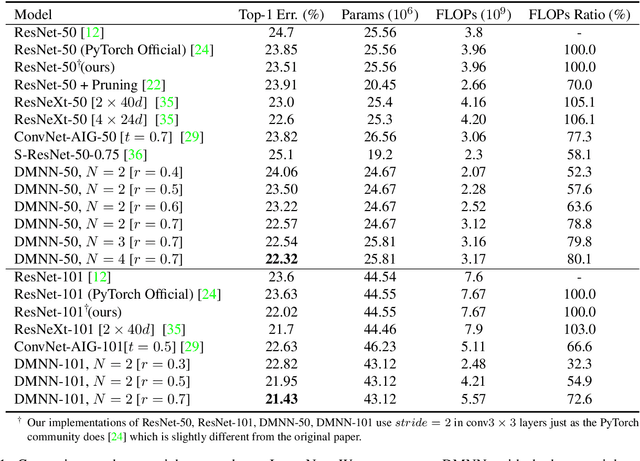
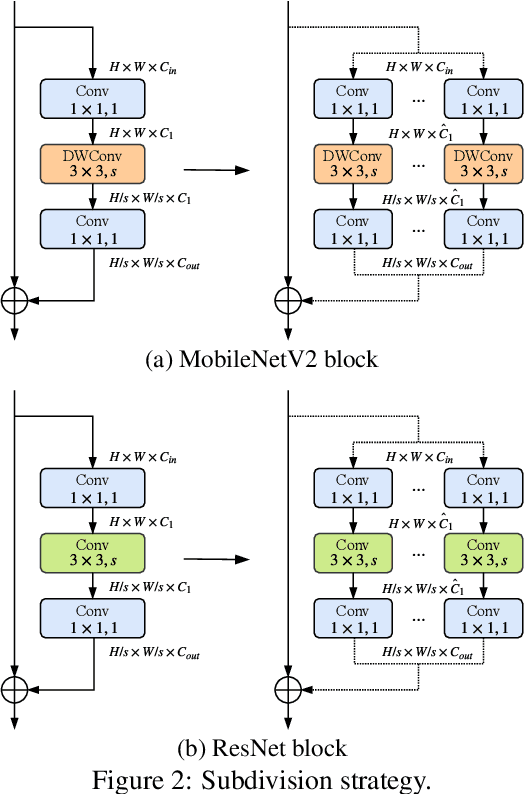
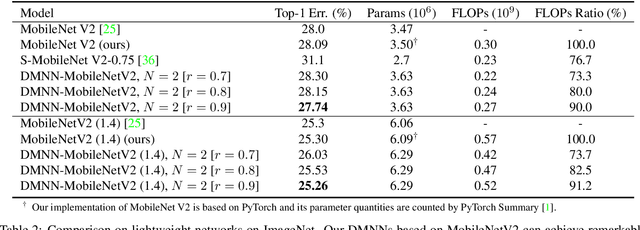
Although deeper and larger neural networks have achieved better performance, the complex network structure and increasing computational cost cannot meet the demands of many resource-constrained applications. Existing methods usually choose to execute or skip an entire specific layer, which can only alter the depth of the network. In this paper, we propose a novel method called Dynamic Multi-path Neural Network (DMNN), which provides more path selection choices in terms of network width and depth during inference. The inference path of the network is determined by a controller, which takes into account both previous state and object category information. The proposed method can be easily incorporated into most modern network architectures. Experimental results on ImageNet and CIFAR-100 demonstrate the superiority of our method on both efficiency and overall classification accuracy. To be specific, DMNN-101 significantly outperforms ResNet-101 with an encouraging 45.1% FLOPs reduction, and DMNN-50 performs comparably to ResNet-101 while saving 42.1% parameters.