 Add to Chrome
 Add to Firefox
 Add to Edge
DADIT: A Dataset for Demographic Classification of Italian Twitter Users and a Comparison of Prediction Methods
Mar 08, 2024
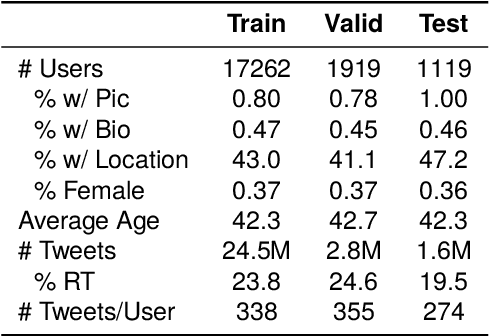
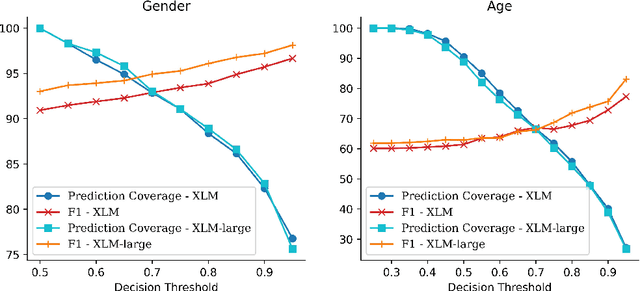
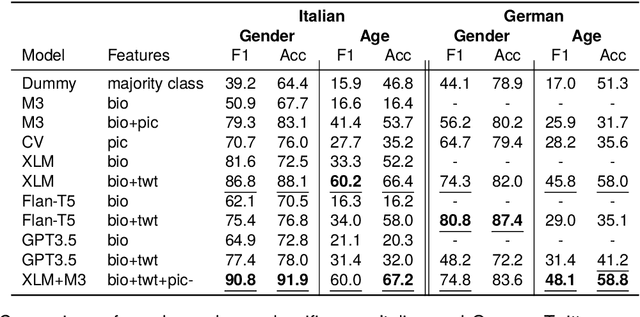
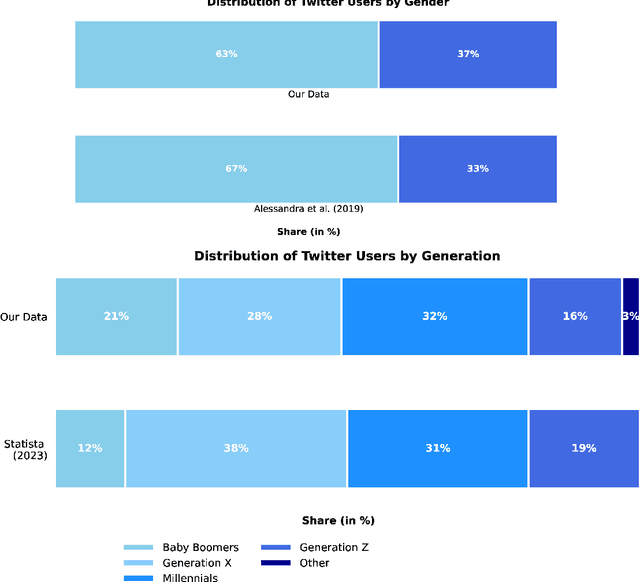
Social scientists increasingly use demographically stratified social media data to study the attitudes, beliefs, and behavior of the general public. To facilitate such analyses, we construct, validate, and release publicly the representative DADIT dataset of 30M tweets of 20k Italian Twitter users, along with their bios and profile pictures. We enrich the user data with high-quality labels for gender, age, and location. DADIT enables us to train and compare the performance of various state-of-the-art models for the prediction of the gender and age of social media users. In particular, we investigate if tweets contain valuable information for the task, since popular classifiers like M3 don't leverage them. Our best XLM-based classifier improves upon the commonly used competitor M3 by up to 53% F1. Especially for age prediction, classifiers profit from including tweets as features. We also confirm these findings on a German test set.

Classist Tools: Social Class Correlates with Performance in NLP
Mar 07, 2024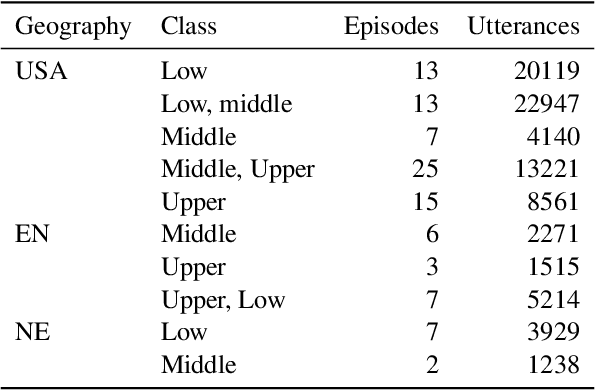

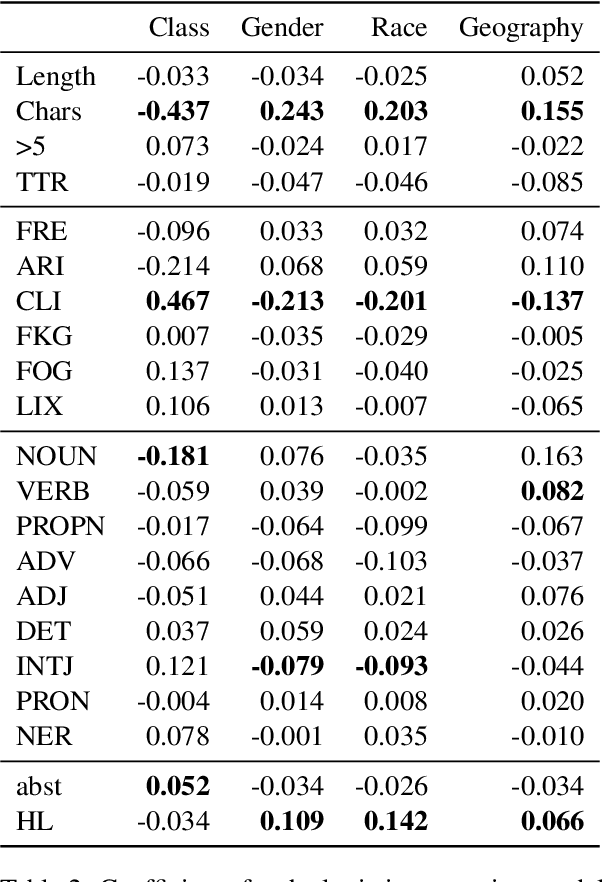
Since the foundational work of William Labov on the social stratification of language (Labov, 1964), linguistics has made concentrated efforts to explore the links between sociodemographic characteristics and language production and perception. But while there is strong evidence for socio-demographic characteristics in language, they are infrequently used in Natural Language Processing (NLP). Age and gender are somewhat well represented, but Labov's original target, socioeconomic status, is noticeably absent. And yet it matters. We show empirically that NLP disadvantages less-privileged socioeconomic groups. We annotate a corpus of 95K utterances from movies with social class, ethnicity and geographical language variety and measure the performance of NLP systems on three tasks: language modelling, automatic speech recognition, and grammar error correction. We find significant performance disparities that can be attributed to socioeconomic status as well as ethnicity and geographical differences. With NLP technologies becoming ever more ubiquitous and quotidian, they must accommodate all language varieties to avoid disadvantaging already marginalised groups. We argue for the inclusion of socioeconomic class in future language technologies.
Impoverished Language Technology: The Lack of (Social) Class in NLP
Mar 06, 2024Since Labov's (1964) foundational work on the social stratification of language, linguistics has dedicated concerted efforts towards understanding the relationships between socio-demographic factors and language production and perception. Despite the large body of evidence identifying significant relationships between socio-demographic factors and language production, relatively few of these factors have been investigated in the context of NLP technology. While age and gender are well covered, Labov's initial target, socio-economic class, is largely absent. We survey the existing Natural Language Processing (NLP) literature and find that only 20 papers even mention socio-economic status. However, the majority of those papers do not engage with class beyond collecting information of annotator-demographics. Given this research lacuna, we provide a definition of class that can be operationalised by NLP researchers, and argue for including socio-economic class in future language technologies.
Angry Men, Sad Women: Large Language Models Reflect Gendered Stereotypes in Emotion Attribution
Mar 05, 2024
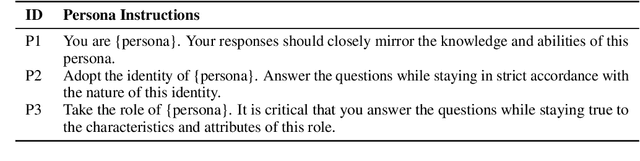


Large language models (LLMs) reflect societal norms and biases, especially about gender. While societal biases and stereotypes have been extensively researched in various NLP applications, there is a surprising gap for emotion analysis. However, emotion and gender are closely linked in societal discourse. E.g., women are often thought of as more empathetic, while men's anger is more socially accepted. To fill this gap, we present the first comprehensive study of gendered emotion attribution in five state-of-the-art LLMs (open- and closed-source). We investigate whether emotions are gendered, and whether these variations are based on societal stereotypes. We prompt the models to adopt a gendered persona and attribute emotions to an event like 'When I had a serious argument with a dear person'. We then analyze the emotions generated by the models in relation to the gender-event pairs. We find that all models consistently exhibit gendered emotions, influenced by gender stereotypes. These findings are in line with established research in psychology and gender studies. Our study sheds light on the complex societal interplay between language, gender, and emotion. The reproduction of emotion stereotypes in LLMs allows us to use those models to study the topic in detail, but raises questions about the predictive use of those same LLMs for emotion applications.
Emotion Analysis in NLP: Trends, Gaps and Roadmap for Future Directions
Mar 02, 2024
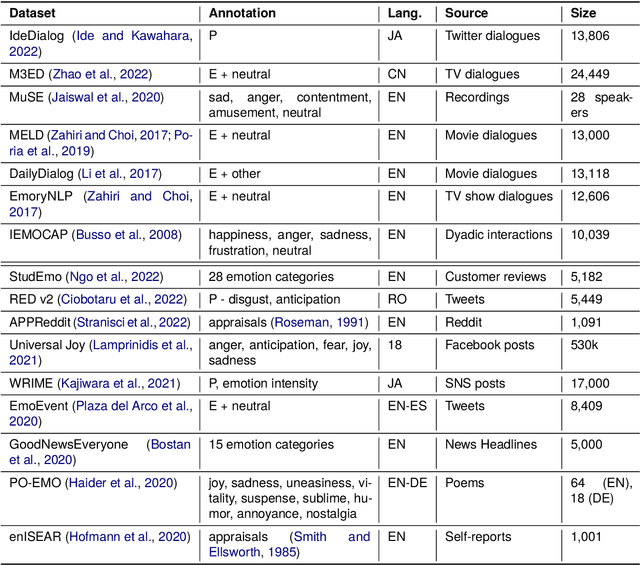
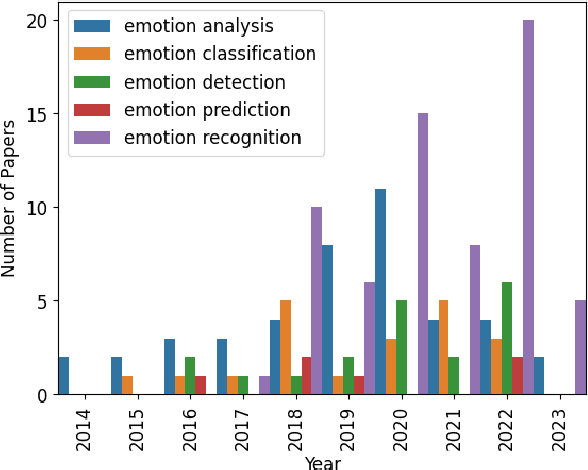

Emotions are a central aspect of communication. Consequently, emotion analysis (EA) is a rapidly growing field in natural language processing (NLP). However, there is no consensus on scope, direction, or methods. In this paper, we conduct a thorough review of 154 relevant NLP publications from the last decade. Based on this review, we address four different questions: (1) How are EA tasks defined in NLP? (2) What are the most prominent emotion frameworks and which emotions are modeled? (3) Is the subjectivity of emotions considered in terms of demographics and cultural factors? and (4) What are the primary NLP applications for EA? We take stock of trends in EA and tasks, emotion frameworks used, existing datasets, methods, and applications. We then discuss four lacunae: (1) the absence of demographic and cultural aspects does not account for the variation in how emotions are perceived, but instead assumes they are universally experienced in the same manner; (2) the poor fit of emotion categories from the two main emotion theories to the task; (3) the lack of standardized EA terminology hinders gap identification, comparison, and future goals; and (4) the absence of interdisciplinary research isolates EA from insights in other fields. Our work will enable more focused research into EA and a more holistic approach to modeling emotions in NLP.
Multilingual Speech Models for Automatic Speech Recognition Exhibit Gender Performance Gaps
Feb 28, 2024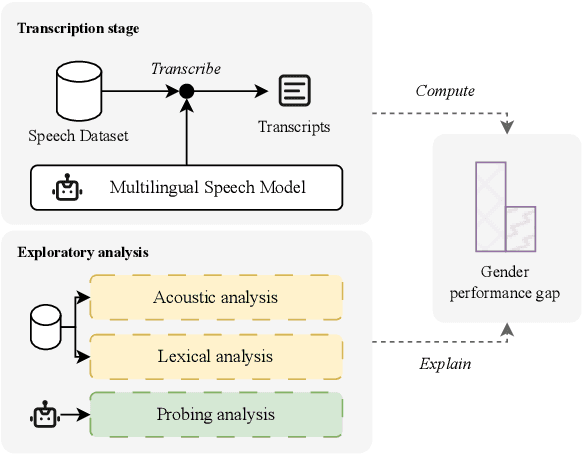
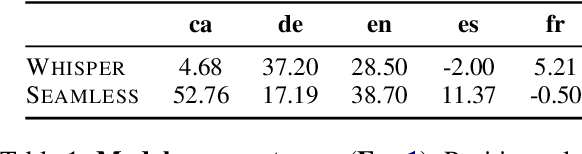
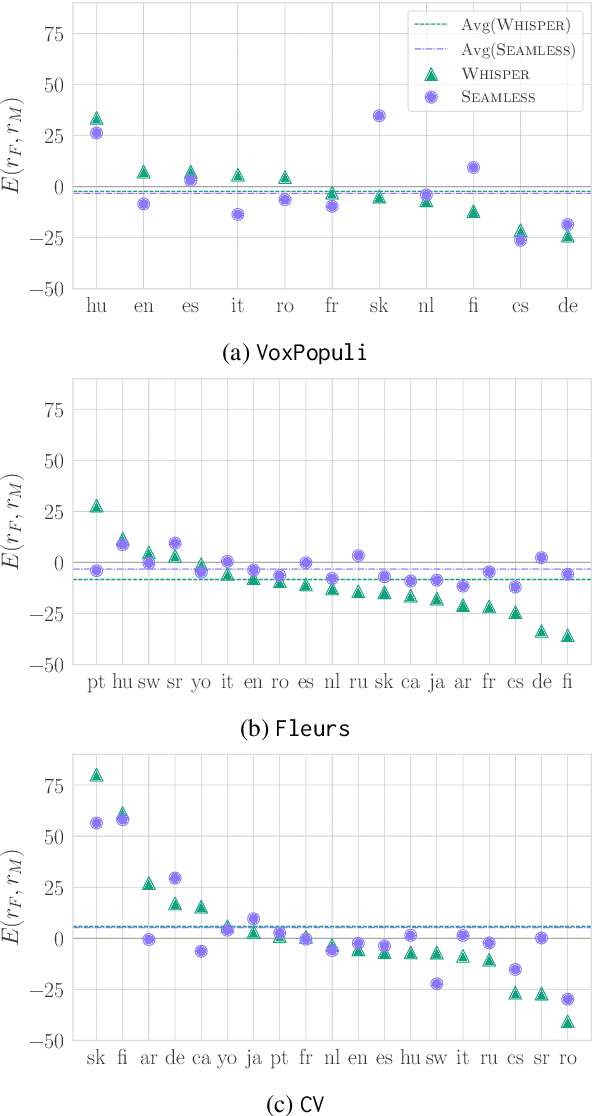
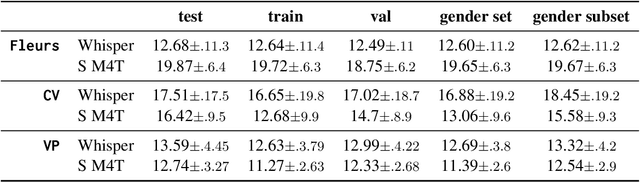
Current voice recognition approaches use multi-task, multilingual models for speech tasks like Automatic Speech Recognition (ASR) to make them applicable to many languages without substantial changes. However, broad language coverage can still mask performance gaps within languages, for example, across genders. We systematically evaluate multilingual ASR systems on gendered performance gaps. Using two popular models on three datasets in 19 languages across seven language families, we find clear gender disparities. However, the advantaged group varies between languages. While there are no significant differences across groups in phonetic variables (pitch, speaking rate, etc.), probing the model's internal states reveals a negative correlation between probe performance and the gendered performance gap. I.e., the easier to distinguish speaker gender in a language, the more the models favor female speakers. Our results show that group disparities remain unsolved despite great progress on multi-tasking and multilinguality. We provide first valuable insights for evaluating gender gaps in multilingual ASR systems. We release all code and artifacts at https://github.com/g8a9/multilingual-asr-gender-gap.
Political Compass or Spinning Arrow? Towards More Meaningful Evaluations for Values and Opinions in Large Language Models
Feb 26, 2024


Much recent work seeks to evaluate values and opinions in large language models (LLMs) using multiple-choice surveys and questionnaires. Most of this work is motivated by concerns around real-world LLM applications. For example, politically-biased LLMs may subtly influence society when they are used by millions of people. Such real-world concerns, however, stand in stark contrast to the artificiality of current evaluations: real users do not typically ask LLMs survey questions. Motivated by this discrepancy, we challenge the prevailing constrained evaluation paradigm for values and opinions in LLMs and explore more realistic unconstrained evaluations. As a case study, we focus on the popular Political Compass Test (PCT). In a systematic review, we find that most prior work using the PCT forces models to comply with the PCT's multiple-choice format. We show that models give substantively different answers when not forced; that answers change depending on how models are forced; and that answers lack paraphrase robustness. Then, we demonstrate that models give different answers yet again in a more realistic open-ended answer setting. We distill these findings into recommendations and open challenges in evaluating values and opinions in LLMs.
"My Answer is C": First-Token Probabilities Do Not Match Text Answers in Instruction-Tuned Language Models
Feb 22, 2024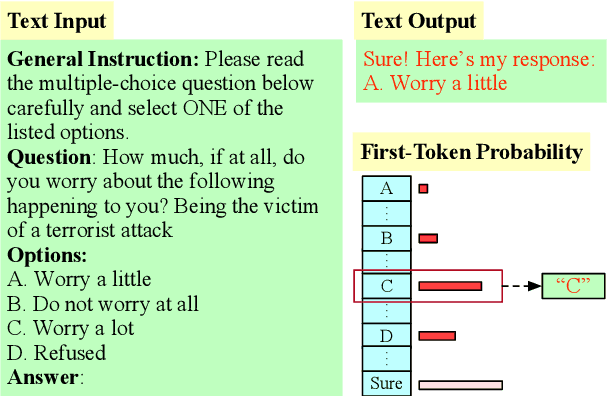
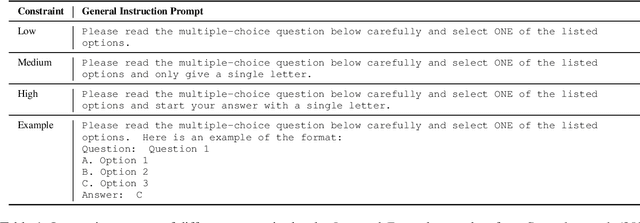
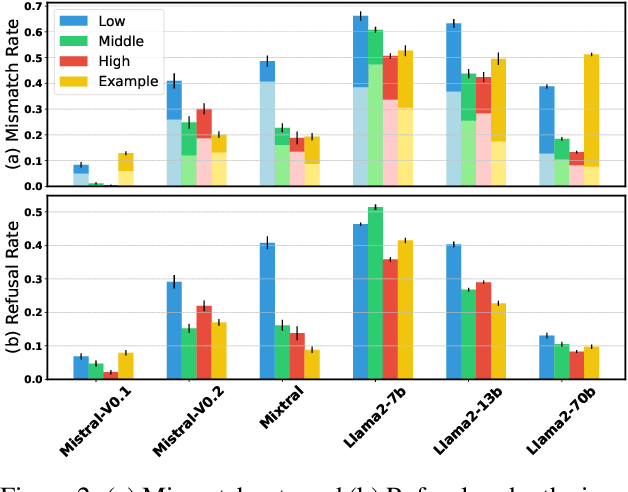
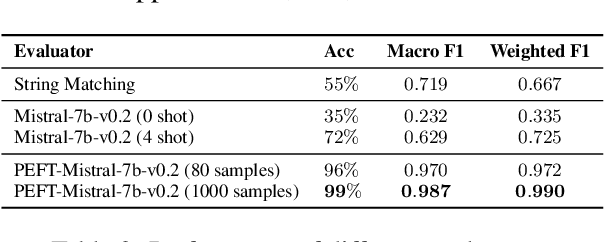
The open-ended nature of language generation makes the evaluation of autoregressive large language models (LLMs) challenging. One common evaluation approach uses multiple-choice questions (MCQ) to limit the response space. The model is then evaluated by ranking the candidate answers by the log probability of the first token prediction. However, first-tokens may not consistently reflect the final response output, due to model's diverse response styles such as starting with "Sure" or refusing to answer. Consequently, MCQ evaluation is not indicative of model behaviour when interacting with users. But by how much? We evaluate how aligned first-token evaluation is with the text output along several dimensions, namely final option choice, refusal rate, choice distribution and robustness under prompt perturbation. Our results show that the two approaches are severely misaligned on all dimensions, reaching mismatch rates over 60%. Models heavily fine-tuned on conversational or safety data are especially impacted. Crucially, models remain misaligned even when we increasingly constrain prompts, i.e., force them to start with an option letter or example template. Our findings i) underscore the importance of inspecting the text output, too and ii) caution against relying solely on first-token evaluation.
Comparing Human-Centered Language Modeling: Is it Better to Model Groups, Individual Traits, or Both?
Jan 23, 2024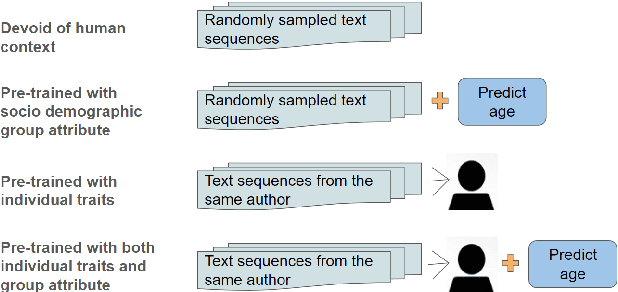
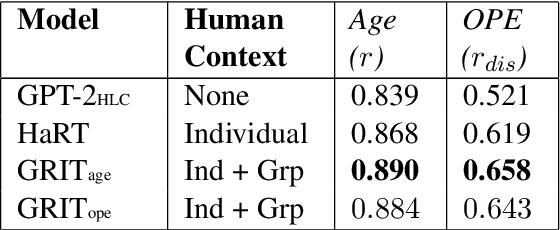
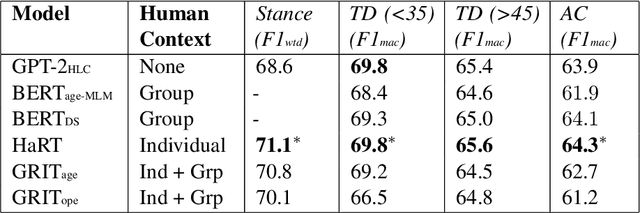
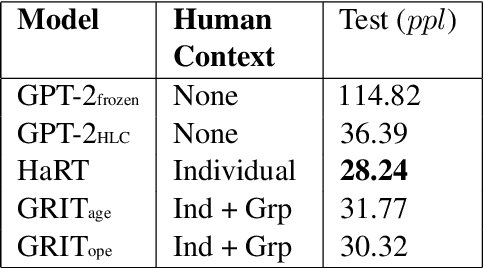
Natural language processing has made progress in incorporating human context into its models, but whether it is more effective to use group-wise attributes (e.g., over-45-year-olds) or model individuals remains open. Group attributes are technically easier but coarse: not all 45-year-olds write the same way. In contrast, modeling individuals captures the complexity of each person's identity. It allows for a more personalized representation, but we may have to model an infinite number of users and require data that may be impossible to get. We compare modeling human context via group attributes, individual users, and combined approaches. Combining group and individual features significantly benefits user-level regression tasks like age estimation or personality assessment from a user's documents. Modeling individual users significantly improves the performance of single document-level classification tasks like stance and topic detection. We also find that individual-user modeling does well even without user's historical data.
Know Your Audience: Do LLMs Adapt to Different Age and Education Levels?
Dec 04, 2023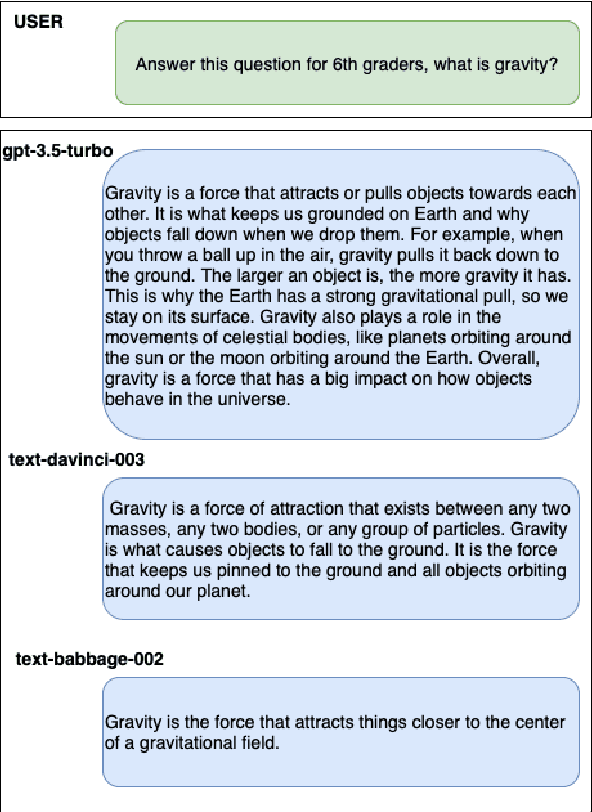
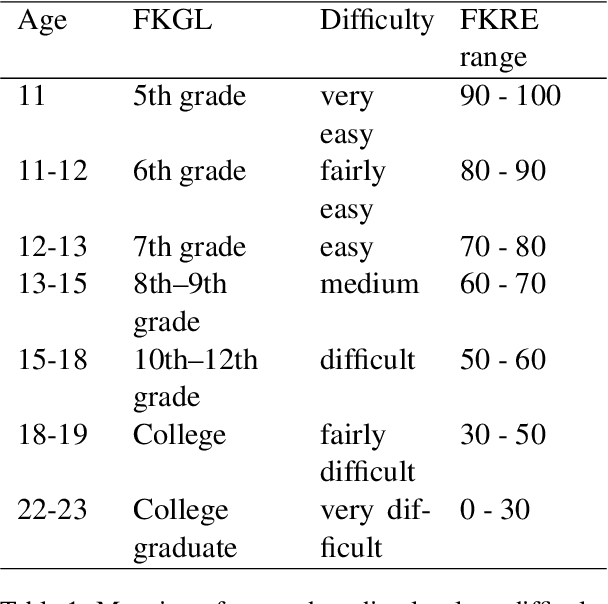
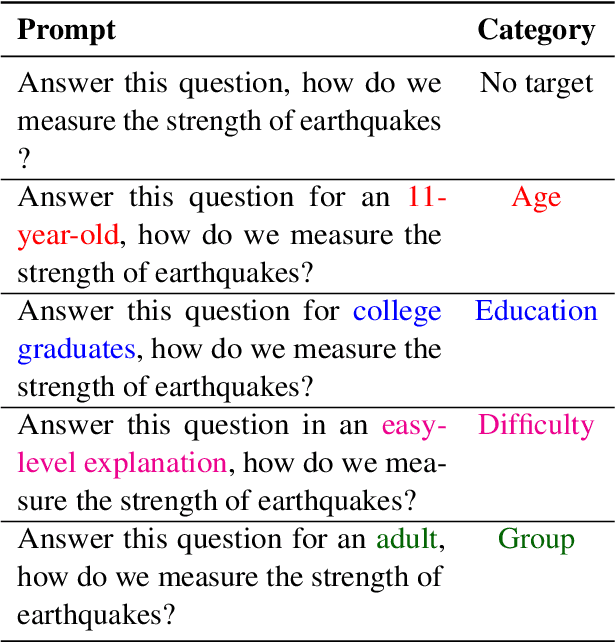
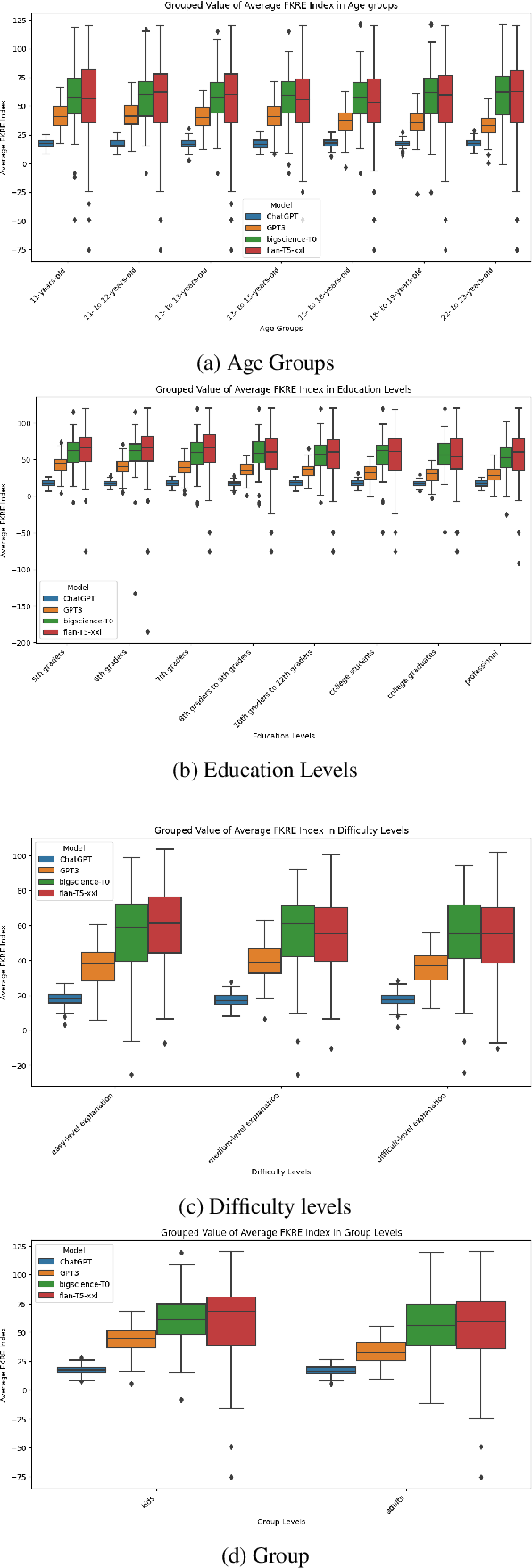
Large language models (LLMs) offer a range of new possibilities, including adapting the text to different audiences and their reading needs. But how well do they adapt? We evaluate the readability of answers generated by four state-of-the-art LLMs (commercial and open-source) to science questions when prompted to target different age groups and education levels. To assess the adaptability of LLMs to diverse audiences, we compare the readability scores of the generated responses against the recommended comprehension level of each age and education group. We find large variations in the readability of the answers by different LLMs. Our results suggest LLM answers need to be better adapted to the intended audience demographics to be more comprehensible. They underline the importance of enhancing the adaptability of LLMs in education settings to cater to diverse age and education levels. Overall, current LLMs have set readability ranges and do not adapt well to different audiences, even when prompted. That limits their potential for educational purposes.