 Add to Chrome
 Add to Firefox
 Add to Edge
COMEX: A Composition-Grounded Benchmark and Learning Framework for Explainable Aesthetic Image Cropping
Aug 04, 2026
Explainable aesthetic image cropping requires not only localizing a visually pleasing crop but also explaining why it is preferred. Existing crop-and-explain methods largely treat explanation as post-hoc text generation and overlook composition, a key aesthetic factor that links crop decisions with interpretable reasoning. In this paper, we reformulate explainable aesthetic image cropping as a structured crop-composition-explanation problem. To support this setting, we introduce COMEX, a new benchmark built through image expansion and an IO-reversal pipeline. COMEX contains 33,161 quadruples, each consisting of an expanded image, a crop box, a composition category, and a composition-grounded explanation, enabling joint learning of crop localization, composition understanding, and explanation generation. We further propose a two-stage SFT+GRPO framework, where supervised fine-tuning establishes the structured output protocol and basic cropping ability, and GRPO further improves crop quality, composition prediction, and explanation faithfulness. We benchmark 15 large vision-language models and existing cropping methods on COMEX, establishing a comprehensive testbed for composition-grounded explainable aesthetic cropping. Experiments on both COMEX and prior benchmarks demonstrate the effectiveness and transferability of our framework, with strong performance across evaluation metrics.

Technique Report of CVPR 2024 PBDL Challenges
Jun 15, 2024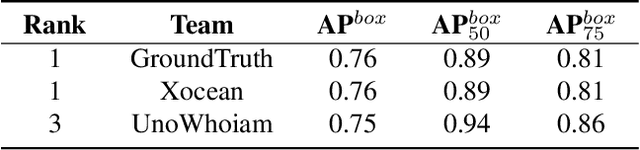
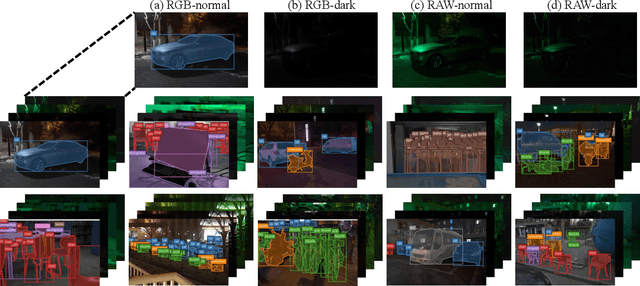
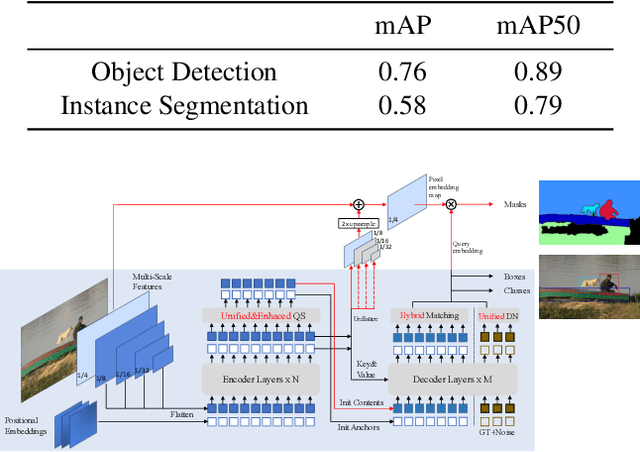

The intersection of physics-based vision and deep learning presents an exciting frontier for advancing computer vision technologies. By leveraging the principles of physics to inform and enhance deep learning models, we can develop more robust and accurate vision systems. Physics-based vision aims to invert the processes to recover scene properties such as shape, reflectance, light distribution, and medium properties from images. In recent years, deep learning has shown promising improvements for various vision tasks, and when combined with physics-based vision, these approaches can enhance the robustness and accuracy of vision systems. This technical report summarizes the outcomes of the Physics-Based Vision Meets Deep Learning (PBDL) 2024 challenge, held in CVPR 2024 workshop. The challenge consisted of eight tracks, focusing on Low-Light Enhancement and Detection as well as High Dynamic Range (HDR) Imaging. This report details the objectives, methodologies, and results of each track, highlighting the top-performing solutions and their innovative approaches.