 Add to Chrome
 Add to Firefox
 Add to Edge
Evolutionary Two-Stage Hyperparameter Optimization Strategies for Physics-Informed Neural Networks
Jun 18, 2026
Physics-Informed Neural Networks (PINNs) solve Partial Differential Equations (PDEs) by embedding physical laws into neural network training. However, their performance suffers from unstable convergence, training plateaus, and strong sensitivity to architectural and optimization hyperparameters due to the highly non-convex and multi-term structure of the physics-informed loss. In this setting, the outer-loop hyperparameter search is a noisy and black-box optimization problem over heterogeneous parameters, where classical local or gradient-based strategies are easily trapped in suboptimal regions. Evolutionary algorithms, with their population-based exploration and ability to handle mixed, non-differentiable search spaces, provide a more robust mechanism for discovering promising configurations. We propose and investigate a two-stage approach based on evolutionary algorithms that combines exploration and exploitation parts of PINNs training to improve solution accuracy and robustness under fixed computational budgets. In the first stage, we perform low-fidelity training runs with truncated epochs to rapidly screen candidate configurations, treating hyperparameter selection as a black-box outer-loop problem. In the second stage, only the most promising candidates are fully trained with standard gradient-based optimizers to refine the solution. Evaluated on three popular problems, namely Advection, Klein-Gordon and Helmholtz equations, our method consistently outperforms standard training and achieves significantly lower mean error within constrained computational resources.

Correcting Sensor-Induced Distribution Drift with Wasserstein Adversarial Learning
Jun 17, 2026The quality of recorded data depends on the stability of the sensor system that acquires it. Sensor motion and aging can degrade the performance and stability of downstream data-driven methods. We present a Wasserstein-GAN-inspired approach for unsupervised inference of physically interpretable transformation parameters that map a changed detector response distribution back to a nominal reference distribution. In contrast to standard generative modeling, the generator is used as a learnable calibration transformation whose trainable weights represent the sought parameters, while the critic provides a distributional distance signal via the Wasserstein objective. We validate the approach on a tracking-detector toy model with controlled layer shifts and demonstrate its application on high-granularity Geant4-simulated calorimeter data with cell-wise aging effects. The method recovers aging coefficients for individual cells with correlation to ground truth and improves agreement between calibrated and reference energy-sum distributions, while exhibiting the expected degradation at increasing channel-to-channel noise levels. These results indicate that adversarial distribution matching can serve as a data-driven component of calibration strategies in settings where direct labels for degradation parameters are unavailable.
Physics-Constrained Neural Networks for Improved Short-Term Weather Forecasting: A Case Study over the South Pacific
Jun 16, 2026This study introduces enhancements to physics-constrained neural networks (PCNNs) that improve the accuracy and stability of hybrid short-term weather forecasting models. Building on the WeatherGFT architecture, three innovations are proposed. First, an upgraded numerical solver, combining a fifth-order weighted essentially non-oscillatory scheme (WENO-5), a beta-plane approximation, and subgrid-scale viscosity, permits a fourfold increase in the integration time step to 1200 s while reducing the daily mean squared error by up to 26%. Second, a unified autoregressive hybrid block replaces the original chain of 24 specialised modules, eliminating overfitting to specific lead times. Third, the physical core is integrated with two state-of-the-art neural backbones, resulting in PI-PredFormer and PI-IAM4VP. Evaluation on the WeatherBench South Pacific subset from 2000 to 2004 shows that these hybrids reduce root mean squared error at 1-12 h lead times by 8-22% compared to purely neural counterparts, while better preserving physical consistency. These results demonstrate that incremental refinement of hybrid components offers a practical route toward more accurate and efficient short-range weather forecasting.
RL-ABC: Reinforcement Learning for Accelerator Beamline Control
Apr 21, 2026Particle accelerator beamline optimization is a high-dimensional control problem traditionally requiring significant expert intervention. We present RLABC (Reinforcement Learning for Accelerator Beamline Control), an open-source Python framework that automatically transforms standard Elegant beamline configurations into reinforcement learning environments. RLABC integrates with the widely-used Elegant beam dynamics simulation code via SDDS-based interfaces, enabling researchers to apply modern RL algorithms to beamline optimization with minimal RL-specific development. The main contribution is a general methodology for formulating beamline tuning as a Markov decision process: RLABC automatically preprocesses lattice files to insert diagnostic watch points before each tunable element, constructs a 57-dimensional state representation from beam statistics, covariance information, and aperture constraints, and provides a configurable reward function for transmission optimization. The framework supports multiple RL algorithms through Stable-Baselines3 compatibility and implements stage learning strategies for improved training efficiency. Validation on a test beamline derived from the VEPP-5 injection complex (37 control parameters across 11 quadrupoles and 4 dipoles) demonstrates that the framework successfully enables RL-based optimization, with a Deep Deterministic Policy Gradient agent achieving 70.3\% particle transmission -- performance matching established methods such as differential evolution. The framework's stage learning capability allows decomposition of complex optimization problems into manageable subproblems, improving training efficiency. The complete framework, including configuration files and example notebooks, is available as open-source software to facilitate adoption and further research.
Distilling Normalizing Flows
Jun 26, 2025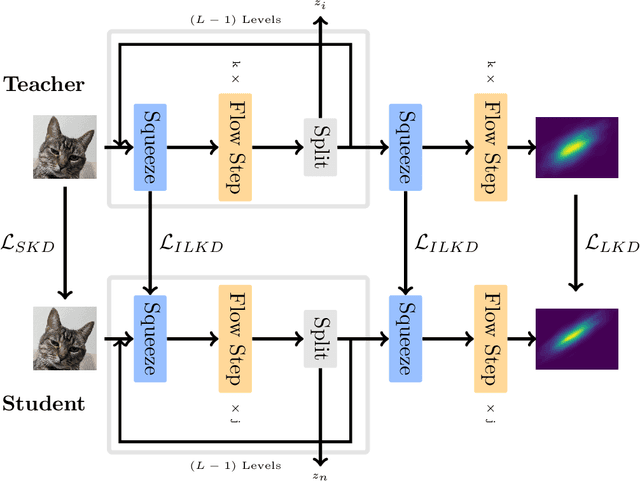
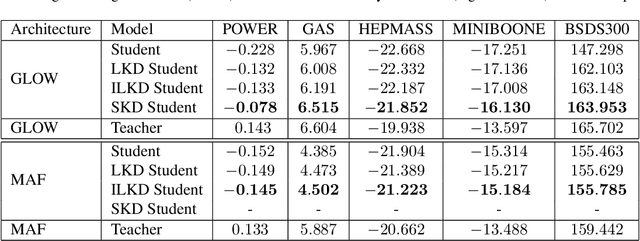
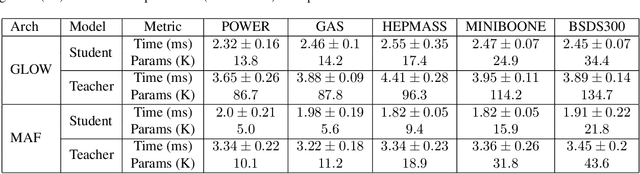
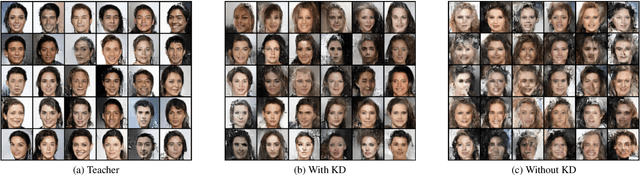
Explicit density learners are becoming an increasingly popular technique for generative models because of their ability to better model probability distributions. They have advantages over Generative Adversarial Networks due to their ability to perform density estimation and having exact latent-variable inference. This has many advantages, including: being able to simply interpolate, calculate sample likelihood, and analyze the probability distribution. The downside of these models is that they are often more difficult to train and have lower sampling quality. Normalizing flows are explicit density models, that use composable bijective functions to turn an intractable probability function into a tractable one. In this work, we present novel knowledge distillation techniques to increase sampling quality and density estimation of smaller student normalizing flows. We seek to study the capacity of knowledge distillation in Compositional Normalizing Flows to understand the benefits and weaknesses provided by these architectures. Normalizing flows have unique properties that allow for a non-traditional forms of knowledge transfer, where we can transfer that knowledge within intermediate layers. We find that through this distillation, we can make students significantly smaller while making substantial performance gains over a non-distilled student. With smaller models there is a proportionally increased throughput as this is dependent upon the number of bijectors, and thus parameters, in the network.
Learning to Hear Broken Motors: Signature-Guided Data Augmentation for Induction-Motor Diagnostics
Jun 10, 2025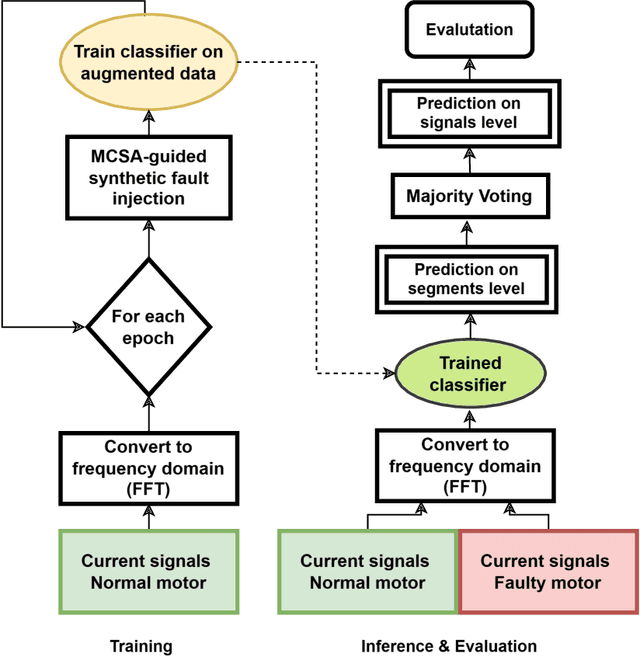
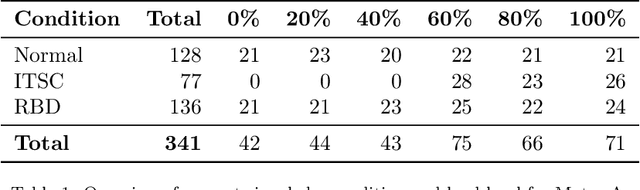
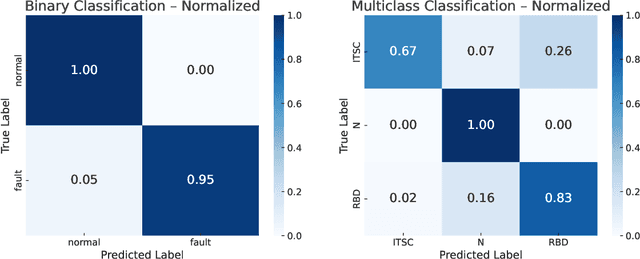
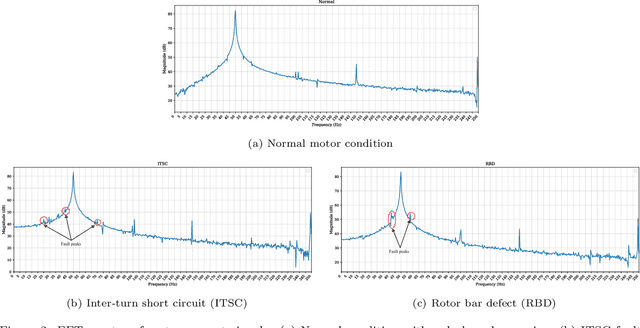
The application of machine learning (ML) algorithms in the intelligent diagnosis of three-phase engines has the potential to significantly enhance diagnostic performance and accuracy. Traditional methods largely rely on signature analysis, which, despite being a standard practice, can benefit from the integration of advanced ML techniques. In our study, we innovate by combining ML algorithms with a novel unsupervised anomaly generation methodology that takes into account the engine physics model. We propose Signature-Guided Data Augmentation (SGDA), an unsupervised framework that synthesizes physically plausible faults directly in the frequency domain of healthy current signals. Guided by Motor Current Signature Analysis, SGDA creates diverse and realistic anomalies without resorting to computationally intensive simulations. This hybrid approach leverages the strengths of both supervised ML and unsupervised signature analysis, achieving superior diagnostic accuracy and reliability along with wide industrial application. The findings highlight the potential of our approach to contribute significantly to the field of engine diagnostics, offering a robust and efficient solution for real-world applications.
Application of Physics-Informed Neural Networks for Solving the Inverse Advection-Diffusion Problem to Localize Pollution Sources
Mar 24, 2025This paper investigates the application of Physics-Informed Neural Networks (PINNs) for solving the inverse advection-diffusion problem to localize pollution sources. The study focuses on optimizing neural network architectures to accurately model pollutant dispersion dynamics under diverse conditions, including scenarios with weak and strong winds and multiple pollution sources. Various PINN configurations are evaluated, showing the strong dependence of solution accuracy on hyperparameter selection. Recommendations for efficient PINN configurations are provided based on these comparisons. The approach is tested across multiple scenarios and validated using real-world data that accounts for atmospheric variability. The results demonstrate that the proposed methodology achieves high accuracy in source localization, showcasing the stability and potential of PINNs for addressing environmental monitoring and pollution management challenges under complex weather conditions.
Optimisation of the Accelerator Control by Reinforcement Learning: A Simulation-Based Approach
Mar 12, 2025Optimizing accelerator control is a critical challenge in experimental particle physics, requiring significant manual effort and resource expenditure. Traditional tuning methods are often time-consuming and reliant on expert input, highlighting the need for more efficient approaches. This study aims to create a simulation-based framework integrated with Reinforcement Learning (RL) to address these challenges. Using \texttt{Elegant} as the simulation backend, we developed a Python wrapper that simplifies the interaction between RL algorithms and accelerator simulations, enabling seamless input management, simulation execution, and output analysis. The proposed RL framework acts as a co-pilot for physicists, offering intelligent suggestions to enhance beamline performance, reduce tuning time, and improve operational efficiency. As a proof of concept, we demonstrate the application of our RL approach to an accelerator control problem and highlight the improvements in efficiency and performance achieved through our methodology. We discuss how the integration of simulation tools with a Python-based RL framework provides a powerful resource for the accelerator physics community, showcasing the potential of machine learning in optimizing complex physical systems.
Intelligent Algorithms For Signature Diagnostics Of Three-Phase Motors
Nov 13, 2024

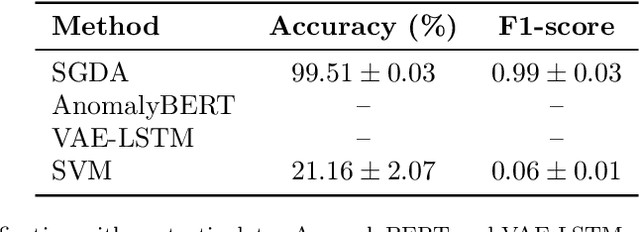

The application of machine learning (ML) algorithms in the intelligent diagnosis of three-phase engines has the potential to significantly enhance diagnostic performance and accuracy. Traditional methods largely rely on signature analysis, which, despite being a standard practice, can benefit from the integration of advanced ML techniques. In our study, we innovate by combining state of the art algorithms with a novel unsupervised anomaly generation methodology that takes into account physics model of the engine. This hybrid approach leverages the strengths of both supervised ML and unsupervised signature analysis, achieving superior diagnostic accuracy and reliability along with a wide industrial application. Our experimental results demonstrate that this method significantly outperforms existing ML and non-ML state-of-the-art approaches while retaining the practical advantages of an unsupervised methodology. The findings highlight the potential of our approach to significantly contribute to the field of engine diagnostics, offering a robust and efficient solution for real-world applications.
Global Optimisation of Black-Box Functions with Generative Models in the Wasserstein Space
Jul 16, 2024
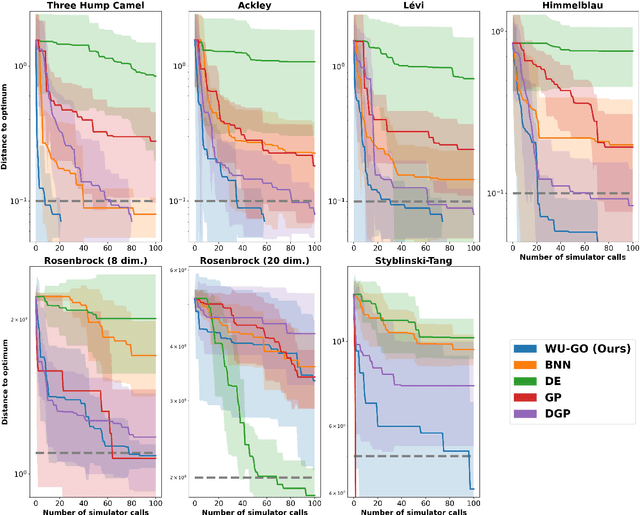


We propose a new uncertainty estimator for gradient-free optimisation of black-box simulators using deep generative surrogate models. Optimisation of these simulators is especially challenging for stochastic simulators and higher dimensions. To address these issues, we utilise a deep generative surrogate approach to model the black box response for the entire parameter space. We then leverage this knowledge to estimate the proposed uncertainty based on the Wasserstein distance - the Wasserstein uncertainty. This approach is employed in a posterior agnostic gradient-free optimisation algorithm that minimises regret over the entire parameter space. A series of tests were conducted to demonstrate that our method is more robust to the shape of both the black box function and the stochastic response of the black box than state-of-the-art methods, such as efficient global optimisation with a deep Gaussian process surrogate.