 Add to Chrome
 Add to Firefox
 Add to Edge
Correcting Sensor-Induced Distribution Drift with Wasserstein Adversarial Learning
Jun 17, 2026
The quality of recorded data depends on the stability of the sensor system that acquires it. Sensor motion and aging can degrade the performance and stability of downstream data-driven methods. We present a Wasserstein-GAN-inspired approach for unsupervised inference of physically interpretable transformation parameters that map a changed detector response distribution back to a nominal reference distribution. In contrast to standard generative modeling, the generator is used as a learnable calibration transformation whose trainable weights represent the sought parameters, while the critic provides a distributional distance signal via the Wasserstein objective. We validate the approach on a tracking-detector toy model with controlled layer shifts and demonstrate its application on high-granularity Geant4-simulated calorimeter data with cell-wise aging effects. The method recovers aging coefficients for individual cells with correlation to ground truth and improves agreement between calibrated and reference energy-sum distributions, while exhibiting the expected degradation at increasing channel-to-channel noise levels. These results indicate that adversarial distribution matching can serve as a data-driven component of calibration strategies in settings where direct labels for degradation parameters are unavailable.

Learning to Hear Broken Motors: Signature-Guided Data Augmentation for Induction-Motor Diagnostics
Jun 10, 2025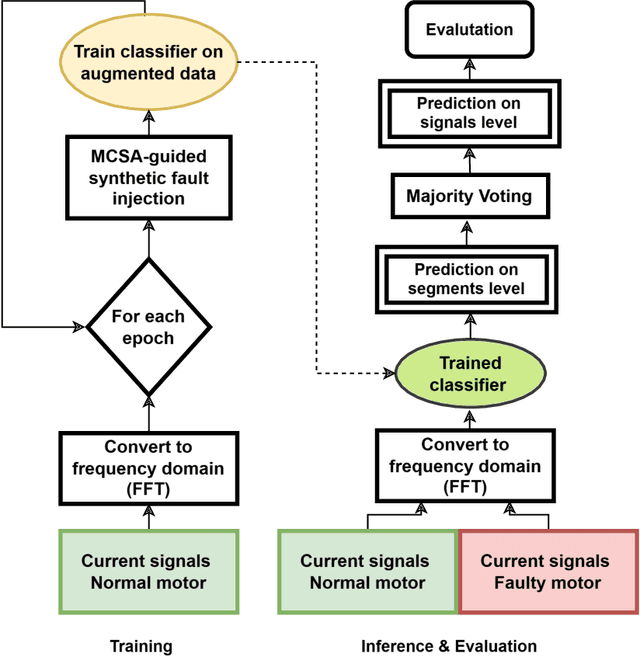
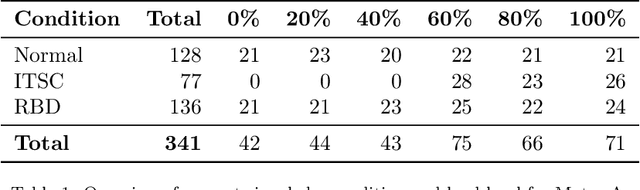
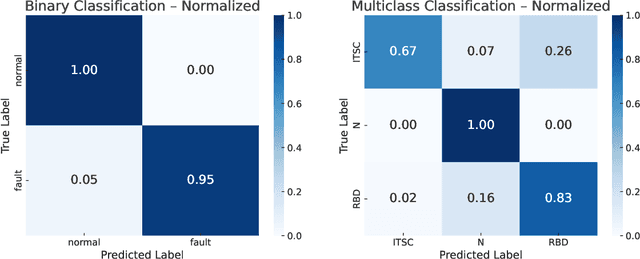
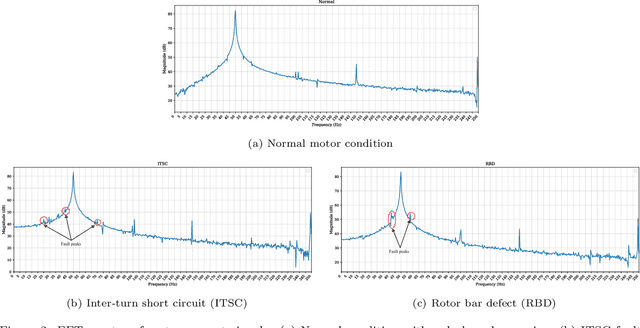
The application of machine learning (ML) algorithms in the intelligent diagnosis of three-phase engines has the potential to significantly enhance diagnostic performance and accuracy. Traditional methods largely rely on signature analysis, which, despite being a standard practice, can benefit from the integration of advanced ML techniques. In our study, we innovate by combining ML algorithms with a novel unsupervised anomaly generation methodology that takes into account the engine physics model. We propose Signature-Guided Data Augmentation (SGDA), an unsupervised framework that synthesizes physically plausible faults directly in the frequency domain of healthy current signals. Guided by Motor Current Signature Analysis, SGDA creates diverse and realistic anomalies without resorting to computationally intensive simulations. This hybrid approach leverages the strengths of both supervised ML and unsupervised signature analysis, achieving superior diagnostic accuracy and reliability along with wide industrial application. The findings highlight the potential of our approach to contribute significantly to the field of engine diagnostics, offering a robust and efficient solution for real-world applications.
Intelligent Algorithms For Signature Diagnostics Of Three-Phase Motors
Nov 13, 2024

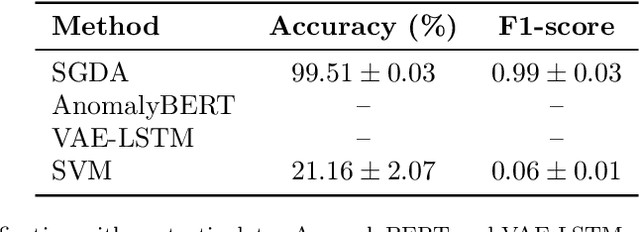

The application of machine learning (ML) algorithms in the intelligent diagnosis of three-phase engines has the potential to significantly enhance diagnostic performance and accuracy. Traditional methods largely rely on signature analysis, which, despite being a standard practice, can benefit from the integration of advanced ML techniques. In our study, we innovate by combining state of the art algorithms with a novel unsupervised anomaly generation methodology that takes into account physics model of the engine. This hybrid approach leverages the strengths of both supervised ML and unsupervised signature analysis, achieving superior diagnostic accuracy and reliability along with a wide industrial application. Our experimental results demonstrate that this method significantly outperforms existing ML and non-ML state-of-the-art approaches while retaining the practical advantages of an unsupervised methodology. The findings highlight the potential of our approach to significantly contribute to the field of engine diagnostics, offering a robust and efficient solution for real-world applications.