 Add to Chrome
 Add to Firefox
 Add to Edge
Evolutionary Two-Stage Hyperparameter Optimization Strategies for Physics-Informed Neural Networks
Jun 18, 2026
Physics-Informed Neural Networks (PINNs) solve Partial Differential Equations (PDEs) by embedding physical laws into neural network training. However, their performance suffers from unstable convergence, training plateaus, and strong sensitivity to architectural and optimization hyperparameters due to the highly non-convex and multi-term structure of the physics-informed loss. In this setting, the outer-loop hyperparameter search is a noisy and black-box optimization problem over heterogeneous parameters, where classical local or gradient-based strategies are easily trapped in suboptimal regions. Evolutionary algorithms, with their population-based exploration and ability to handle mixed, non-differentiable search spaces, provide a more robust mechanism for discovering promising configurations. We propose and investigate a two-stage approach based on evolutionary algorithms that combines exploration and exploitation parts of PINNs training to improve solution accuracy and robustness under fixed computational budgets. In the first stage, we perform low-fidelity training runs with truncated epochs to rapidly screen candidate configurations, treating hyperparameter selection as a black-box outer-loop problem. In the second stage, only the most promising candidates are fully trained with standard gradient-based optimizers to refine the solution. Evaluated on three popular problems, namely Advection, Klein-Gordon and Helmholtz equations, our method consistently outperforms standard training and achieves significantly lower mean error within constrained computational resources.

Correcting Sensor-Induced Distribution Drift with Wasserstein Adversarial Learning
Jun 17, 2026The quality of recorded data depends on the stability of the sensor system that acquires it. Sensor motion and aging can degrade the performance and stability of downstream data-driven methods. We present a Wasserstein-GAN-inspired approach for unsupervised inference of physically interpretable transformation parameters that map a changed detector response distribution back to a nominal reference distribution. In contrast to standard generative modeling, the generator is used as a learnable calibration transformation whose trainable weights represent the sought parameters, while the critic provides a distributional distance signal via the Wasserstein objective. We validate the approach on a tracking-detector toy model with controlled layer shifts and demonstrate its application on high-granularity Geant4-simulated calorimeter data with cell-wise aging effects. The method recovers aging coefficients for individual cells with correlation to ground truth and improves agreement between calibrated and reference energy-sum distributions, while exhibiting the expected degradation at increasing channel-to-channel noise levels. These results indicate that adversarial distribution matching can serve as a data-driven component of calibration strategies in settings where direct labels for degradation parameters are unavailable.
Physics-Constrained Neural Networks for Improved Short-Term Weather Forecasting: A Case Study over the South Pacific
Jun 16, 2026This study introduces enhancements to physics-constrained neural networks (PCNNs) that improve the accuracy and stability of hybrid short-term weather forecasting models. Building on the WeatherGFT architecture, three innovations are proposed. First, an upgraded numerical solver, combining a fifth-order weighted essentially non-oscillatory scheme (WENO-5), a beta-plane approximation, and subgrid-scale viscosity, permits a fourfold increase in the integration time step to 1200 s while reducing the daily mean squared error by up to 26%. Second, a unified autoregressive hybrid block replaces the original chain of 24 specialised modules, eliminating overfitting to specific lead times. Third, the physical core is integrated with two state-of-the-art neural backbones, resulting in PI-PredFormer and PI-IAM4VP. Evaluation on the WeatherBench South Pacific subset from 2000 to 2004 shows that these hybrids reduce root mean squared error at 1-12 h lead times by 8-22% compared to purely neural counterparts, while better preserving physical consistency. These results demonstrate that incremental refinement of hybrid components offers a practical route toward more accurate and efficient short-range weather forecasting.
RL-ABC: Reinforcement Learning for Accelerator Beamline Control
Apr 21, 2026Particle accelerator beamline optimization is a high-dimensional control problem traditionally requiring significant expert intervention. We present RLABC (Reinforcement Learning for Accelerator Beamline Control), an open-source Python framework that automatically transforms standard Elegant beamline configurations into reinforcement learning environments. RLABC integrates with the widely-used Elegant beam dynamics simulation code via SDDS-based interfaces, enabling researchers to apply modern RL algorithms to beamline optimization with minimal RL-specific development. The main contribution is a general methodology for formulating beamline tuning as a Markov decision process: RLABC automatically preprocesses lattice files to insert diagnostic watch points before each tunable element, constructs a 57-dimensional state representation from beam statistics, covariance information, and aperture constraints, and provides a configurable reward function for transmission optimization. The framework supports multiple RL algorithms through Stable-Baselines3 compatibility and implements stage learning strategies for improved training efficiency. Validation on a test beamline derived from the VEPP-5 injection complex (37 control parameters across 11 quadrupoles and 4 dipoles) demonstrates that the framework successfully enables RL-based optimization, with a Deep Deterministic Policy Gradient agent achieving 70.3\% particle transmission -- performance matching established methods such as differential evolution. The framework's stage learning capability allows decomposition of complex optimization problems into manageable subproblems, improving training efficiency. The complete framework, including configuration files and example notebooks, is available as open-source software to facilitate adoption and further research.
Approach to Finding a Robust Deep Learning Model
May 22, 2025The rapid development of machine learning (ML) and artificial intelligence (AI) applications requires the training of large numbers of models. This growing demand highlights the importance of training models without human supervision, while ensuring that their predictions are reliable. In response to this need, we propose a novel approach for determining model robustness. This approach, supplemented with a proposed model selection algorithm designed as a meta-algorithm, is versatile and applicable to any machine learning model, provided that it is appropriate for the task at hand. This study demonstrates the application of our approach to evaluate the robustness of deep learning models. To this end, we study small models composed of a few convolutional and fully connected layers, using common optimizers due to their ease of interpretation and computational efficiency. Within this framework, we address the influence of training sample size, model weight initialization, and inductive bias on the robustness of deep learning models.
Optimisation of the Accelerator Control by Reinforcement Learning: A Simulation-Based Approach
Mar 12, 2025Optimizing accelerator control is a critical challenge in experimental particle physics, requiring significant manual effort and resource expenditure. Traditional tuning methods are often time-consuming and reliant on expert input, highlighting the need for more efficient approaches. This study aims to create a simulation-based framework integrated with Reinforcement Learning (RL) to address these challenges. Using \texttt{Elegant} as the simulation backend, we developed a Python wrapper that simplifies the interaction between RL algorithms and accelerator simulations, enabling seamless input management, simulation execution, and output analysis. The proposed RL framework acts as a co-pilot for physicists, offering intelligent suggestions to enhance beamline performance, reduce tuning time, and improve operational efficiency. As a proof of concept, we demonstrate the application of our RL approach to an accelerator control problem and highlight the improvements in efficiency and performance achieved through our methodology. We discuss how the integration of simulation tools with a Python-based RL framework provides a powerful resource for the accelerator physics community, showcasing the potential of machine learning in optimizing complex physical systems.
What Machine Learning Can Do for Focusing Aerogel Detectors
Dec 05, 2023Particle identification at the Super Charm-Tau factory experiment will be provided by a Focusing Aerogel Ring Imaging CHerenkov detector (FARICH). The specifics of detector location make proper cooling difficult, therefore a significant number of ambient background hits are captured. They must be mitigated to reduce the data flow and improve particle velocity resolution. In this work we present several approaches to filtering signal hits, inspired by machine learning techniques from computer vision.
Energy reconstruction for large liquid scintillator detectors with machine learning techniques: aggregated features approach
Jun 17, 2022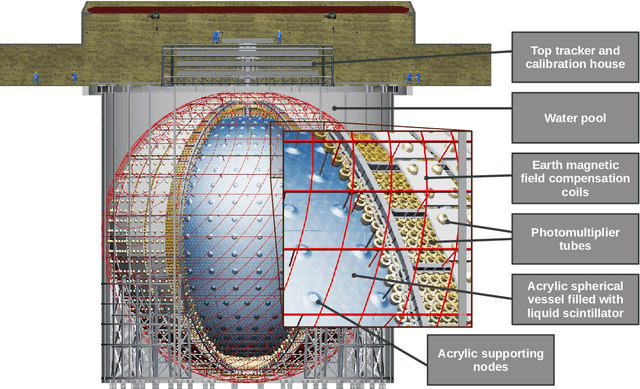
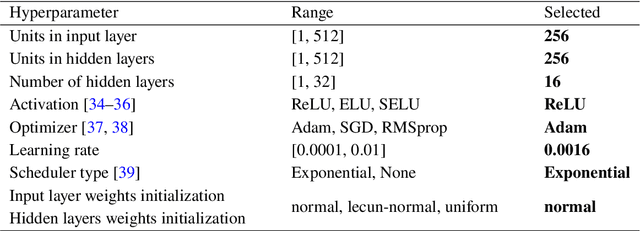
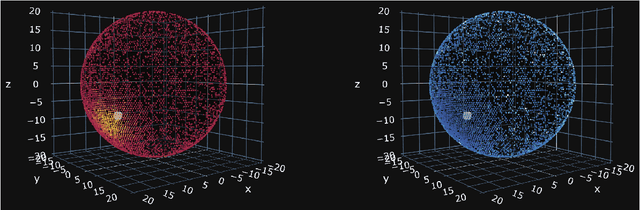

Large scale detectors consisting of a liquid scintillator (LS) target surrounded by an array of photo-multiplier tubes (PMT) are widely used in modern neutrino experiments: Borexino, KamLAND, Daya Bay, Double Chooz, RENO, and upcoming JUNO with its satellite detector TAO. Such apparatuses are able to measure neutrino energy, which can be derived from the amount of light and its spatial and temporal distribution over PMT-channels. However, achieving a fine energy resolution in large scale detectors is challenging. In this work, we present machine learning methods for energy reconstruction in JUNO, the most advanced detector of its type. We focus on positron events in the energy range of 0-10 MeV which corresponds to the main signal in JUNO $-$ neutrinos originated from nuclear reactor cores and detected via an inverse beta-decay channel. We consider Boosted Decision Trees and Fully Connected Deep Neural Network trained on aggregated features, calculated using information collected by PMTs. We describe the details of our feature engineering procedure and show that machine learning models can provide energy resolution $\sigma = 3\%$ at 1 MeV using subsets of engineered features. The dataset for model training and testing is generated by the Monte Carlo method with the official JUNO software. Consideration of calibration sources for evaluation of the reconstruction algorithms performance on real data is also presented.
Using Machine Learning to Speed Up and Improve Calorimeter R&D
Mar 27, 2020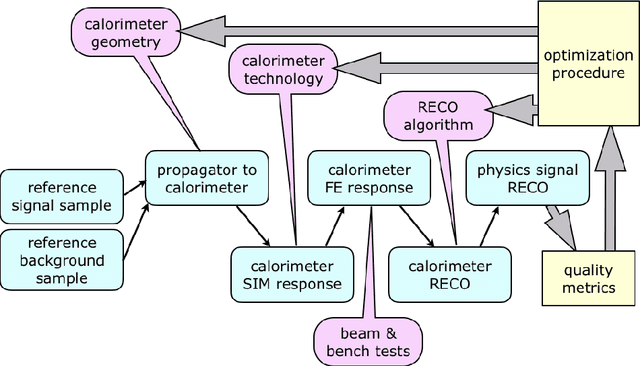
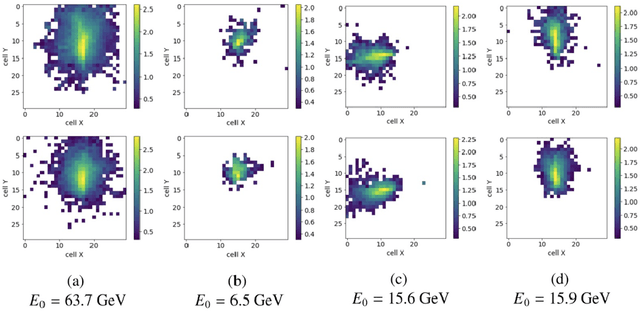
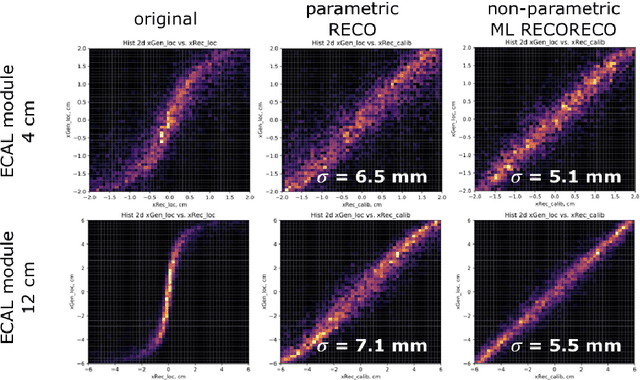
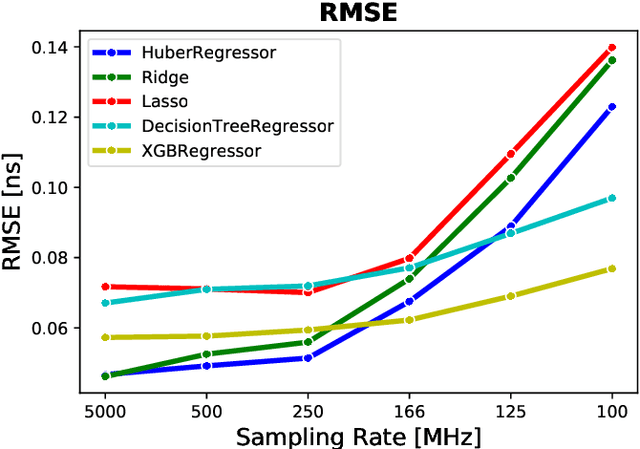
Design of new experiments, as well as upgrade of ongoing ones, is a continuous process in the experimental high energy physics. Since the best solution is a trade-off between different kinds of limitations, a quick turn over is necessary to evaluate physics performance for different techniques in different configurations. Two typical problems which slow down evaluation of physics performance for particular approaches to calorimeter detector technologies and configurations are: - Emulating particular detector properties including raw detector response together with a signal processing chain to adequately simulate a calorimeter response for different signal and background conditions. This includes combining detector properties obtained from the general Geant simulation with properties obtained from different kinds of bench and beam tests of detector and electronics prototypes. - Building an adequate reconstruction algorithm for physics reconstruction of the detector response which is reasonably tuned to extract the most of the performance provided by the given detector configuration. Being approached from the first principles, both problems require significant development efforts. Fortunately, both problems may be addressed by using modern machine learning approaches, that allow a combination of available details of the detector techniques into corresponding higher level physics performance in a semi-automated way. In this paper, we discuss the use of advanced machine learning techniques to speed up and improve the precision of the detector development and optimisation cycle, with an emphasis on the experience and practical results obtained by applying this approach to epitomising the electromagnetic calorimeter design as a part of the upgrade project for the LHCb detector at LHC.
Generative Adversarial Networks for LHCb Fast Simulation
Mar 21, 2020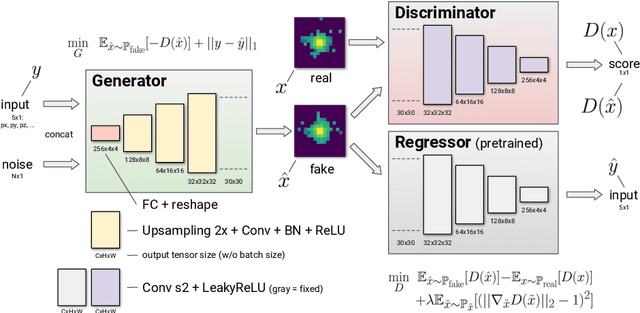
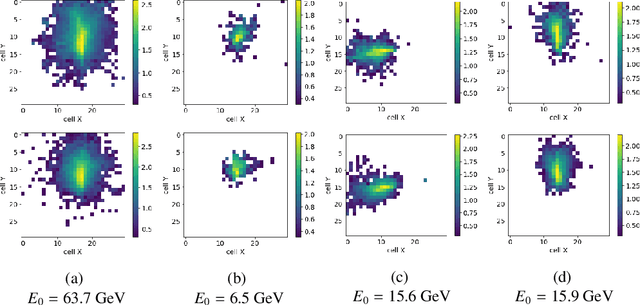
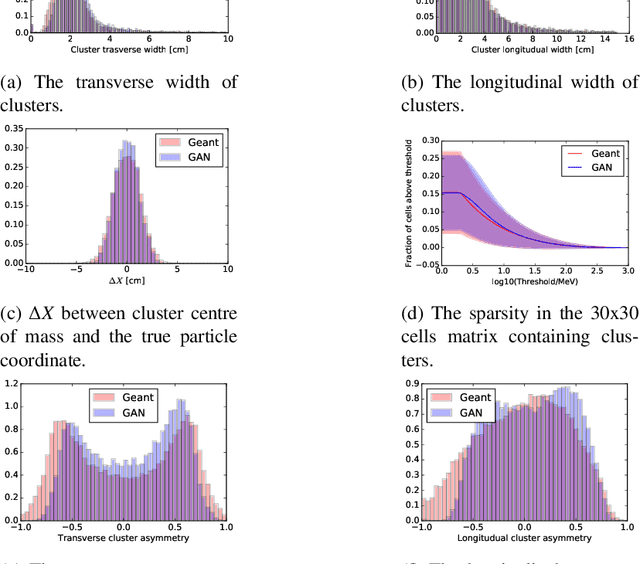
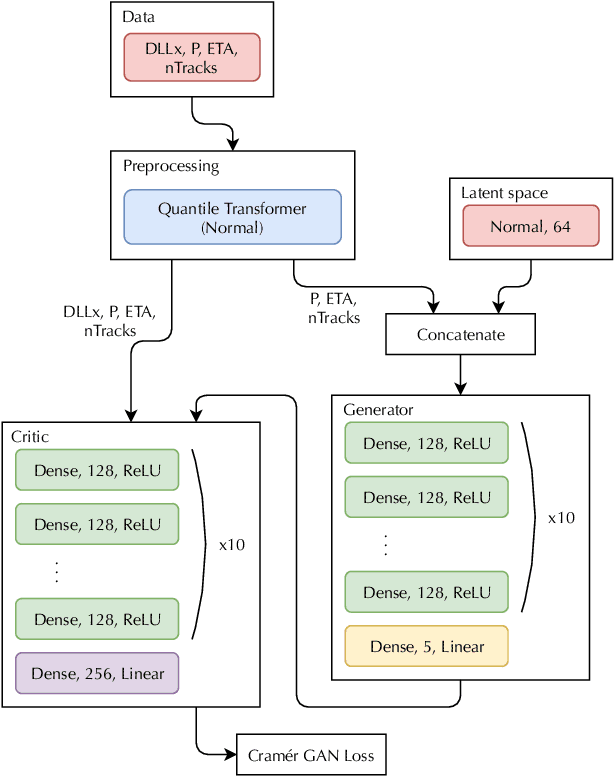
LHCb is one of the major experiments operating at the Large Hadron Collider at CERN. The richness of the physics program and the increasing precision of the measurements in LHCb lead to the need of ever larger simulated samples. This need will increase further when the upgraded LHCb detector will start collecting data in the LHC Run 3. Given the computing resources pledged for the production of Monte Carlo simulated events in the next years, the use of fast simulation techniques will be mandatory to cope with the expected dataset size. In LHCb generative models, which are nowadays widely used for computer vision and image processing are being investigated in order to accelerate the generation of showers in the calorimeter and high-level responses of Cherenkov detector. We demonstrate that this approach provides high-fidelity results along with a significant speed increase and discuss possible implication of these results. We also present an implementation of this algorithm into LHCb simulation software and validation tests.