 Add to Chrome
 Add to Firefox
 Add to Edge
Evolutionary Two-Stage Hyperparameter Optimization Strategies for Physics-Informed Neural Networks
Jun 18, 2026
Physics-Informed Neural Networks (PINNs) solve Partial Differential Equations (PDEs) by embedding physical laws into neural network training. However, their performance suffers from unstable convergence, training plateaus, and strong sensitivity to architectural and optimization hyperparameters due to the highly non-convex and multi-term structure of the physics-informed loss. In this setting, the outer-loop hyperparameter search is a noisy and black-box optimization problem over heterogeneous parameters, where classical local or gradient-based strategies are easily trapped in suboptimal regions. Evolutionary algorithms, with their population-based exploration and ability to handle mixed, non-differentiable search spaces, provide a more robust mechanism for discovering promising configurations. We propose and investigate a two-stage approach based on evolutionary algorithms that combines exploration and exploitation parts of PINNs training to improve solution accuracy and robustness under fixed computational budgets. In the first stage, we perform low-fidelity training runs with truncated epochs to rapidly screen candidate configurations, treating hyperparameter selection as a black-box outer-loop problem. In the second stage, only the most promising candidates are fully trained with standard gradient-based optimizers to refine the solution. Evaluated on three popular problems, namely Advection, Klein-Gordon and Helmholtz equations, our method consistently outperforms standard training and achieves significantly lower mean error within constrained computational resources.

Enhancing GNNs Performance on Combinatorial Optimization by Recurrent Feature Update
Jul 23, 2024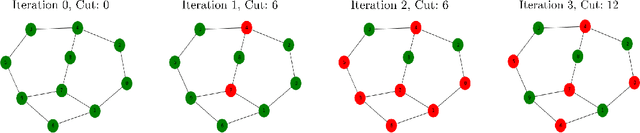
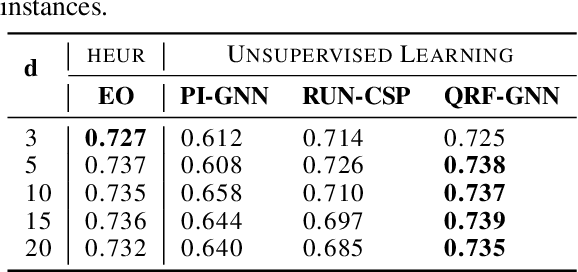
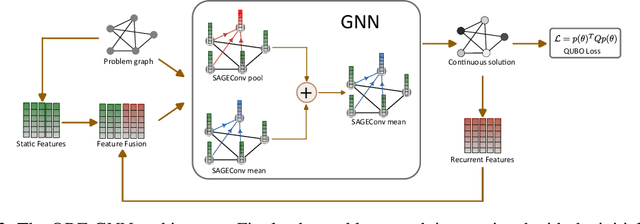

Combinatorial optimization (CO) problems are crucial in various scientific and industrial applications. Recently, researchers have proposed using unsupervised Graph Neural Networks (GNNs) to address NP-hard combinatorial optimization problems, which can be reformulated as Quadratic Unconstrained Binary Optimization (QUBO) problems. GNNs have demonstrated high performance with nearly linear scalability and significantly outperformed classic heuristic-based algorithms in terms of computational efficiency on large-scale problems. However, when utilizing standard node features, GNNs tend to get trapped to suboptimal local minima of the energy landscape, resulting in low quality solutions. We introduce a novel algorithm, denoted hereafter as QRF-GNN, leveraging the power of GNNs to efficiently solve CO problems with QUBO formulation. It relies on unsupervised learning by minimizing the loss function derived from QUBO relaxation. The proposed key components of the architecture include the recurrent use of intermediate GNN predictions, parallel convolutional layers and combination of static node features as input. Altogether, it helps to adapt the intermediate solution candidate to minimize QUBO-based loss function, taking into account not only static graph features, but also intermediate predictions treated as dynamic, i.e. iteratively changing recurrent features. The performance of the proposed algorithm has been evaluated on the canonical benchmark datasets for maximum cut, graph coloring and maximum independent set problems. Results of experiments show that QRF-GNN drastically surpasses existing learning-based approaches and is comparable to the state-of-the-art conventional heuristics, improving their scalability on large instances.