 Add to Chrome
 Add to Firefox
 Add to Edge
ESC: Emotional Self-Correction for Reliable Vision-Language Models
Jul 01, 2026
Vision-language models (VLMs) have achieved strong performance across diverse multimodal tasks, yet they remain vulnerable to unreliable reasoning. Existing self-correction methods mitigate these issues but typically rely on post-training or carefully engineered feedback, incurring high computational cost. In this work, we revisit this challenge through the lens of emotional cues, asking whether they can activate latent self-correction behaviors in VLMs without additional training. \textbf{We find that emotional signals serve as an effective trigger for self-correction, encouraging more cautious and reflective reasoning}. Motivated by this finding, we propose \escabstract (\textbf{\underline{E}}motional \textbf{\underline{S}}elf-\textbf{\underline{C}}orrection), a training-free self-correction framework. ESC introduces an external verifier that detects potentially incorrect initial responses and injects emotional feedback to encourage model to reflect, and produce a better revised response without additional training. Extensive experiments across safety, hallucination, vision-centric perception, and multimodal reasoning benchmarks show that ESC consistently improves reliability while preserving overall model utility. These results suggest that emotion can function not only as an ability to be recognized, but also as a practical control signal for scalable self-correction in VLMs. \textbf{We therefore believe that ESC provides a strong foundation for a new reliable human-like, emotion-integrated research direction.} Our project is publicly available at \textcolor{red}{https://genai4e.github.io/ESC/}.

When AUC Misleads: Polarization-Aware Evaluation of Deepfake Detectors under Domain Shift
Jun 17, 2026Recent advances in generative AI, such as diffusion models and face-swapping tools, have enabled the creation of highly realistic deepfakes, leading to real-world harms including financial fraud and non-consensual explicit content. In response, deepfake detection has become an active research area, with recent methods increasingly focusing on improving generalization to unseen manipulations. This is typically evaluated using the Area Under the ROC Curve (AUC) measured separately across multiple datasets. However, such an evaluation fails to reflect real-world scenarios where detectors face a mixture of data sources and varying artifact types. To address this limitation, we introduce a novel metric, Cross-dataset AUC (Cross-AUC) that averages per-domain AUCs with a measure of prediction polarization for taking into account the robustness to domain shift. The polarization extent is quantified by the Wasserstein Distance between class score distributions. Cross-AUC not only assesses the generalization capabilities of deepfake detectors under domain shifts more realistically, but it is also interpretable as it better explains the reason behind a drop in performance. Experiments performed on seven benchmark datasets demonstrate its practical relevance.
Domain Generalization through Spatial Relation Induction over Visual Primitives
May 07, 2026Domain generalization requires identifying stable representations that support reliable classification across domains. Most existing methods seek such stability through improving the training process, for example, through model selection strategies, data augmentation, or feature-alignment objectives. Although these strategies can be effective, they leave the representation learning of structural composition implicit, which may limit performance on compositional domain generalization benchmarks. In this work, we propose Primitive-Aware Relational Structure for domain gEneralization (PARSE), an image classification framework that factors visual recognition into visual primitives and their relational composition. We represent these compositions using soft binary, ternary, and quaternary predicates over primitive locations, yielding differentiable measures of spatial alignment that can be learned end-to-end. To learn primitives and relational structures jointly, we design an end-to-end architecture with three components: (1) a convolutional neural network (CNN) backbone that extracts general visual features, (2) a concept bottleneck layer that maps these features to primitive heatmaps with differentiable spatial coordinates, and (3) a structural scoring layer that evaluates candidate spatial relations among the detected primitives. We then compute class probability from the joint evidence of its class-specific relational compositions. Across CUB-DG and the DomainBed benchmark suite,PARSE improves accuracy by over 4.5 percentage points on CUB-DG and remains competitive with existing DG methods on DomainBed.
LAA-X: Unified Localized Artifact Attention for Quality-Agnostic and Generalizable Face Forgery Detection
Apr 05, 2026In this paper, we propose Localized Artifact Attention X (LAA-X), a novel deepfake detection framework that is both robust to high-quality forgeries and capable of generalizing to unseen manipulations. Existing approaches typically rely on binary classifiers coupled with implicit attention mechanisms, which often fail to generalize beyond known manipulations. In contrast, LAA-X introduces an explicit attention strategy based on a multi-task learning framework combined with blending-based data synthesis. Auxiliary tasks are designed to guide the model toward localized, artifact-prone (i.e., vulnerable) regions. The proposed framework is compatible with both CNN and transformer backbones, resulting in two different versions, namely, LAA-Net and LAA-Former, respectively. Despite being trained only on real and pseudo-fake samples, LAA-X competes with state-of-the-art methods across multiple benchmarks. Code and pre-trained weights for LAA-Net\footnote{https://github.com/10Ring/LAA-Net} and LAA-Former\footnote{https://github.com/10Ring/LAA-Former} are publicly available.
VirDA: Reusing Backbone for Unsupervised Domain Adaptation with Visual Reprogramming
Oct 02, 2025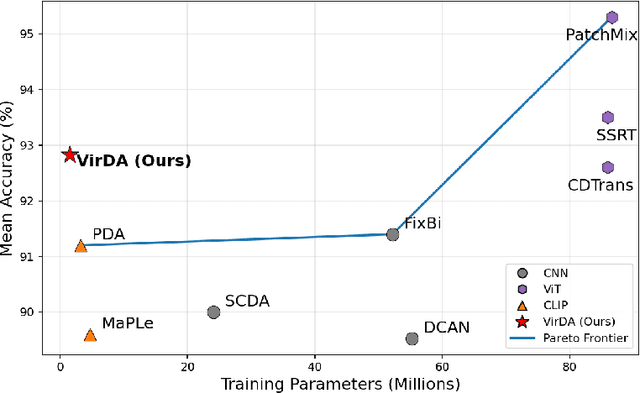
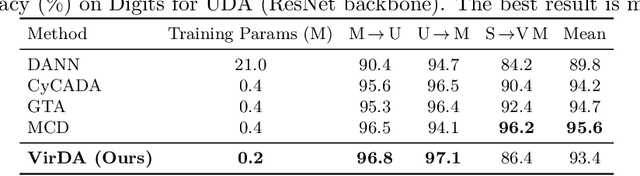
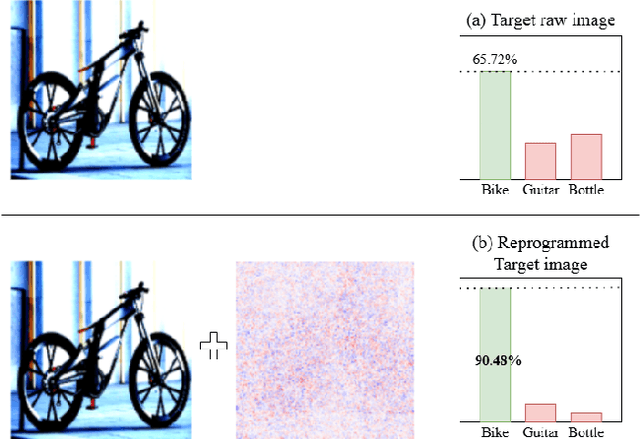
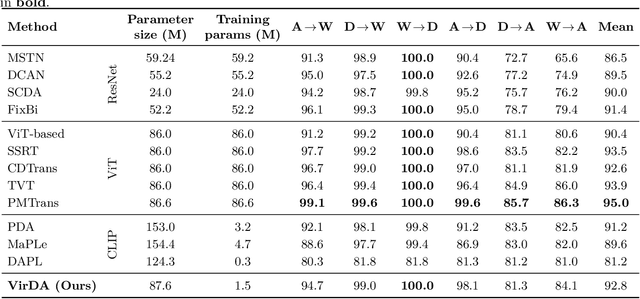
Existing UDA pipelines fine-tune already well-trained backbone parameters for every new source-and-target pair, resulting in the number of training parameters and storage memory growing linearly with each new pair, and also preventing the reuse of these well-trained backbone parameters. Inspired by recent implications that existing backbones have textural biases, we propose making use of domain-specific textural bias for domain adaptation via visual reprogramming, namely VirDA.Instead of fine-tuning the full backbone, VirDA prepends a domain-specific visual reprogramming layer to the backbone. This layer produces visual prompts that act as an added textural bias to the input image, adapting its ``style'' to a target domain. To optimize these visual reprogramming layers, we use multiple objective functions that optimize the intra- and inter-domain distribution differences when domain-adapting visual prompts are applied. This process does not require modifying the backbone parameters, allowing the same backbone to be reused across different domains. We evaluate VirDA on Office-31 and obtain 92.8% mean accuracy with only 1.5M trainable parameters. VirDA surpasses PDA, the state-of-the-art parameter-efficient UDA baseline, by +1.6% accuracy while using just 46% of its parameters. Compared with full-backbone fine-tuning, VirDA outperforms CDTrans and FixBi by +0.2% and +1.4%, respectively, while requiring only 1.7% and 2.8% of their trainable parameters. Relative to the strongest current methods (PMTrans and TVT), VirDA uses ~1.7% of their parameters and trades off only 2.2% and 1.1% accuracy, respectively.
The NazoNazo Benchmark: A Cost-Effective and Extensible Test of Insight-Based Reasoning in LLMs
Sep 18, 2025Benchmark saturation and contamination undermine confidence in LLM evaluation. We present Nazonazo, a cost-effective and extensible benchmark built from Japanese children's riddles to test insight-based reasoning. Items are short (mostly one sentence), require no specialized domain knowledge, and can be generated at scale, enabling rapid refresh of blind sets when leakage is suspected. We evaluate 38 frontier models and 126 adults on 120 riddles. No model except for GPT-5 is comparable to human performance, which achieves a 52.9% mean accuracy. Model comparison on extended 201 items shows that reasoning models significantly outperform non-reasoning peers, while model size shows no reliable association with accuracy. Beyond aggregate accuracy, an informal candidate-tracking analysis of thought logs reveals many cases of verification failure: models often produce the correct solution among intermediate candidates yet fail to select it as the final answer, which we illustrate with representative examples observed in multiple models. Nazonazo thus offers a cost-effective, scalable, and easily renewable benchmark format that addresses the current evaluation crisis while also suggesting a recurrent meta-cognitive weakness, providing clear targets for future control and calibration methods.
Vulnerability-Aware Spatio-Temporal Learning for Generalizable and Interpretable Deepfake Video Detection
Jan 02, 2025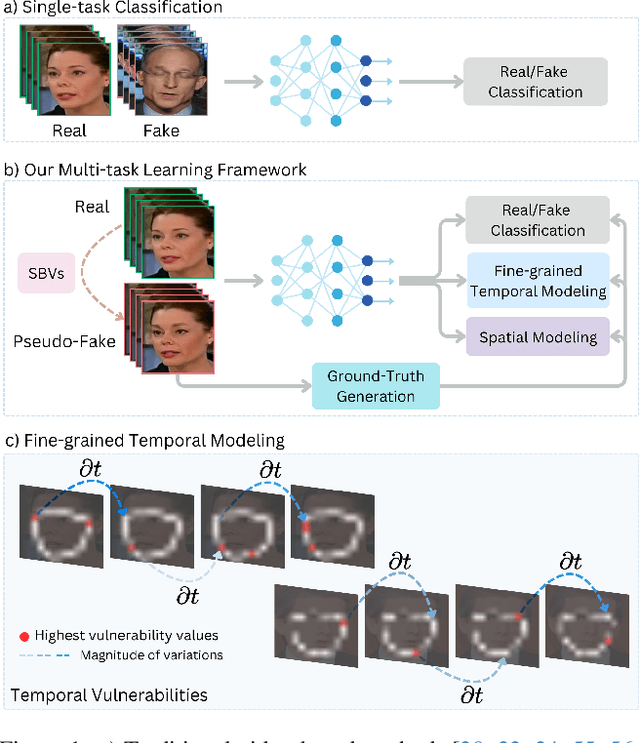
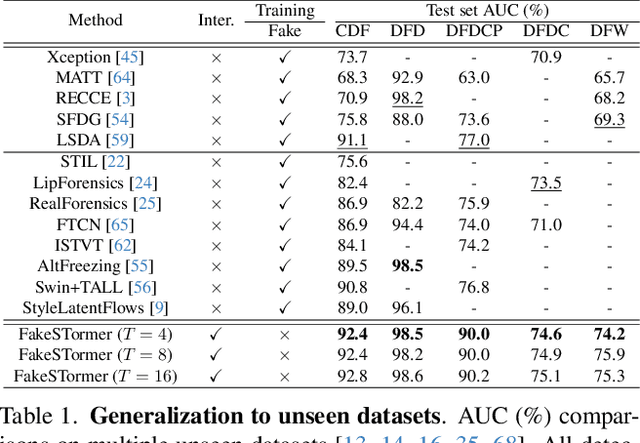

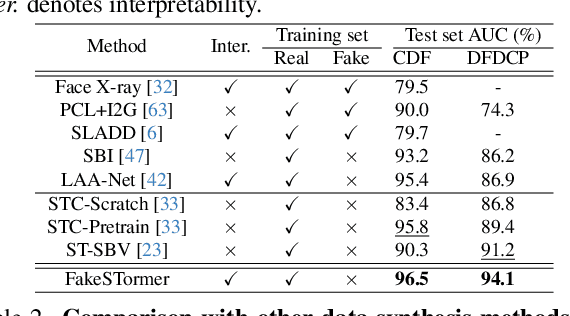
Detecting deepfake videos is highly challenging due to the complex intertwined spatial and temporal artifacts in forged sequences. Most recent approaches rely on binary classifiers trained on both real and fake data. However, such methods may struggle to focus on important artifacts, which can hinder their generalization capability. Additionally, these models often lack interpretability, making it difficult to understand how predictions are made. To address these issues, we propose FakeSTormer, offering two key contributions. First, we introduce a multi-task learning framework with additional spatial and temporal branches that enable the model to focus on subtle spatio-temporal artifacts. These branches also provide interpretability by highlighting video regions that may contain artifacts. Second, we propose a video-level data synthesis algorithm that generates pseudo-fake videos with subtle artifacts, providing the model with high-quality samples and ground truth data for our spatial and temporal branches. Extensive experiments on several challenging benchmarks demonstrate the competitiveness of our approach compared to recent state-of-the-art methods. The code is available at https://github.com/10Ring/FakeSTormer.
Combining Induction and Transduction for Abstract Reasoning
Nov 04, 2024When learning an input-output mapping from very few examples, is it better to first infer a latent function that explains the examples, or is it better to directly predict new test outputs, e.g. using a neural network? We study this question on ARC, a highly diverse dataset of abstract reasoning tasks. We train neural models for induction (inferring latent functions) and transduction (directly predicting the test output for a given test input). Our models are trained on synthetic data generated by prompting LLMs to produce Python code specifying a function to be inferred, plus a stochastic subroutine for generating inputs to that function. We find inductive and transductive models solve very different problems, despite training on the same problems, and despite sharing the same neural architecture.
FakeFormer: Efficient Vulnerability-Driven Transformers for Generalisable Deepfake Detection
Oct 29, 2024


Recently, Vision Transformers (ViTs) have achieved unprecedented effectiveness in the general domain of image classification. Nonetheless, these models remain underexplored in the field of deepfake detection, given their lower performance as compared to Convolution Neural Networks (CNNs) in that specific context. In this paper, we start by investigating why plain ViT architectures exhibit a suboptimal performance when dealing with the detection of facial forgeries. Our analysis reveals that, as compared to CNNs, ViT struggles to model localized forgery artifacts that typically characterize deepfakes. Based on this observation, we propose a deepfake detection framework called FakeFormer, which extends ViTs to enforce the extraction of subtle inconsistency-prone information. For that purpose, an explicit attention learning guided by artifact-vulnerable patches and tailored to ViTs is introduced. Extensive experiments are conducted on diverse well-known datasets, including FF++, Celeb-DF, WildDeepfake, DFD, DFDCP, and DFDC. The results show that FakeFormer outperforms the state-of-the-art in terms of generalization and computational cost, without the need for large-scale training datasets. The code is available at \url{https://github.com/10Ring/FakeFormer}.
KinDEL: DNA-Encoded Library Dataset for Kinase Inhibitors
Oct 11, 2024

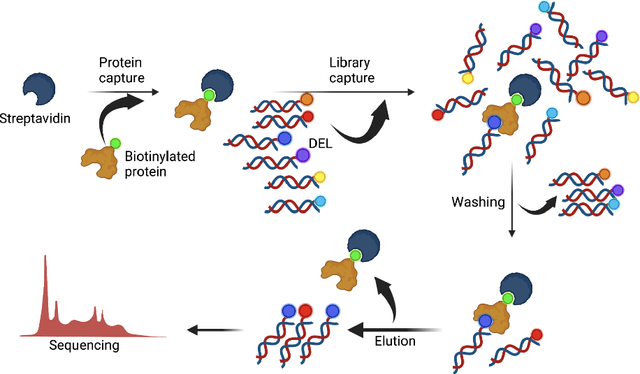

DNA-Encoded Libraries (DEL) are combinatorial small molecule libraries that offer an efficient way to characterize diverse chemical spaces. Selection experiments using DELs are pivotal to drug discovery efforts, enabling high-throughput screens for hit finding. However, limited availability of public DEL datasets hinders the advancement of computational techniques designed to process such data. To bridge this gap, we present KinDEL, one of the first large, publicly available DEL datasets on two kinases: Mitogen-Activated Protein Kinase 14 (MAPK14) and Discoidin Domain Receptor Tyrosine Kinase 1 (DDR1). Interest in this data modality is growing due to its ability to generate extensive supervised chemical data that densely samples around select molecular structures. Demonstrating one such application of the data, we benchmark different machine learning techniques to develop predictive models for hit identification; in particular, we highlight recent structure-based probabilistic approaches. Finally, we provide biophysical assay data, both on- and off-DNA, to validate our models on a smaller subset of molecules. Data and code for our benchmarks can be found at: https://github.com/insitro/kindel.