 Add to Chrome
 Add to Firefox
 Add to Edge
An Insight on Evaluation Metrics Under the Imbalanced Case of Anomaly Detection
Jul 24, 2026
Anomaly detection is inherently characterised by severe class imbalance, making the interpretation of evaluation metrics challenging. Although metrics such as AUROC, AUPR, F1-score, and MCC are widely used, their values convey different meanings depending on the anomaly ratio. In this work, we analyse the behaviour of those four common anomaly detection metrics under varying levels of imbalance. We focus on the study of metric landscapes, visualisations that relate metric values to true positive and true negative rates, providing an intuitive view of metric preferences and stability. Our analysis offers practical guidance for interpreting and comparing anomaly detection results across datasets with different imbalance ratios.

When AUC Misleads: Polarization-Aware Evaluation of Deepfake Detectors under Domain Shift
Jun 17, 2026Recent advances in generative AI, such as diffusion models and face-swapping tools, have enabled the creation of highly realistic deepfakes, leading to real-world harms including financial fraud and non-consensual explicit content. In response, deepfake detection has become an active research area, with recent methods increasingly focusing on improving generalization to unseen manipulations. This is typically evaluated using the Area Under the ROC Curve (AUC) measured separately across multiple datasets. However, such an evaluation fails to reflect real-world scenarios where detectors face a mixture of data sources and varying artifact types. To address this limitation, we introduce a novel metric, Cross-dataset AUC (Cross-AUC) that averages per-domain AUCs with a measure of prediction polarization for taking into account the robustness to domain shift. The polarization extent is quantified by the Wasserstein Distance between class score distributions. Cross-AUC not only assesses the generalization capabilities of deepfake detectors under domain shifts more realistically, but it is also interpretable as it better explains the reason behind a drop in performance. Experiments performed on seven benchmark datasets demonstrate its practical relevance.
When Unsupervised Domain Adaptation meets One-class Anomaly Detection: Addressing the Two-fold Unsupervised Curse by Leveraging Anomaly Scarcity
Feb 28, 2025This paper introduces the first fully unsupervised domain adaptation (UDA) framework for unsupervised anomaly detection (UAD). The performance of UAD techniques degrades significantly in the presence of a domain shift, difficult to avoid in a real-world setting. While UDA has contributed to solving this issue in binary and multi-class classification, such a strategy is ill-posed in UAD. This might be explained by the unsupervised nature of the two tasks, namely, domain adaptation and anomaly detection. Herein, we first formulate this problem that we call the two-fold unsupervised curse. Then, we propose a pioneering solution to this curse, considered intractable so far, by assuming that anomalies are rare. Specifically, we leverage clustering techniques to identify a dominant cluster in the target feature space. Posed as the normal cluster, the latter is aligned with the source normal features. Concretely, given a one-class source set and an unlabeled target set composed mostly of normal data and some anomalies, we fit the source features within a hypersphere while jointly aligning them with the features of the dominant cluster from the target set. The paper provides extensive experiments and analysis on common adaptation benchmarks for anomaly detection, demonstrating the relevance of both the newly introduced paradigm and the proposed approach. The code will be made publicly available.
DAVINCI: A Single-Stage Architecture for Constrained CAD Sketch Inference
Oct 30, 2024This work presents DAVINCI, a unified architecture for single-stage Computer-Aided Design (CAD) sketch parameterization and constraint inference directly from raster sketch images. By jointly learning both outputs, DAVINCI minimizes error accumulation and enhances the performance of constrained CAD sketch inference. Notably, DAVINCI achieves state-of-the-art results on the large-scale SketchGraphs dataset, demonstrating effectiveness on both precise and hand-drawn raster CAD sketches. To reduce DAVINCI's reliance on large-scale annotated datasets, we explore the efficacy of CAD sketch augmentations. We introduce Constraint-Preserving Transformations (CPTs), i.e. random permutations of the parametric primitives of a CAD sketch that preserve its constraints. This data augmentation strategy allows DAVINCI to achieve reasonable performance when trained with only 0.1% of the SketchGraphs dataset. Furthermore, this work contributes a new version of SketchGraphs, augmented with CPTs. The newly introduced CPTSketchGraphs dataset includes 80 million CPT-augmented sketches, thus providing a rich resource for future research in the CAD sketch domain.
PICASSO: A Feed-Forward Framework for Parametric Inference of CAD Sketches via Rendering Self-Supervision
Jul 18, 2024We propose PICASSO, a novel framework CAD sketch parameterization from hand-drawn or precise sketch images via rendering self-supervision. Given a drawing of a CAD sketch, the proposed framework turns it into parametric primitives that can be imported into CAD software. Compared to existing methods, PICASSO enables the learning of parametric CAD sketches from either precise or hand-drawn sketch images, even in cases where annotations at the parameter level are scarce or unavailable. This is achieved by leveraging the geometric characteristics of sketches as a learning cue to pre-train a CAD parameterization network. Specifically, PICASSO comprises two primary components: (1) a Sketch Parameterization Network (SPN) that predicts a series of parametric primitives from CAD sketch images, and (2) a Sketch Rendering Network (SRN) that renders parametric CAD sketches in a differentiable manner. SRN facilitates the computation of a image-to-image loss, which can be utilized to pre-train SPN, thereby enabling zero- and few-shot learning scenarios for the parameterization of hand-drawn sketches. Extensive evaluation on the widely used SketchGraphs dataset validates the effectiveness of the proposed framework.
LAA-Net: Localized Artifact Attention Network for High-Quality Deepfakes Detection
Jan 24, 2024


This paper introduces a novel approach for high-quality deepfake detection called Localized Artifact Attention Network (LAA-Net). Existing methods for high-quality deepfake detection are mainly based on a supervised binary classifier coupled with an implicit attention mechanism. As a result, they do not generalize well to unseen manipulations. To handle this issue, two main contributions are made. First, an explicit attention mechanism within a multi-task learning framework is proposed. By combining heatmap-based and self-consistency attention strategies, LAA-Net is forced to focus on a few small artifact-prone vulnerable regions. Second, an Enhanced Feature Pyramid Network (E-FPN) is proposed as a simple and effective mechanism for spreading discriminative low-level features into the final feature output, with the advantage of limiting redundancy. Experiments performed on several benchmarks show the superiority of our approach in terms of Area Under the Curve (AUC) and Average Precision (AP). The code will be released soon.
Unsupervised Anomaly Detection in Time-series: An Extensive Evaluation and Analysis of State-of-the-art Methods
Dec 06, 2022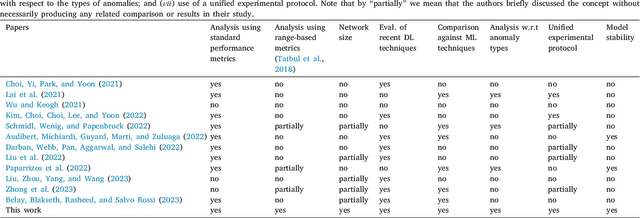
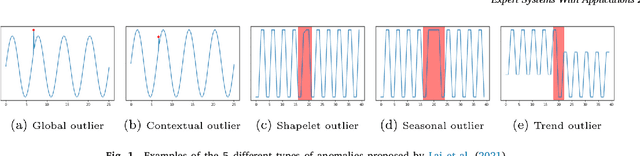
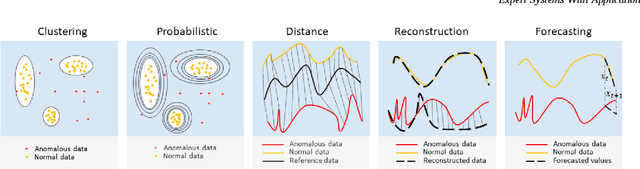
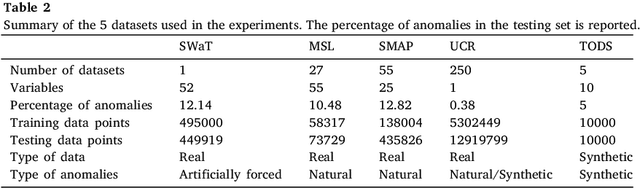
Unsupervised anomaly detection in time-series has been extensively investigated in the literature. Notwithstanding the relevance of this topic in numerous application fields, a complete and extensive evaluation of recent state-of-the-art techniques is still missing. Few efforts have been made to compare existing unsupervised time-series anomaly detection methods rigorously. However, only standard performance metrics, namely precision, recall, and F1-score are usually considered. Essential aspects for assessing their practical relevance are therefore neglected. This paper proposes an original and in-depth evaluation study of recent unsupervised anomaly detection techniques in time-series. Instead of relying solely on standard performance metrics, additional yet informative metrics and protocols are taken into account. In particular, (1) more elaborate performance metrics specifically tailored for time-series are used; (2) the model size and the model stability are studied; (3) an analysis of the tested approaches with respect to the anomaly type is provided; and (4) a clear and unique protocol is followed for all experiments. Overall, this extensive analysis aims to assess the maturity of state-of-the-art time-series anomaly detection, give insights regarding their applicability under real-world setups and provide to the community a more complete evaluation protocol.