 Add to Chrome
 Add to Firefox
 Add to Edge
ASTER: Latent Pseudo-Anomaly Generation for Unsupervised Time-Series Anomaly Detection
Apr 15, 2026
Time-series anomaly detection (TSAD) is critical in domains such as industrial monitoring, healthcare, and cybersecurity, but it remains challenging due to rare and heterogeneous anomalies and the scarcity of labelled data. This scarcity makes unsupervised approaches predominant, yet existing methods often rely on reconstruction or forecasting, which struggle with complex data, or on embedding-based approaches that require domain-specific anomaly synthesis and fixed distance metrics. We propose ASTER, a framework that generates pseudo-anomalies directly in the latent space, avoiding handcrafted anomaly injections and the need for domain expertise. A latent-space decoder produces tailored pseudo-anomalies to train a Transformer-based anomaly classifier, while a pre-trained LLM enriches the temporal and contextual representations of this space. Experiments on three benchmark datasets show that ASTER achieves state-of-the-art performance and sets a new standard for LLM-based TSAD.

Removing Geometric Bias in One-Class Anomaly Detection with Adaptive Feature Perturbation
Mar 07, 2025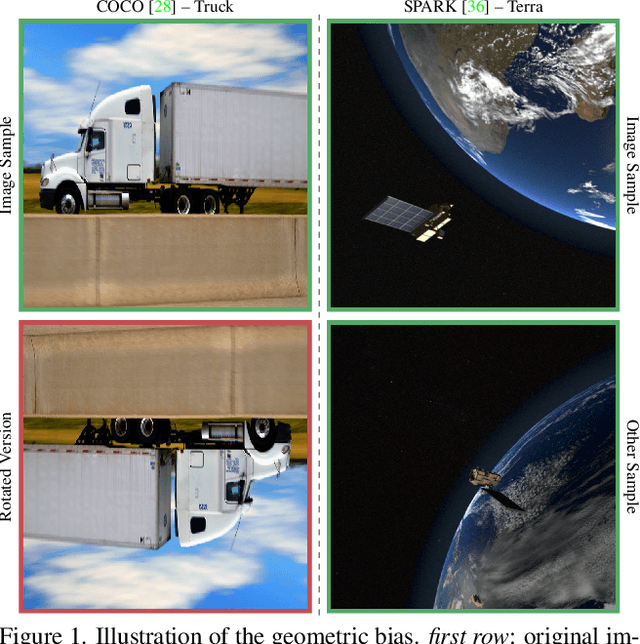
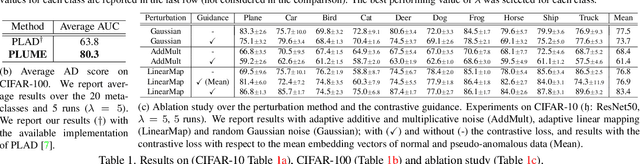
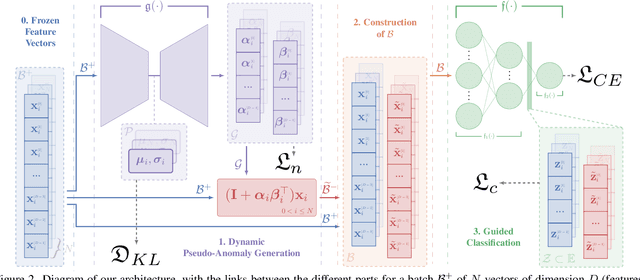
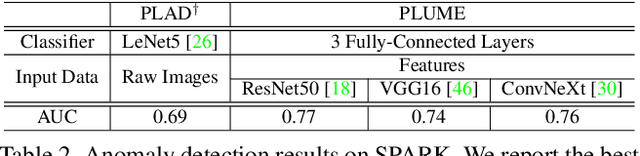
One-class anomaly detection aims to detect objects that do not belong to a predefined normal class. In practice training data lack those anomalous samples; hence state-of-the-art methods are trained to discriminate between normal and synthetically-generated pseudo-anomalous data. Most methods use data augmentation techniques on normal images to simulate anomalies. However the best-performing ones implicitly leverage a geometric bias present in the benchmarking datasets. This limits their usability in more general conditions. Others are relying on basic noising schemes that may be suboptimal in capturing the underlying structure of normal data. In addition most still favour the image domain to generate pseudo-anomalies training models end-to-end from only the normal class and overlooking richer representations of the information. To overcome these limitations we consider frozen yet rich feature spaces given by pretrained models and create pseudo-anomalous features with a novel adaptive linear feature perturbation technique. It adapts the noise distribution to each sample applies decaying linear perturbations to feature vectors and further guides the classification process using a contrastive learning objective. Experimental evaluation conducted on both standard and geometric bias-free datasets demonstrates the superiority of our approach with respect to comparable baselines. The codebase is accessible via our public repository.