 Add to Chrome
 Add to Firefox
 Add to Edge
Llamas on the Web: Memory-Efficient, Performance-Portable, and Multi-Precision LLM Inference with WebGPU
May 20, 2026
Running language models in the browser presents a unique opportunity to build efficient, private, and portable AI applications, but requires contending with constrained memory availability and heterogeneous hardware targets. To realize this opportunity, we present Llamas on the Web (LlamaWeb), a WebGPU backend for llama$.$cpp that enables memory-efficient and performance-portable LLM inference across a wide range of model weight formats in the browser. Our design significantly reduces memory overhead through static memory planning and efficient model loading, addresses cross-device variability through a tunable kernel library, and introduces templated GPU kernels that support performant implementations of numerous quantization formats, enabling broad model support and extensibility to new formats. We evaluate LlamaWeb on 16 devices from 8 vendors, collecting data from 10 language models and four model weight formats. We compare LlamaWeb against existing browser-based LLM frameworks and find that LlamaWeb requires 29-33% less memory across several combinations of device, browser, and operating system. We also evaluate LlamaWeb's performance against these frameworks and find that it increases decode throughput by 45-69% across four GPUs from separate vendors. In addition, we compare LlamaWeb's performance against other llama$.$cpp backends, where it is competitive with and even beats vendor-specific backend performance on some devices.

Arithmetic-Intensity-Aware Quantization
Dec 17, 2025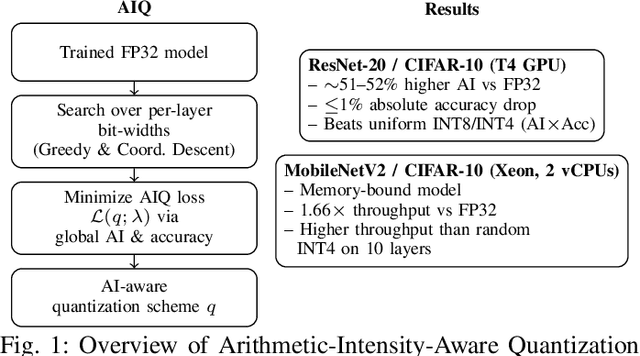
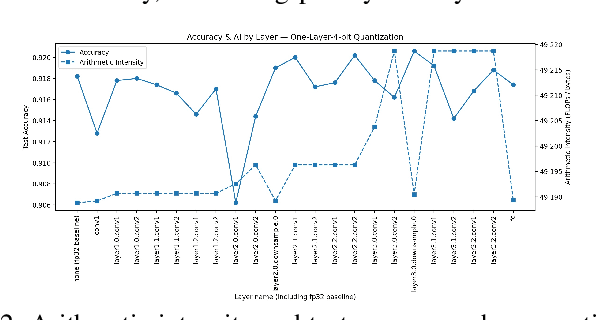
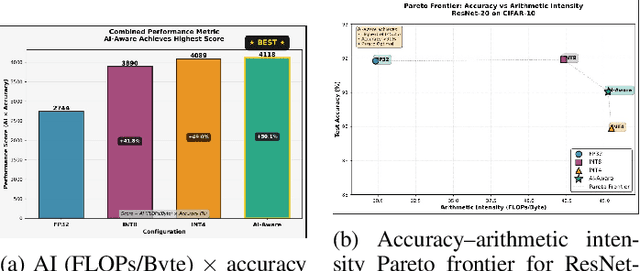
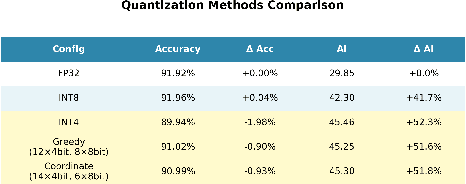
As modern neural networks become increasingly memory-bound, inference throughput is limited by DRAM bandwidth rather than compute. We present Arithmetic-Intensity-Aware Quantization (AIQ), a mixed precision quantization framework that chooses per-layer bit-widths to maximize arithmetic intensity (AI) while minimizing accuracy loss. AIQ is a post-training quantization method that uses search algorithms over per-layer quantization schemes to minimize a weighted loss over AI and accuracy. On ResNet-20/CIFAR-10, AIQ increases AI by ~50% over an FP32 baseline while keeping test accuracy within ~1 percentage point, and outperforming global uniform quantization schemes. On a memory-bound MobileNetV2 architecture, AIQ configurations give a 1.66x higher throughput than the FP32 baseline while keeping test accuracy within 1 percentage point. We also find that AIQ naturally quantizes larger layers more aggressively.
KinDEL: DNA-Encoded Library Dataset for Kinase Inhibitors
Oct 11, 2024

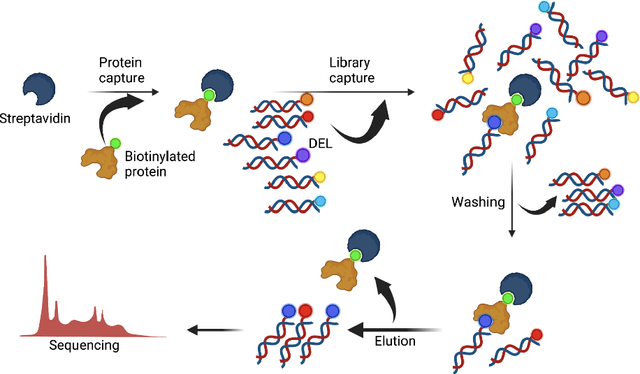

DNA-Encoded Libraries (DEL) are combinatorial small molecule libraries that offer an efficient way to characterize diverse chemical spaces. Selection experiments using DELs are pivotal to drug discovery efforts, enabling high-throughput screens for hit finding. However, limited availability of public DEL datasets hinders the advancement of computational techniques designed to process such data. To bridge this gap, we present KinDEL, one of the first large, publicly available DEL datasets on two kinases: Mitogen-Activated Protein Kinase 14 (MAPK14) and Discoidin Domain Receptor Tyrosine Kinase 1 (DDR1). Interest in this data modality is growing due to its ability to generate extensive supervised chemical data that densely samples around select molecular structures. Demonstrating one such application of the data, we benchmark different machine learning techniques to develop predictive models for hit identification; in particular, we highlight recent structure-based probabilistic approaches. Finally, we provide biophysical assay data, both on- and off-DNA, to validate our models on a smaller subset of molecules. Data and code for our benchmarks can be found at: https://github.com/insitro/kindel.